200-201 Exam Details
-
Exam Code
:200-201 -
Exam Name
:Understanding Cisco Cybersecurity Operations Fundamentals (CBROPS) -
Certification
:CyberOps Associate -
Vendor
:Cisco -
Total Questions
:543 Q&As -
Last Updated
:May 24, 2026
Cisco 200-201 Online Questions & Answers
-
Question 111:
Refer to the exhibit.
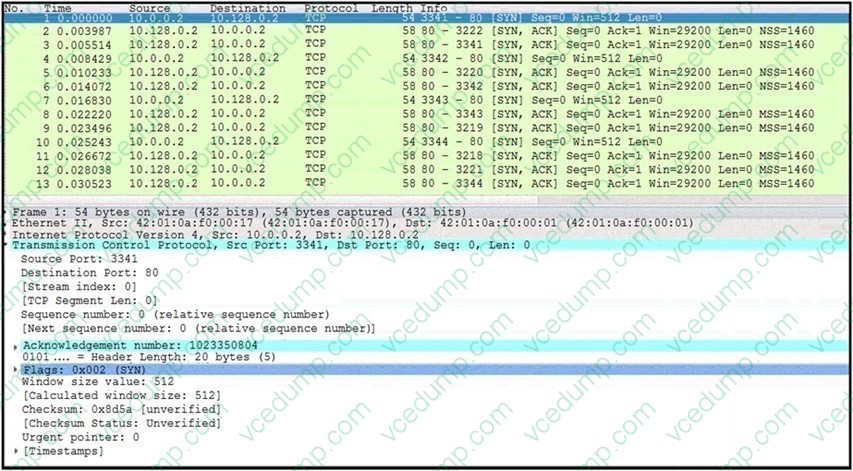
What is occurring in this network traffic?
A. High rate of SYN packets being sent from a multiple source towards a single destination IP.
B. High rate of ACK packets being sent from a single source IP towards multiple destination IPs.
C. Flood of ACK packets coming from a single source IP to multiple destination IPs.
D. Flood of SYN packets coming from a single source IP to a single destination IP. -
Question 112:
Why is encryption challenging to security monitoring?
A. Encryption analysis is used by attackers to monitor VPN tunnels.
B. Encryption is used by threat actors as a method of evasion and obfuscation.
C. Encryption introduces additional processing requirements by the CPU.
D. Encryption introduces larger packet sizes to analyze and store. -
Question 113:
An organization is cooperating with several third-party companies. Data exchange is on an unsecured channel using port 80 Internal employees use the FTP service to upload and download sensitive data An engineer must ensure confidentiality while preserving the integrity of the communication.
Which technology must the engineer implement in this scenario'?
A. X 509 certificates
B. RADIUS server
C. CA server
D. web application firewall -
Question 114:
What is the impact of encryption on data visibility?
A. TLS 1.3 traffic cannot be decrypted and monitored.
B. Traffic decryption causes high CPU load on monitoring systems.
C. Traffic decryption is needed for deep inspection of SSL traffic via NGFW.
D. IPsec encryption of traffic is vulnerable to man-in-the-middle attacks. -
Question 115:
Refer to the exhibit.
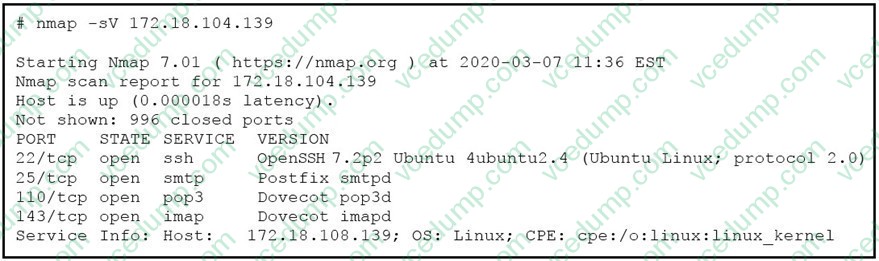
What does the output indicate about the server with the IP address 172.18.104.139?
A. open ports of a web server
B. open port of an FTP server
C. open ports of an email server
D. running processes of the server -
Question 116:
Which information must an organization use to understand the threats currently targeting the organization?
A. threat intelligence
B. risk scores
C. vendor suggestions
D. vulnerability exposure -
Question 117:
Which list identifies the information that the client sends to the server in the negotiation phase of the TLS handshake?
A. ClientStart, ClientKeyExchange, cipher-suites it supports, and suggested compression methods
B. ClientStart, TLS versions it supports, cipher-suites it supports, and suggested compression methods
C. ClientHello, TLS versions it supports, cipher-suites it supports, and suggested compression methods
D. ClientHello, ClientKeyExchange, cipher-suites it supports, and suggested compression methods -
Question 118:
Which security principle ensures that no single individual has complete control over a critical process?
A. least privilege
B. separation of duties
C. need to know
D. due diligence -
Question 119:
Refer to the exhibit.

An engineer must map these events to the source technology that generated the event logs.
To which technology do the generated logs belong?
A. proxy
B. antivirus
C. IPS
D. firewall -
Question 120:
What describes the framework that enables to control user access to critical information in the heterogenous technology environments?
A. vulnerability scanner
B. configuration management
C. mobile device management
D. identity and access management
Tips on How to Prepare for the Exams
Nowadays, the certification exams become more and more important and required by more and more enterprises when applying for a job. But how to prepare for the exam effectively? How to prepare for the exam in a short time with less efforts? How to get a ideal result and how to find the most reliable resources? Here on Vcedump.com, you will find all the answers. Vcedump.com provide not only Cisco exam questions, answers and explanations but also complete assistance on your exam preparation and certification application. If you are confused on your 200-201 exam preparations and Cisco certification application, do not hesitate to visit our Vcedump.com to find your solutions here.