200-201 Exam Details
-
Exam Code
:200-201 -
Exam Name
:Understanding Cisco Cybersecurity Operations Fundamentals (CBROPS) -
Certification
:CyberOps Associate -
Vendor
:Cisco -
Total Questions
:543 Q&As -
Last Updated
:Jul 11, 2026
Cisco 200-201 Online Questions & Answers
-
Question 1:
Refer to the exhibit.
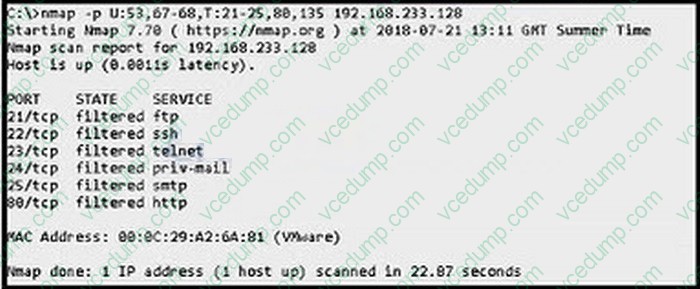
An attacker scanned the server using Nmap.
What did the attacker obtain from this scan?
A. Identified a firewall device preventing the pert state from being returned.
B. Identified open SMB ports on the server
C. Gathered information on processes running on the server
D. Gathered a list of Active Directory users -
Question 2:
What is the key difference between mandatory access control (MAC) and discretionary access control (DAC)?
A. DAC is controlled by the OS, and MAC is controlled by the owner of the access list.
B. DAC is the most strict access control, and MAC is object-based access.
C. MAC is controlled by the OS, and DAC is controlled by the owner of the access list.
D. MAC is the most strict access control, and DAC is object-based access. -
Question 3:
What are two types of cross site scripting attacks? (Choose two.)
A. directed
B. encoded
C. reflected
D. stored
E. cascaded -
Question 4:
Refer to the exhibit.
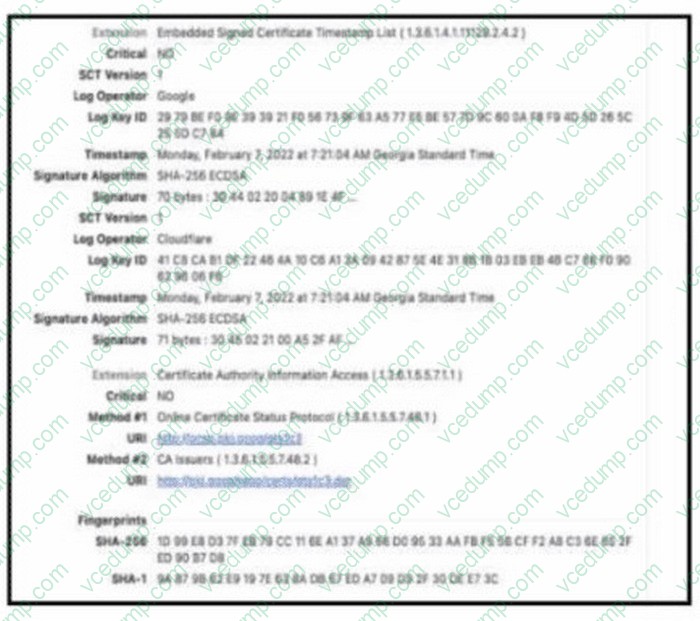
The figure shows an X 509 certificate.
Which field represents the digital cryptographic algorithm used by the issuer to sign the certificate?
A. Signature Algorithm
B. Timestamp
C. Fingerprints
D. Log Operator -
Question 5:
An engineer received a flood of phishing emails from HR with the source address HRjacobm@companycom.
What is the threat actor in this scenario?
A. phishing email
B. sender
C. HR
D. receiver -
Question 6:
Refer to the exhibit.
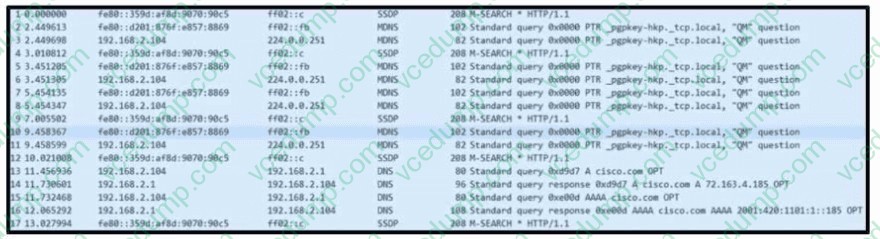
Based on the .
pcap file, which DNS server is used to resolve cisco.com?
A. 224.0.0.251
B. 192.168.2.1
C. 72.163.4.185
D. 192.168.2.104 -
Question 7:
At a company party a guest asks questions about the company's user account format and password complexity.
How is this type of conversation classified?
A. Phishing attack
B. Password Revelation Strategy
C. Piggybacking
D. Social Engineering -
Question 8:
Refer to the exhibit.
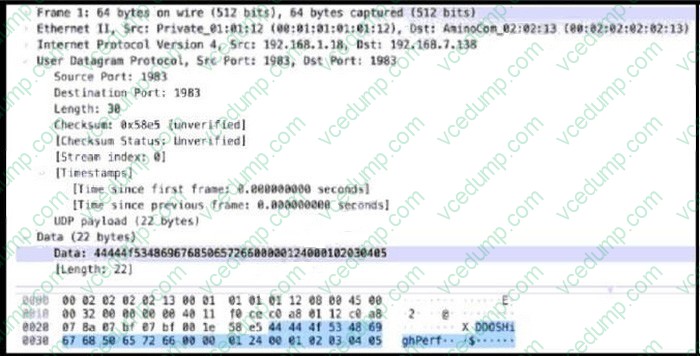
What should be interpreted from this packet capture?
A. 192.168.7.138 is sending a packet from port 1983 to port 1983 of IP address 192.168.1.18 using UDP protocol.
B. 192.168.7.138 is sending a packet from port 1983 to port 1983 of IP address 192.168.1.18 using TCP protocol.
C. 192.168.1.18 is sending a packet from port 1983 to port 1983 of IP address 192.168.7.138 using UDP protocol.
D. 192.168.1.18 is sending a packet from port 1983 to port 1983 of IP address 192.168.7.138 using TCP protocol. -
Question 9:
What is the primary function of NetFlow data in network security monitoring?
A. capturing full packet payloads
B. identifying session metadata
C. encrypting traffic flows
D. blocking malicious connections -
Question 10:
What is a difference between SOAR and SIEM?
A. SOAR platforms are used for threat and vulnerability management, but SIEM applications are not
B. SIEM applications are used for threat and vulnerability management, but SOAR platforms are not
C. SOAR receives information from a single platform and delivers it to a SIEM
D. SIEM receives information from a single platform and delivers it to a SOAR
Tips on How to Prepare for the Exams
Nowadays, the certification exams become more and more important and required by more and more enterprises when applying for a job. But how to prepare for the exam effectively? How to prepare for the exam in a short time with less efforts? How to get a ideal result and how to find the most reliable resources? Here on Vcedump.com, you will find all the answers. Vcedump.com provide not only Cisco exam questions, answers and explanations but also complete assistance on your exam preparation and certification application. If you are confused on your 200-201 exam preparations and Cisco certification application, do not hesitate to visit our Vcedump.com to find your solutions here.