200-120 Exam Details
-
Exam Code
:200-120 -
Exam Name
:Cisco Certified Network Associate -
Certification
:Cisco Certifications -
Vendor
:Cisco -
Total Questions
:364 Q&As -
Last Updated
:Dec 14, 2021
Cisco 200-120 Online Questions & Answers
-
Question 181:
Which feature builds a FIB and an adjacency table to expedite packet forwarding?
A. Cisco Express Forwarding
B. process switching
C. fast switching
D. cut-through -
Question 182:
Refer to the exhibit.
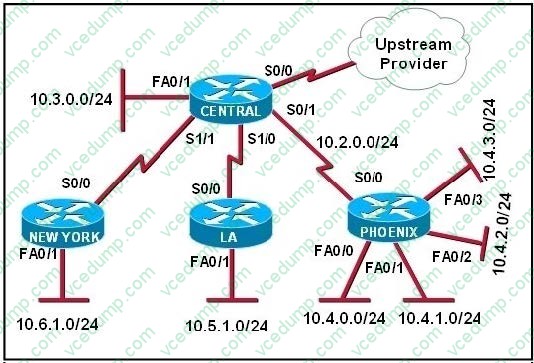
The Lakeside Company has the internetwork in the exhibit. The administrator would like to reduce the size of the routing table on the Central router. Which partial routing table entry in the Central router represents a route summary that represents the LANs in Phoenix but no additional subnets?
A. 10.0.0.0/22 is subnetted, 1 subnets D 10.0.0.0 [90/20514560] via 10.2.0.2, 6w0d, Serial0/1
B. 10.0.0.0/28 is subnetted, 1 subnets D 10.2.0.0 [90/20514560] via 10.2.0.2, 6w0d, Serial0/1
C. 10.0.0.0/30 is subnetted, 1 subnets D 10.2.2.0 [90/20514560] via 10.2.0.2, 6w0d, Serial0/1
D. 10.0.0.0/22 is subnetted, 1 subnets D 10.4.0.0 [90/20514560] via 10.2.0.2, 6w0d, Serial0/1
E. 10.0.0.0/28 is subnetted, 1 subnets D 10.4.4.0 [90/20514560] via 10.2.0.2, 6w0d, Serial0/1
F. 10.0.0.0/30 is subnetted, 1 subnets D 10.4.4.4 [90/20514560] via 10.2.0.2, 6w0d, Serial0/1 -
Question 183:
Which three characteristics are representative of a link-state routing protocol? (Choose three.)
A. provides common view of entire topology
B. exchanges routing tables with neighbors
C. calculates shortest path
D. utilizes event-triggered updates
E. utilizes frequent periodic updates -
Question 184:
A router receives information about network 192.168.10.0/24 from multiple sources. What will the router consider the most reliable information about the path to that network?
A. a directly connected interface with an address of 192.168.10.254/24
B. a static route to network 192.168.10.0/24
C. a RIP update for network 192.168.10.0/24
D. an OSPF update for network 192.168.0.0/16
E. a default route with a next hop address of 192.168.10.1
F. a static route to network 192.168.10.0/24 with a local serial interface configured as the next hop -
Question 185:
What SNMP message alerts the manager to a condition on the network?
A. response
B. get
C. trap
D. capture -
Question 186:
Scenario
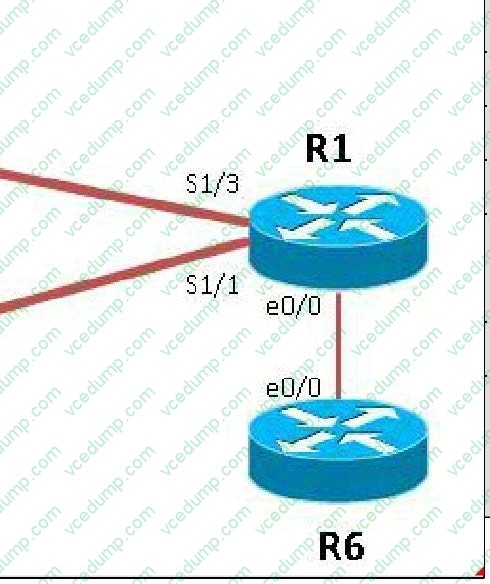
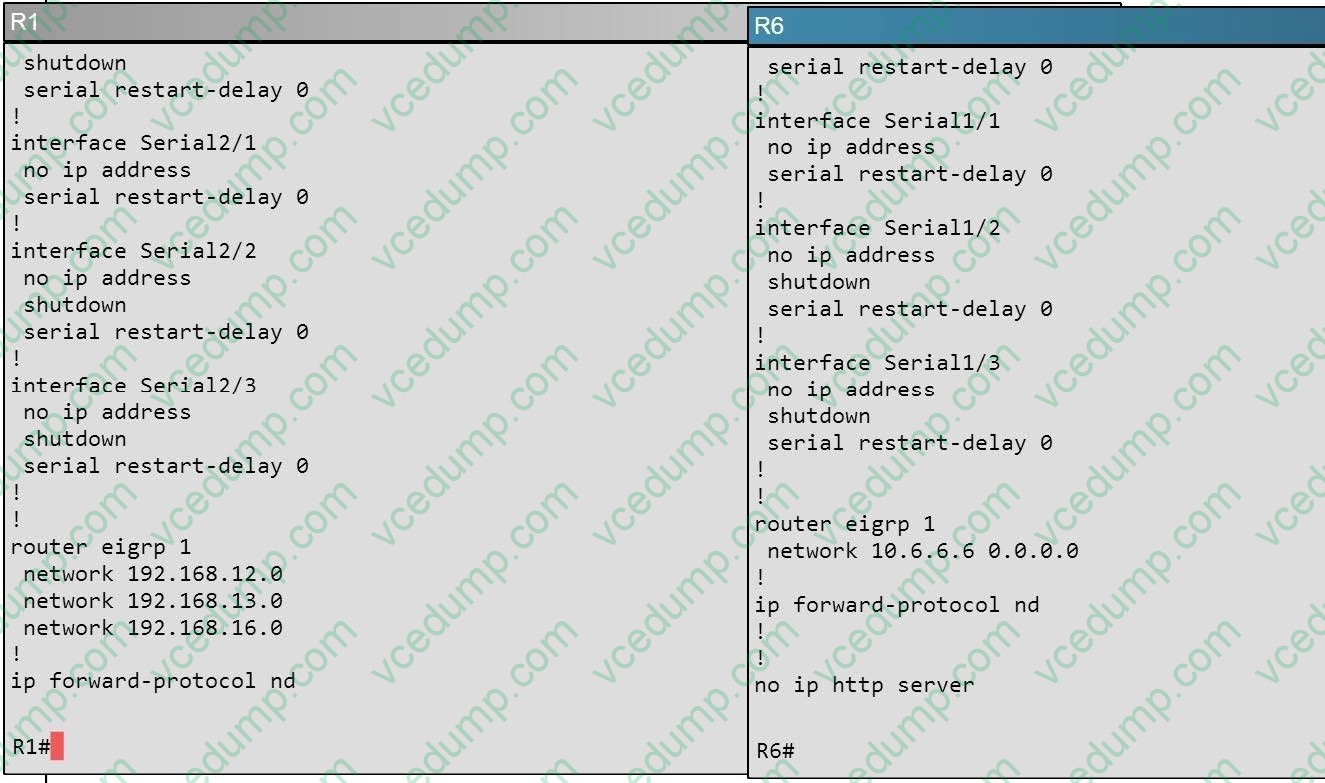
Refer to the topology. Your company has connected the routers R1, R2, and R3 with serial links. R2 and R3 are connected to the switches SW1 and SW2, respectively. SW1 and SW2 are also connected to the routers R4 and R5.
The EIGRP routing protocol is configured.
You are required to troubleshoot and resolve the EIGRP issues between the various routers.
Use the appropriate show commands to troubleshoot the issues.
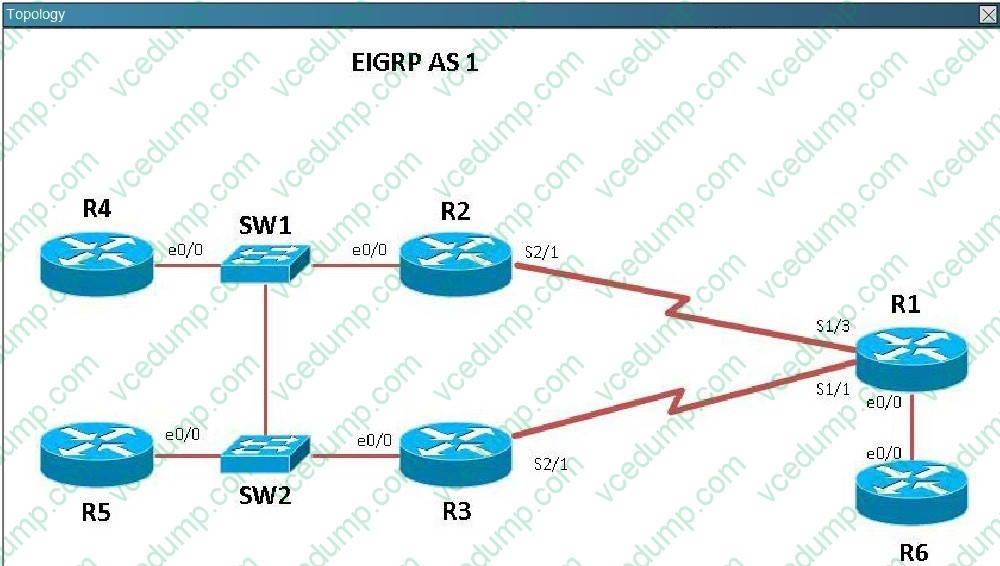

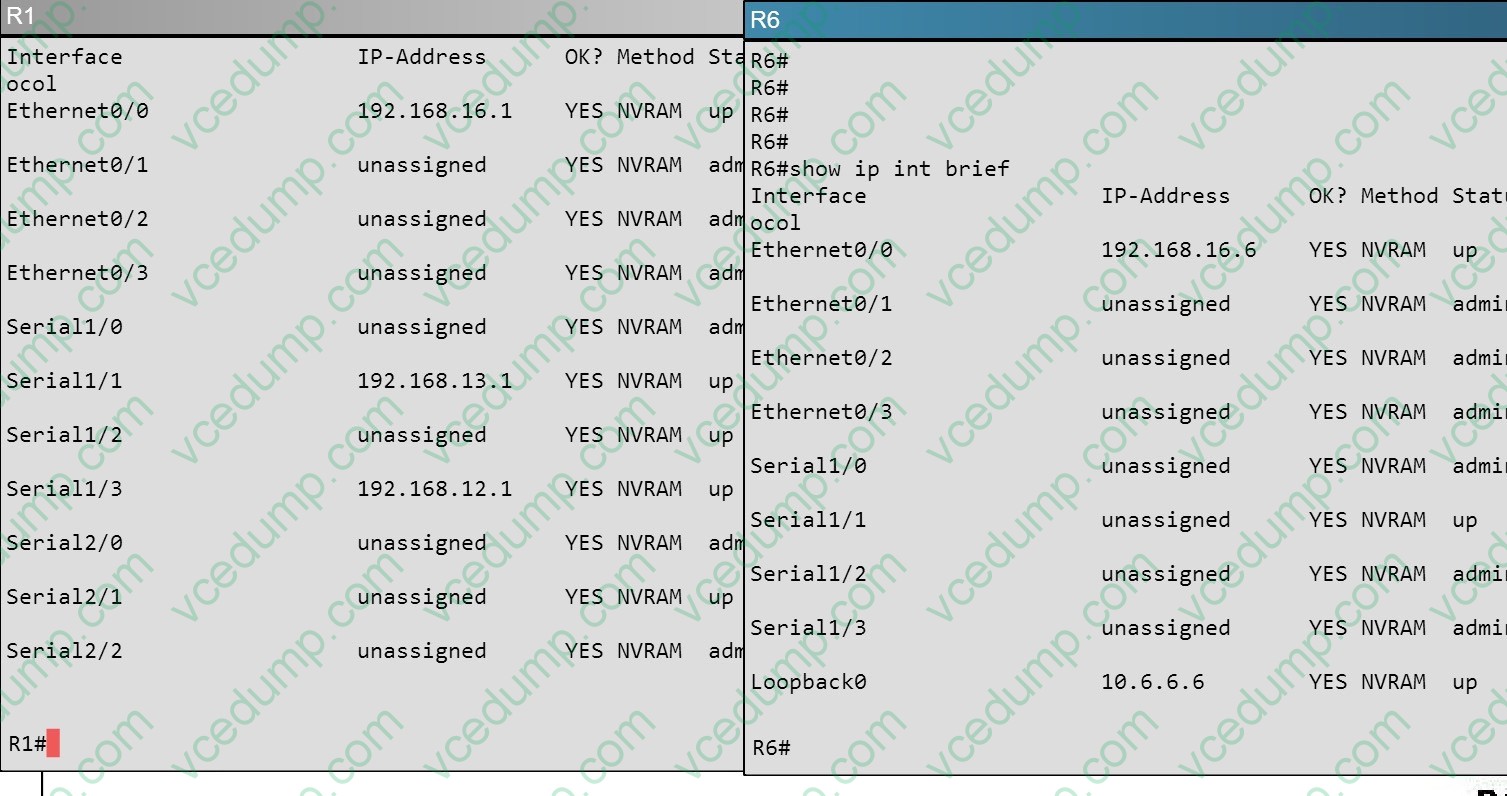
Router R6 does not form an EIGRP neighbor relationship correctly with router R1. What is the cause for this misconfiguration?
A. The K values mismatch.
B. The AS does not match.
C. The network command is missing.
D. The passive interface command is enabled. -
Question 187:
Three switches are connected to one another via trunk ports. Assuming the default switch configuration, which switch is elected as the root bridge for the spanning-tree instance of VLAN 1?
A. the switch with the highest MAC address
B. the switch with the lowest MAC address
C. the switch with the highest IP address
D. the switch with the lowest IP address -
Question 188:
What information does a router running a link-state protocol use to build and maintain its topological database? (Choose two.)
A. hello packets
B. SAP messages sent by other routers
C. LSAs from other routers
D. beacons received on point-to-point links
E. routing tables received from other link-state routers
F. TTL packets from designated routers -
Question 189:
Refer to the exhibit.
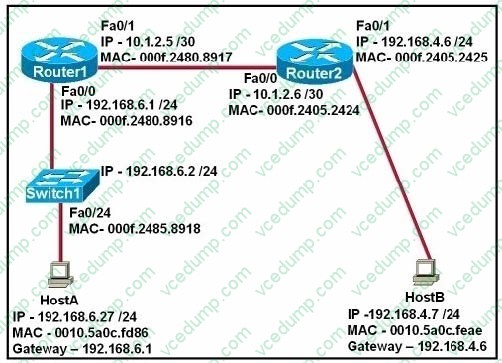
After HostA pings HostB, which entry will be in the ARP cache of HostA to support this transmission?
A. Exhibit A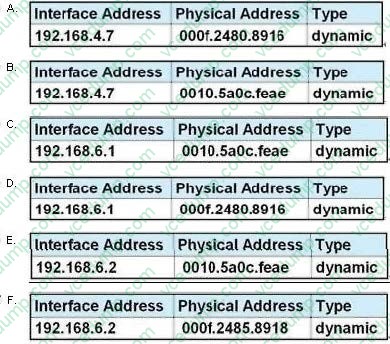
B. Exhibit B
C. Exhibit C
D. Exhibit D
E. Exhibit E
F. Exhibit F -
Question 190:
Which command allows you to verify the encapsulation type (CISCO or IETF) for a Frame Relay link?
A. show frame-relay lmi
B. show frame-relay map
C. show frame-relay pvc
D. show interfaces serial
Related Exams:
-
300-745
Designing Cisco Security Infrastructure (300-745 SDSI) v1.0 -
350-101
Implementing and Operating Cisco Wireless Core Technologies (350-101 WLCOR)v1.0 -
352-011
Cisco Certified Design Expert Practical -
500-052
Cisco Unified Contact Center Express -
500-173
Designing the FlexPod Solution (FPDESIGN) -
500-201
Deploying Cisco Service Provider Mobile Backhaul Solutions -
500-210
SP Optical Technology Field Engineer Representative -
500-220
Engineering Cisco Meraki Solutions (ECMS) v2.2 -
500-230
Cisco Service Provider Routing Field Engineer -
500-240
Cisco Mobile Backhaul for Field Engineers
Tips on How to Prepare for the Exams
Nowadays, the certification exams become more and more important and required by more and more enterprises when applying for a job. But how to prepare for the exam effectively? How to prepare for the exam in a short time with less efforts? How to get a ideal result and how to find the most reliable resources? Here on Vcedump.com, you will find all the answers. Vcedump.com provide not only Cisco exam questions, answers and explanations but also complete assistance on your exam preparation and certification application. If you are confused on your 200-120 exam preparations and Cisco certification application, do not hesitate to visit our Vcedump.com to find your solutions here.