200-120 Exam Details
-
Exam Code
:200-120 -
Exam Name
:Cisco Certified Network Associate -
Certification
:Cisco Certifications -
Vendor
:Cisco -
Total Questions
:364 Q&As -
Last Updated
:Dec 14, 2021
Cisco 200-120 Online Questions & Answers
-
Question 151:
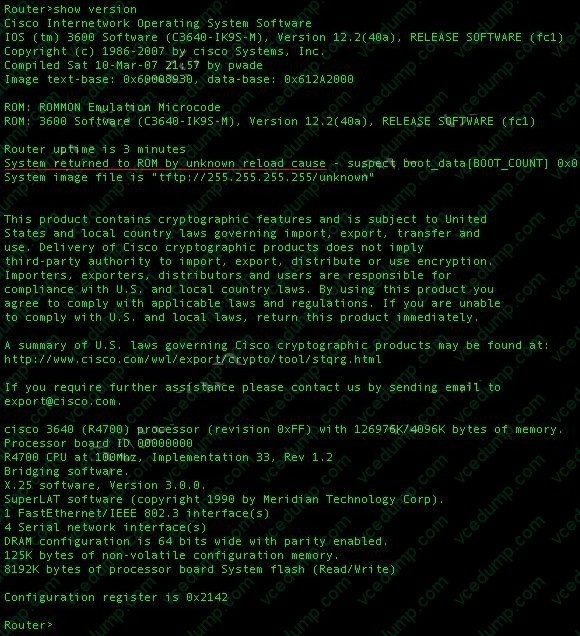
Which command reveals the last method used to powercycle a router?
A. show reload
B. show boot
C. show running-config
D. show version -
Question 152:
What will happen if a private IP address is assigned to a public interface connected to an ISP?
A. Addresses in a private range will not be routed on the Internet backbone.
B. Only the ISP router will have the capability to access the public network.
C. The NAT process will be used to translate this address to a valid IP address.
D. A conflict of IP addresses happens, because other public routers can use the same range. -
Question 153:
Refer to the exhibit.
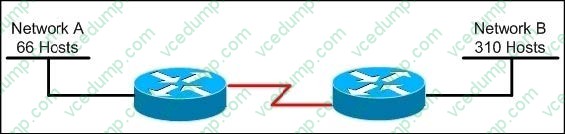
Which subnet mask will place all hosts on Network B in the same subnet with the least amount of wasted addresses?
A. 255.255.255.0
B. 255.255.254.0
C. 255.255.252.0
D. 255.255.248.0 -
Question 154:
A Cisco router is booting and has just completed the POST process. It is now ready to find and load an IOS image. What function does the router perform next?
A. It checks the configuration register.
B. It attempts to boot from a TFTP server.
C. It loads the first image file in flash memory.
D. It inspects the configuration file in NVRAM for boot instructions. -
Question 155:
Refer to the exhibit.
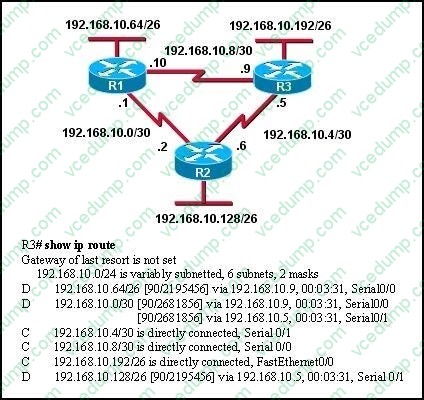
Based on the exhibited routing table, how will packets from a host within the 192.168.10.192/26 LAN be forwarded to 192.168.10.1?
A. The router will forward packets from R3 to R2 to R1.
B. The router will forward packets from R3 to R1 to R2.
C. The router will forward packets from R3 to R2 to R1 AND from R3 to R1.
D. The router will forward packets from R3 to R1. -
Question 156:
Refer to the exhibit.
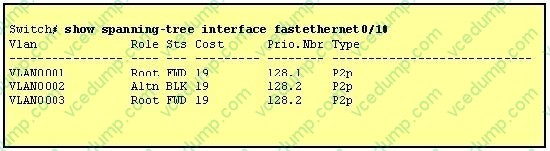
Given the output shown from this Cisco Catalyst 2950, what is the reason that interface FastEthernet 0/10 is not the root port for VLAN 2?
A. This switch has more than one interface connected to the root network segment in VLAN 2.
B. This switch is running RSTP while the elected designated switch is running 802.1d Spanning Tree.
C. This switch interface has a higher path cost to the root bridge than another in the topology.
D. This switch has a lower bridge ID for VLAN 2 than the elected designated switch. -
Question 157:
Based on the network shown in the graphic Which option contains both the potential networking problem and the protocol or setting that should be used to prevent the problem?
A. routing loops, hold down timers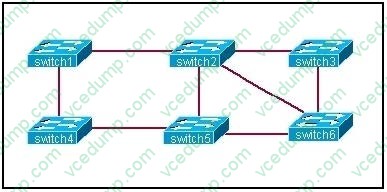
B. switching loops, split horizon
C. routing loops, split horizon
D. switching loops, VTP
E. routing loops, STP
F. switching loops, STP -
Question 158:
Refer to the exhibit.
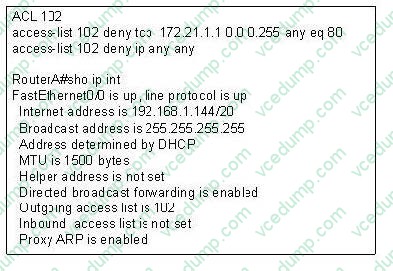
An attempt to deny web access to a subnet blocks all traffic from the subnet. Which interface command immediately removes the effect of ACL 102?
A. no ip access-class 102 in
B. no ip access-class 102 out
C. no ip access-group 102 in
D. no ip access-group 102 out
E. no ip access-list 102 in -
Question 159:
What are three characteristics of satellite Internet connections? (Choose three.)
A. Their upload speed is about 10 percent of their download speed.
B. They are frequently used by rural users without access to other high-speed connections.
C. They are usually at least 10 times faster than analog modem connections.
D. They are usually faster than cable and DSL connections.
E. They require a WiMax tower within 30 miles of the user location.
F. They use radio waves to communicate with cellular phone towers. -
Question 160:
Which protocol is an open standard protocol framework that is commonly used in VPNs, to provide secure end-to-end communications?
A. RSA
B. L2TP
C. IPsec
D. PPTP
Related Exams:
-
300-745
Designing Cisco Security Infrastructure (300-745 SDSI) v1.0 -
350-101
Implementing and Operating Cisco Wireless Core Technologies (350-101 WLCOR)v1.0 -
352-011
Cisco Certified Design Expert Practical -
500-052
Cisco Unified Contact Center Express -
500-173
Designing the FlexPod Solution (FPDESIGN) -
500-201
Deploying Cisco Service Provider Mobile Backhaul Solutions -
500-210
SP Optical Technology Field Engineer Representative -
500-220
Engineering Cisco Meraki Solutions (ECMS) v2.2 -
500-230
Cisco Service Provider Routing Field Engineer -
500-240
Cisco Mobile Backhaul for Field Engineers
Tips on How to Prepare for the Exams
Nowadays, the certification exams become more and more important and required by more and more enterprises when applying for a job. But how to prepare for the exam effectively? How to prepare for the exam in a short time with less efforts? How to get a ideal result and how to find the most reliable resources? Here on Vcedump.com, you will find all the answers. Vcedump.com provide not only Cisco exam questions, answers and explanations but also complete assistance on your exam preparation and certification application. If you are confused on your 200-120 exam preparations and Cisco certification application, do not hesitate to visit our Vcedump.com to find your solutions here.