200-101 Exam Details
-
Exam Code
:200-101 -
Exam Name
:Interconnecting Cisco Networking Devices Part 2 (ICND2) -
Certification
:Cisco Certifications -
Vendor
:Cisco -
Total Questions
:149 Q&As -
Last Updated
:Dec 14, 2021
Cisco 200-101 Online Questions & Answers
-
Question 21:
Which command is used to enable CHAP authentication, with PAP as the fallback method, on a serial interface?
A. Router(config-if)# ppp authentication chap fallback ppp
B. Router(config-if)# ppp authentication chap pap
C. Router(config-if)# authentication ppp chap fallback ppp
D. Router(config-if)# authentication ppp chap pap -
Question 22:
What is a valid HSRP virtual MAC address?
A. 0000.5E00.01A3
B. 0007.B400.AE01
C. 0000.0C07.AC15
D. 0007.5E00.B301 -
Question 23:
Which three of these statements regarding 802.1Q trunking are correct? (Choose three.)
A. 802.1Q native VLAN frames are untagged by default.
B. 802.1Q trunking ports can also be secure ports.
C. 802.1Q trunks can use 10 Mb/s Ethernet interfaces.
D. 802.1Q trunks require full-duplex, point-to-point connectivity.
E. 802.1Q trunks should have native VLANs that are the same at both ends. -
Question 24:
Refer to the exhibit.
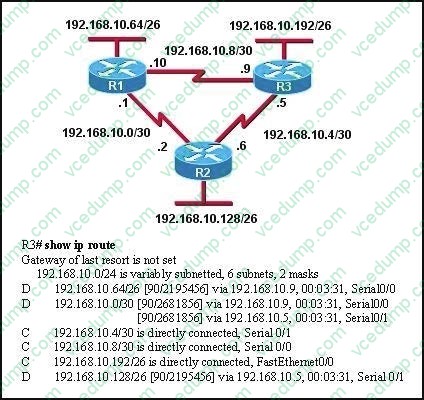
Based on the exhibited routing table, how will packets from a host within the 192.168.10.192/26 LAN be forwarded to 192.168.10.1?
A. The router will forward packets from R3 to R2 to R1.
B. The router will forward packets from R3 to R1 to R2.
C. The router will forward packets from R3 to R2 to R1 AND from R3 to R1.
D. The router will forward packets from R3 to R1. -
Question 25:
Refer to the exhibit.
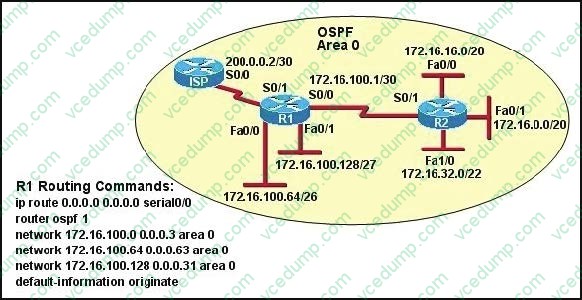
Assume that all router interfaces are operational and correctly configured. In addition, assume that OSPF has been correctly configured on router R2. How will the default route configured on R1 affect the operation of R2?
A. Any packet destined for a network that is not directly connected to router R1 will be dropped.
B. Any packet destined for a network that is not directly connected to router R2 will be dropped immediately.
C. Any packet destined for a network that is not directly connected to router R2 will be dropped immediately because of the lack of a gateway on R1.
D. The networks directly connected to router R2 will not be able to communicate with the 172.16.100.0, 172.16.100.128, and 172.16.100.64 subnetworks.
E. Any packet destined for a network that is not referenced in the routing table of router R2 will be directed to R1. R1 will then send that packet back to R2 and a routing loop will occur. -
Question 26:
Which three statements about RSTP are true? (Choose three.)
A. RSTP significantly reduces topology reconverging time after a link failure.
B. RSTP expands the STP port roles by adding the alternate and backup roles.
C. RSTP port states are blocking, discarding, learning, or forwarding.
D. RSTP provides a faster transition to the forwarding state on point-to-point links than STP does.
E. RSTP also uses the STP proposal-agreement sequence.
F. RSTP uses the same timer-based process as STP on point-to-point links. -
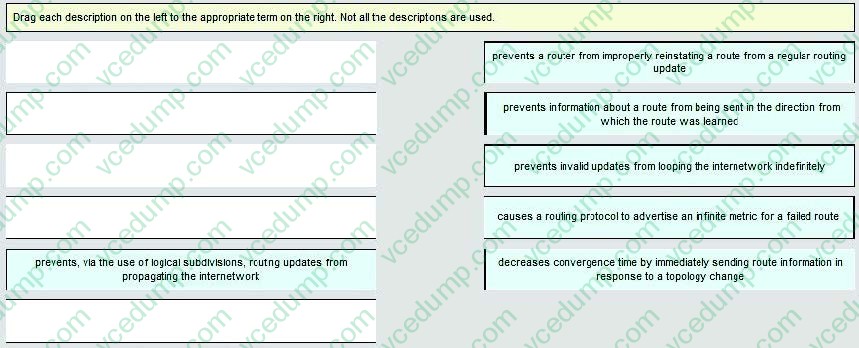
Question 27:
Select and Place:
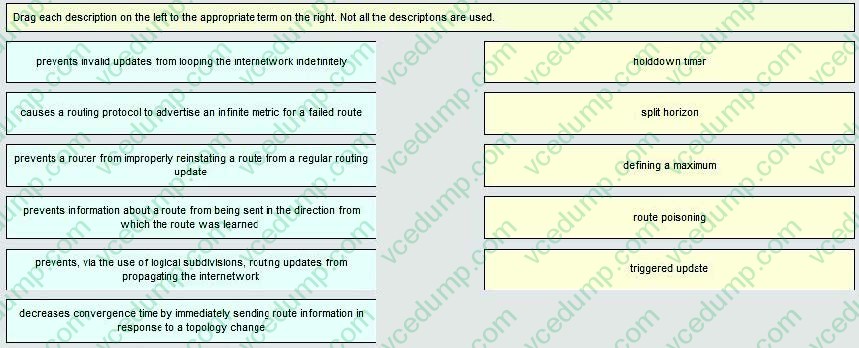
-
Question 28:
Refer to the exhibit.
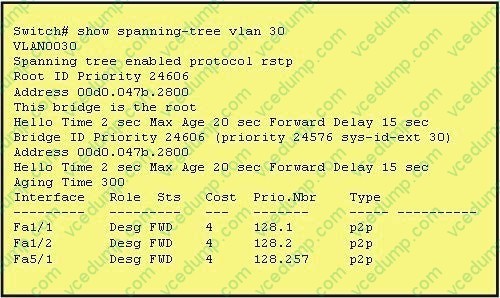
The output that is shown is generated at a switch. Which three statements are true? (Choose three.)
A. All ports will be in a state of discarding, learning, or forwarding.
B. Thirty VLANs have been configured on this switch.
C. The bridge priority is lower than the default value for spanning tree.
D. All interfaces that are shown are on shared media.
E. All designated ports are in a forwarding state.
F. This switch must be the root bridge for all VLANs on this switch. -
Question 29:
Which two statements about using the CHAP authentication mechanism in a PPP link are true? (Choose two.)
A. CHAP uses a two-way handshake.
B. CHAP uses a three-way handshake.
C. CHAP authentication periodically occurs after link establishment.
D. CHAP authentication passwords are sent in plaintext.
E. CHAP authentication is performed only upon link establishment.
F. CHAP has no protection from playback attacks. -
Question 30:
Which three statements are typical characteristics of VLAN arrangements? (Choose three.)
A. A new switch has no VLANs configured.
B. Connectivity between VLANs requires a Layer 3 device.
C. VLANs typically decrease the number of collision domains.
D. Each VLAN uses a separate address space.
E. A switch maintains a separate bridging table for each VLAN.
F. VLANs cannot span multiple switches.
Related Exams:
-
300-745
Designing Cisco Security Infrastructure (300-745 SDSI) v1.0 -
350-101
Implementing and Operating Cisco Wireless Core Technologies (350-101 WLCOR)v1.0 -
352-011
Cisco Certified Design Expert Practical -
500-052
Cisco Unified Contact Center Express -
500-173
Designing the FlexPod Solution (FPDESIGN) -
500-201
Deploying Cisco Service Provider Mobile Backhaul Solutions -
500-210
SP Optical Technology Field Engineer Representative -
500-220
Engineering Cisco Meraki Solutions (ECMS) v2.2 -
500-230
Cisco Service Provider Routing Field Engineer -
500-240
Cisco Mobile Backhaul for Field Engineers
Tips on How to Prepare for the Exams
Nowadays, the certification exams become more and more important and required by more and more enterprises when applying for a job. But how to prepare for the exam effectively? How to prepare for the exam in a short time with less efforts? How to get a ideal result and how to find the most reliable resources? Here on Vcedump.com, you will find all the answers. Vcedump.com provide not only Cisco exam questions, answers and explanations but also complete assistance on your exam preparation and certification application. If you are confused on your 200-101 exam preparations and Cisco certification application, do not hesitate to visit our Vcedump.com to find your solutions here.