1Z0-997-20 Exam Details
-
Exam Code
:1Z0-997-20 -
Exam Name
:Oracle Cloud Infrastructure 2020 Architect Professional -
Certification
:Oracle Certifications -
Vendor
:Oracle -
Total Questions
:165 Q&As -
Last Updated
:May 31, 2026
Oracle 1Z0-997-20 Online Questions & Answers
-
Question 131:
You are building a demo for a customer that showcases Oracle Cloud Infrastructure (OCI) Events service and Oracle Functions. You plan to create an event every time an image is uploaded to an OCI Object Storage bucket. You have also created a function that is listening to the event and processes the image for face recognition.
Choose the two actions from below that are NOT required to run the demo successfully.
A. You must specify an action type while creating an Event service and specify the function you want to trigger.
B. Creating an event rule is not permitted for OCI Object storage.
C. The function must be deployed only to Oracle Kubernetes Engine (OKE).
D. You have to enable Object Storage buckets to emit events for state changes.
E. You must deploy the function that does facial recognition for the demo to work. -
Question 132:
You developed a microservices-based application that runs on Oracle Cloud Infrastructure (OCI) Container Engine for Kubernetes (OKE). It has multiple endpoints that needs to be exposed to the public internet.
What is the most cost-effective way to expose multiple application endpoints without adding complexity to the application?
A. Use NodePort service type in Kubernetes for each of your service endpoint and use node's public IP address to access the applications.
B. Use separate load balancer instance for each service, but use the 100 Mbps load balancer option.
C. Deploy an Ingress Controller and use it to expose each endpoint with its own routing endpoint.
D. Use ClusterIP service type in Kubernetes for each of your service endpoint and use a load balancer to expose the endpoints. -
Question 133:
You are working with a social media company as a solution architect. The media company wants to collect and analyze large amounts of data being generated from their websites and social media feeds to gain insights and continuously improve the user experience. In order to meet this requirement, you have developed a microservices application hosted on Oracle Container Engine for Kubernetes. The application will process the data and store the result to an Autonomous Data Warehouse (ADW) instance.
Which Oracle Cloud Infrastructure (OCI) service can you use to collect and process a large volume of unstructured data in real time?
A. OCI Events
B. OCI Streaming
C. OCI Resource Manager
D. OCI Notifications -
Question 134:
You are currently working for a public health care company based in the United Stats. Their existing patient records runs in an on-premises data center and the customer is sending tape backups offsite as part of their recovery planning.
You have developed an alternative archival solution using Oracle Cloud Infrastructure (OCI) that will save the company a significant amount of mom on a yearly basis. The solution involves storing data in an OCI Object Storage bucket After reviewing your solution with the customer global Compliance (GRC) team they have highlighted the following security requirements:
All data less than 1 year old must be accessible within 2 hour. All data must be retained for at least 10 years and be accessible within 48 hours AH data must be encrypted at rest No data may be transmitted across the public Internet
Which two options meet the requirements outlined by the customer GRC team?
A. Provision a FastConnect link to the closest OCI region and configure a private peering virtual circuit.
B. Create an OCI Object Storage Standard tier bucket Configure a lifecycle policy to archive any object that Is older than 365 days
C. Create a VPN connection between your on premises data center and OCI. Create a Virtual Cloud Network (VCN) along with an OCI Service Gateway for OCI Object Storage.
D. Provision a FastConnect link to the closest OCI region and configure a public peering virtual circuit
E. Create an OCI Object Storage Standard tier bucket. Configure a lifecycle policy to delete any object that is older than 7 years -
Question 135:
A hospital in Austin has hosted its web based medical records portal entirely In Oracle cloud Infrastructure (OCI) using Compute Instances for its web-tier and DB system database for its data tier. To validate compliance with Health Insurance Portability and Accountability (HIPAA), the security professional to check their systems it was found that there are a lot of unauthorized coming requests coming from a set of IP addresses originating from a country in Southeast Asia.
Which option can mitigate this type of attack?
A. Block the attacking IP address by creating by Network Security Group rule to deny access to the compute Instance where the web server Is running
B. Block the attacking IP address by implementing a OCI Web Application Firewall policy using Access Control Rules
C. Mitigate the attack by changing the Route fable to redirect the unauthorized traffic to a dummy Compute instance
D. Block the attacking IP address by creating a Security List rule to deny access to the subnet where the web server Is running -
Question 136:
You have an Oracle database system in a virtual cloud network (VCN) that needs to be accessible on port 1521 from your on-premises network CIDR 172.17.0.0/24.
You have the following configuration currently.
Virtual cloud network (VCD) is associated with a Dynamic Routing Gateway (DRG), and DRG has an active IPSec connection with your on-premises data center.
Oracle database system is hosted in a private subnet
The private subnet route table has the following configuration
The private subnet route table has following configuration.
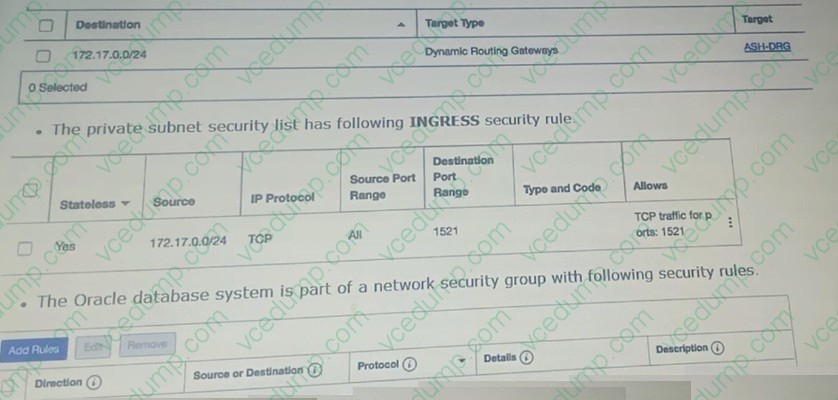
However, you are still unable to connect to the Oracle Database system. Which action will resolve this issue?
A. Option A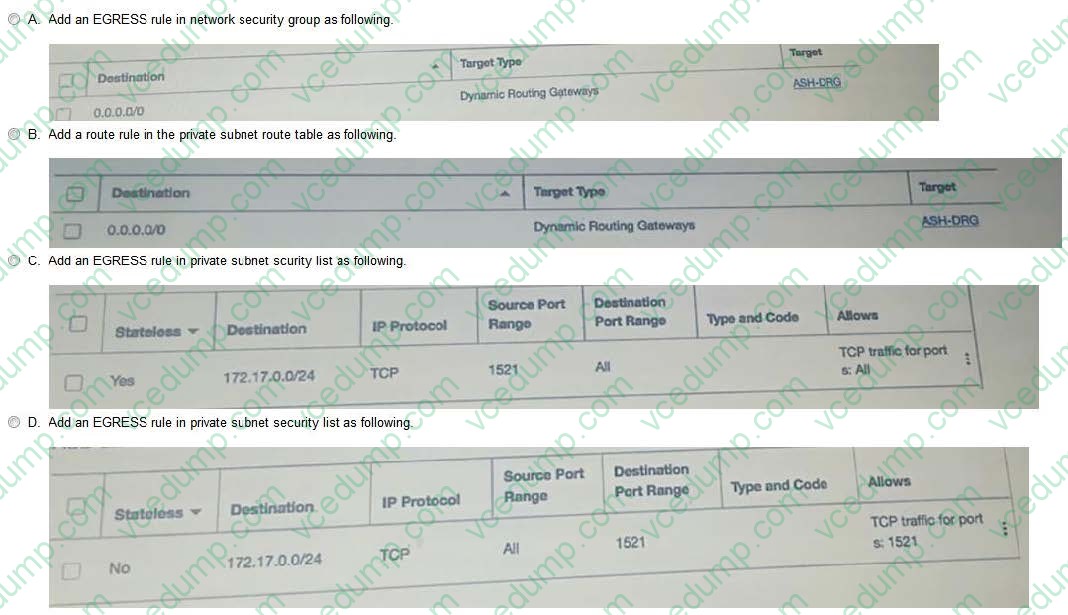
B. Option B
C. Option C
D. Option D -
Question 137:
You work for a retail company and they developed a Microservices based shopping application that needs to access Oracle Autonomous Database from the application. As an Architect, you have been tasked to treat all of the application
components as Kubernetes native objects, such as the microservices, Oracle
Autonomous database, Kubernetes services, etc.
What should you do to make sure that you can use Kubernetes constructs to manage the life cycle of the application components, including Oracle Autonomous Database? (Choose the best answer.)
A. Create an Oracle Cloud Infrastructure (OCI) Service Gateway and connect to the Oracle Autonomous Database using the private IP address from the microservice.
B. Provision an Oracle Autonomous Database and then use OCI Service Broker to access the database as a native component to your Kubernetes cluster.
C. Create a service from the Kubernetes cluster and point to the Oracle Autonomous Database using its FQDN.
D. Install and secure the OCI Service Broker for Kubernetes. Then provision and bind to the required Oracle Cloud Infrastructure services. -
Question 138:
A telecom company has an application running in Oracle Cloud Infrastructure (OCI) Germany Central (eu-frankfurt-1) region. They want to configure Disaster Recovery (DR) site in the OCI UK South (uk-london-1) region. Which is the most cost effective option to help set up application and persistence layers in the DR site?
A. Application layer: configure events service rule in eu-frankfurt-1 region to filter Health Checks event failure and route traffic to uk-london-1 region in the event of a disaster. Persistence layer: set up policy to schedule cross-region automated backups of block volumes between eu-frankfurt-1 and uk-london-1 regions.
B. Application layer: configure Traffic Management steering policy with Load Balancing policy between servers in eu-frankfurt-1 and uk-london-1 regions. Persistence layer: set up policy to schedule cross-region automated backups of block volumes between eu-frankfurt-1 and uk-london-1 regions.
C. Application layer: Set us a public laod balancerin the eu-frankfurt-1 region. Create a backend set with instances running in bothuk-frankfurt-1 and uk-london-1 regions. Persistence layer: Set up OCI Object Storage replication from eu-frankfurt-1 region to uk- london-1 region.
D. Application layer: configure Traffic Management steering policy with Failover policy between servers in eu-frankfurt-1 and uk-london-1 regions. Persistence layer: set up policy to schedule cross-region automated backups of file systems in File Storage service between eu-frankfurt-1 and uk-london-1 regions. -
Question 139:
You are creating an Oracle Cloud Infrastructure Dynamic Group. To determine the members of this group you are defining a set of matching rules.
Which of the following are the supported variables to define conditions in the matching rules? (Choose Two)
A. iam.policy.id - the OCID of the IAM policy to apply to the group.
B. instance.tenancy.id - the OCID of the tenancy where the instance resides.
C. tag...value - the tag namespace and tag key.
D. instance.compartment.id - the OCID of the compartment where the instance resides. -
Question 140:
Which of the following is NOT a good use case for using the functionality available in the Oracle Cloud Infrastructure (OCI) Events service?
A. Publish all events in a specific compartment to Oracle Streaming service for later analysis.
B. Triggers Function using Oracle Functions when new files are uploaded in an OCI Object Storage bucket.
C. Publish a notification when long lived tasks complete, such as OCI Autonomous Database backup completion.
D. Capture Monitoring Alarms and invoke Autoscaling of compute instances.
E. Trigger a notification when a function completes its execution.
Related Exams:
-
1Z0-020
Oracle8i: New Features for Administrators -
1Z0-023
Architecture and Administration -
1Z0-024
Performance Tuning -
1Z0-025
Backup and Recovery -
1Z0-026
Network Administration -
1Z0-034
Upgrade Oracle9i/10g OCA to Oracle Database OCP -
1Z0-036
Managing Oracle9i on Linux -
1Z0-041
Oracle Database 10g: DBA Assessment -
1Z0-052
Oracle Database 11g: Administration Workshop I -
1Z0-053
Oracle Database 11g: Administration II
Tips on How to Prepare for the Exams
Nowadays, the certification exams become more and more important and required by more and more enterprises when applying for a job. But how to prepare for the exam effectively? How to prepare for the exam in a short time with less efforts? How to get a ideal result and how to find the most reliable resources? Here on Vcedump.com, you will find all the answers. Vcedump.com provide not only Oracle exam questions, answers and explanations but also complete assistance on your exam preparation and certification application. If you are confused on your 1Z0-997-20 exam preparations and Oracle certification application, do not hesitate to visit our Vcedump.com to find your solutions here.