
1Z0-997-20 Real Exam Questions

Oracle Cloud Infrastructure 2020 Architect Professional

165 questions available · Page 1 of 17

Updated Exam DumpsVerified AnswersPass Guarantee

Get Complete Exam Dumps
Question 1 Single choice

A civil engineering company is running an online portal In which engineers can upload there constructions photos, videos, and other digital files.

There is a new requirement for you to implement: the online portal must offload the digital content to an Object Storage bucket for a period of 72 hours. After the provided time limit has elapsed, the portal will hold all the digital content locally and wait for the next offload period.

Which option fulfills this requirement?

  1. A

    Create a pre-authenticated URL for the entire Object Storage bucket to read and list the content with an expiration of 72 hours.

  2. B

    Create a pre authenticated URL lot each object that Is uploaded to the Object Storage bucket with an expiration of 72 hours.

  3. C

    Create a Dynamic Group with matching rule for the portal compute Instance and grant access to the Object Storage bucket for 72 hours.

  4. D

    Create a pre authenticated URL for the entire Object Storage bucket to write content with an expiration of 72 hours.

Show answer and explanation

Correct answer: D

Explanation

Pre-authenticated requests provide a way to let users access a bucket or an object without having their own credentials, as long as the request creator has permission to access those objects.
For example, you can create a request that lets operations support user upload backups to a bucket without owning API keys. Or, you can create a request that lets a business partner update shared data in a bucket without owning API keys. When creating a pre-authenticated request, you have the following options: You can specify the name of a bucket that a pre-authenticated request user has write access to and can upload one or more objects to.
You can specify the name of an object that a pre-authenticated request user can read from, write to, or read from and write to.
Scope and Constraints
Understand the following scope and constraints regarding pre-authenticated requests: Users can't list bucket contents.
You can create an unlimited number of pre-authenticated requests. There is no time limit to the expiration date that you can set. You can't edit a pre-authenticated request. If you want to change user access options in response to changing requirements, you must create a new pre-authenticated request. The target and actions for a pre-authenticated request are based on the creator's permissions. The request is not, however, bound to the creator's account login credentials. If the creator's login credentials change, a pre-authenticated request is not affected. You cannot delete a bucket that has a pre-authenticated request associated with that bucket or with an object in that bucket.

Question 2 Single choice

You are trying to delete a compartment. The delete operation is falling and you need to troubleshoot the problem.

Which step should NOT be considered when troubleshooting this issue?

  1. A

    Verify that there are no policies In the root compartment that reference the compartment you are trying to delete.

  2. B

    Verify that you have removed all resources from the compartment.

  3. C

    Make sure you have at least one more compartment in your tenancy other than the root compartment.

  4. D

    Search for resources in the compartment for each region that your tenancy is subscribed to.

Show answer and explanation

Correct answer: C

Question 3 Single choice

You are running a legacy application in a compute instance on Oracle Cloud Infrastructure (OCI). To provide enough space for it to store internal data, a block volume is attached to the instance in paravirtualized mode.

Your application is not resilient to crash-consistent backup.

What should you do to backup the block volume in a secure and cost effective way? (Choose the best answer.)

  1. A

    Save your application data, detach the block volume and create a clone.

  2. B

    Create a volume group, add the boot volume and then run the volume group backup.

  3. C

    Create a backup, detach the block volume and save your application data.

  4. D

    Save your application data, detach the block volume and create a backup.

Show answer and explanation

Correct answer: D

Question 4 Single choice

A cloud consultant is working on a implementation project on Oracle Cloud Infrastructure (OCI). As part of the compliance requirements, the objects placed in OCI Object Storage should be automatically archived first and then deleted. He is testing a lifecycle policy on Object Storage and created a policy as below:

What will happen after this policy is applied?

  1. A

    All the objects having file extension "doc" will be archived for 5 days and will be deleted 10 days after object creation.

  2. B

    All objects with names starting with "doc" will be deleted after 5 days of object creation.

  3. C

    All the objects having file extension "doc" will be archived 5 days after object creation.

  4. D

    All the objects with names starting with "doc" will be archived 5 days after object creation and will be
    deleted 5 days after archival.

Show answer and explanation

Correct answer: B

Question 5 Single choice

A global media organization is working on a project which lets users upload their videos to the site. After upload is complete, the video should be automatically processed by an Al algorithm. The algorithm will try to recognize certain actions in the videos so that it can be used to show related advertisements in future.
The development team wants to focus on writing Al code and not worry about underlying infrastructure for high availability, scalability, security and monitoring.

Which Oracle Cloud Infrastructure (OCI) services would meet these requirements?

  1. A

    OCI Object Storage, OCI Events service and OCI Functions.

  2. B

    Oracle Container Engine for Kubernetes, OCI Notifications and OCI Object Storage.

  3. C

    OCI Events, Oracle Container Engine for Kubernetes and OCI Digital Assistant.

  4. D

    OCI Resource Manager, OCI Functions and OCI Events service.

Show answer and explanation

Correct answer: A

Question 6 Single choice

A customer has a Virtual Machine instance running in their Oracle Cloud Infrastructure tenancy. They realized that they wrongly picked a smaller shape for their compute instance. They are reaching out to you to help them fix the issue.

Which of the below options is best recommended to suggest to the customer?

  1. A

    Delete the running instance and spin up a new instance with the desired shape.

  2. B

    Change the shape of instance without reboot, but stop all the applications running on instance beforehand to prevent data corruption.

  3. C

    Change the shape of the virtual machine instance using the Change Shape feature available in the console.

  4. D

    OCI doesn't allow such an operation.

Show answer and explanation

Correct answer: C

Explanation

You can change the shape of a virtual machine (VM) instance without having to rebuild your instances or redeploy your applications. This lets you scale up your Compute resources for increased performance, or scale down to reduce cost. When you change the shape of an instance, you select a different processor, number of cores, amount of memory, network bandwidth, and maximum number of VNICs for the instance.
The instance's public and private IP addresses, volume attachments, and VNIC attachments remain the same.

Question 7 Single choice

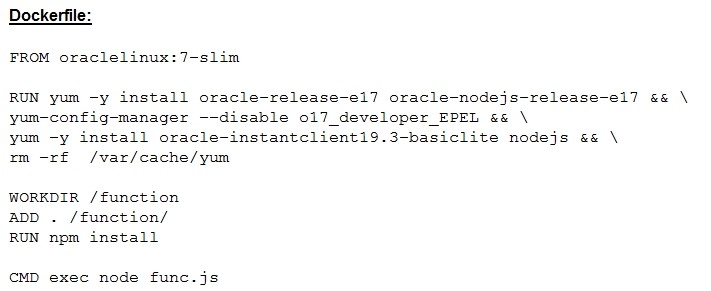
Your company developed a function that needs to access the Oracle Database to inject some data to it at runtime. You are tasked to move this function to the

Oracle Cloud Infrastructure (OCI) and use Oracle Functions and access Oracle Autonomous Database.
You created a Dockerfile below to run this function, however, you are getting this error
"cx_Oracle.DatabaseError: ORA""12560: TNS:protocol adapter error".

What should you do to make sure that Oracle Functions can run this Dockerfile properly? (Choose the best answer.)

  1. A

    Add these two lines to your Dockerfile: groupadd """"gid 1000 fn && \ adduser """"uid 1000 """"gid fn fn

  2. B

    Use """"privileged flag while running the Docker container to add runtime privilege

  3. C

    Use """"cap""add=ALL flag while running the Docker container to add runtime capability

  4. D

    You ned to run this Container as root, so add this line: USER root

Show answer and explanation

Correct answer: A

Explanation

https://docs.cloud.oracle.com/en-us/iaas/Content/Functions/Tasks/functionsrunningasunprivileged.htm

Question 8 Single choice

You are helping a customer troubleshoot a problem. The customer has several Oracle Linux servers in a private subnet within a Virtual Cloud Network (VCN). The servers are configured to periodically communicate to the Internet to get security patches for applications Installed on them.

The servers are unable to reach the Internet. An Internet Gateway has been deployed In the public subnet in the VCN and the appropriate routes are configured in the Route Table associated with the public subnet.

Based on cost considerations, which option will fix this Issue?

  1. A

    Create a Public Load Balancer In front of the servers and add the servers to the Backend Set of the Public Load Balancer.

  2. B

    Create another Internet Gateway and configure it as route target for the private subnet.

  3. C

    Implement a NAT instance In the public subnet of the VCN and configure the NAT instance as the route target for the private subnet.

  4. D

    Create a NAT gateway in the VCN and configure the NAT gateway as the route target for the private subnet.

Show answer and explanation

Correct answer: D

Question 9 Single choice

You are working as a solution architect for a customer in Frankfurt, which uses multiple compute instance VMs spread among three Availability Domains in the Oracle Cloud Infrastructure (OCI) eu-frankfurt-1 region. The compute instances do not have public IP addresses and are running in private subnets inside a Virtual Cloud Network (VCN). You have set up OCI Autoscaling feature for the compute instances, but find out that instances cannot be auto scaled. You have enabled monitoring on the instances.

What could be wrong in this situation?

  1. A

    You need to assign a reserved public IP address to the compute instances.

  2. B

    You need to set up a Service Gateway to send metrics to the OCI Monitoring service.

  3. C

    Autoscaling only works for instances with public IP addresses.

  4. D

    Autoscaling only works with single availability domains.

Show answer and explanation

Correct answer: B

Question 10 Multiple choice

A fast growing E-commerce company has deployed their online shopping application on Oracle Cloud Infrastructure. The application was deployed on compute instances with Autoscaling configuration for application servers fronted by a load balancer and OCI Autonomous Transaction Processing (ATP) in the backend. In order to promote their e- commerce platform 50% discount was announced on all the products for a limited period. During the day 1 of promotional period it was observed that the application is running slow and company's hotline is flooded with complaints.

What could be two possible reasons for this situation?

  1. A

    The health check on some of the backend servers has failed and the load balancer has taken those servers temporarily out of rotation.

  2. B

    As part of Autoscaling, the load balancer shape has dynamically changed to a larger shape to handle more incoming traffic and the system was slow for a short time during this change.

  3. C

    The health check on some of the backend servers has failed and the load balancer was rebooting these servers.

  4. D

    Autoscaling has already scaled to the maximum number of instances specified in the configuration and there is no room for scaling further.

Show answer and explanation

Correct answers: A, D