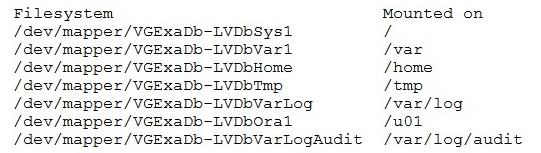
You have configured a multirack Database Machine with two X9M-8 full racks all in a single cluster and storage grid comprising a total of 4 X9M-8 Database servers and 28 X9M-8 Storage servers. Which two options are true regarding the servers on which Enterprise Manager agents must be deployed in order to monitor all components of this multirack configuration?
A. on at least two storage servers in both racks B. on only one database server in both racks C. on all database servers in the first rack D. on all storage servers in both racks E. on all database servers and at least two storage servers in both racks F. on all database servers in the second rack G. on all database servers in both racks and one storage server in each rack
A. on at least two storage servers in both racks E. on all database servers and at least two storage servers in both racks explanation:
Explanation/Reference:
In order to monitor all components of this multirack configuration, Enterprise Manager agents must be deployed on at least two storage servers in both racks and all database servers in both racks. This is according to the Oracle Exadata Database Machine X9M Implementation Essentials official text book [1], in which it states "To monitor all components of the multirack configuration, you must deploy agents on all database servers and at least two storage servers in each rack" (page 6-15).
Question 2:
Your system administrator reports an amber, non-blinking light on one of your Exadata storage disks. You immediately execute the 'list physicaldisk where diskType=HardDisk and status=failed DETAIL' command on the Exadata storage system and the specified disk is indeed reported as failed. Platinum Support has not been enabled for this system. Enterprise Manager Cloud Control is monitoring the system.
What is the next step that you should perform before you do anything else?
A. Ask the system administrator to replace the broken disk with a spare. B. Check the database to see if any rebalance operations are active. C. Call Oracle Support and make an appointment so that the drive can be replaced. D. Wait for the email of the failure that Exadata or Enterprise Manager will send. E. Download and run the latest exadiag tool. F. Wait for a blue light to appear on the disk if the rebalance operation is running.
F. Wait for a blue light to appear on the disk if the rebalance operation is running. explanation:
Explanation/Reference:
According to Oracle documentation1, Exadata Storage software has a complete set of automated operations for hard disk maintenance, when a hard disk has failed or has been flagged as a problematic disk. It will initiate a rebalance operation to redistribute data across other disks and mark the failed disk with an amber light.
Question 3:
Which are two correct statements about backing up Exadata Database Machine?
A. Backup of the Oracle Cluster Registry, which also contains Voting Disk information, is automatically maintained on the file system of the first database server. B. Backing up Exadata Storage Server Software is critical for restoration. C. For high availability, system area can be on the first two disks and M.2 devices. D. The M.2 disk is hot pluggable and can be replaced when the power is on, but you will have to restore the system data manually. E. Use a snapshot-based backup of an Oracle Exadata Database Machine database server software.
A. Backup of the Oracle Cluster Registry, which also contains Voting Disk information, is automatically maintained on the file system of the first database server. B. Backing up Exadata Storage Server Software is critical for restoration. explanation:
Explanation/Reference:
[1] Oracle Exadata Database Machine X9M Implementation Essentials Official Text Book [1][2], Chapter 4: Oracle Clusterware [2] Oracle Exadata Database Machine X9M Implementation Essentials Official Text Book [1][2], Chapter 8: Oracle Exadata Storage Server Software [3] Oracle Exadata Database Machine X9M Implementation Essentials Official Text Book [1][2], Chapter 9: Oracle Exadata Storage Server Infrastructure https://www.oracle.com/technetwork/database/availability/exadata-backup-recovery-bp- 3633870.pdf
Question 4:
Examine these commands:
1.
Execute "crscti stop cluster -all" as the grid user from one database server.
2.
Execute "crscti stop cluster -all" as root from one database server.
3.
Power off all network switches.
4.
Execute "crscti stop cluster" as root from one database server.
5.
Execute "crscti stop cluster" as the grid user from one database server.
6.
Power off the rack using the power switches on the PDUs.
7.
Execute "shutdown -h now" on all database servers.
8.
Execute "shutdown -h now" on all Exadata storage servers.
Which is the correct order or the required commands to completely power off an Exadata Database Machine in an orderly fashion?
A. 5, 8, 7, and 6 B. 4, 7, 8, 3, and 6 C. 2, 8, 7, 3, and 6 D. 2, 7, 8, and 6 E. 1, 8, 7, 3 and 6
C. 2, 8, 7, 3, and 6 explanation:
Explanation/Reference:
Question 5:
Which two sections of the AWR report shows statistics for X9M Persistent Memory Cache?
A. PMEM Pool cache Read Hits in the Cache Sizes portion of the Report Summary B. PMEM Pool Misses in the Exadata Outlier Summary C. cell PMEM cache Read Hits in the Database IOs portion of the Performance Summary D. PMEM Cache section within Memory Statistics E. PMEM Cache section within Exadata Smart Statistics
C. cell PMEM cache Read Hits in the Database IOs portion of the Performance Summary E. PMEM Cache section within Exadata Smart Statistics explanation:
Explanation/Reference:
Option C shows the number of read hits from PMEM cache on storage servers which indicates how much data was served from PMEM instead of flash or disk1. Option E shows detailed information about PMEM cache such as size, utilization, hit ratio, read latency and write latency2.
Question 6:
You have been notified by your Network Administrator that an upstream switch has been replaced due to a hardware fault. Which command verifies that the client network on your Exadata X9M-2 Database Server is available via both client switches?
A. ifconfig -a legrep "re0| re1" B. /opt/oracle.SupportTools/ibdiagtools/checkbadlinks.p1 --all C. netstat -rn D. cat /proc/net/bonding/bondeth0
D. cat /proc/net/bonding/bondeth0 explanation:
Explanation/Reference:
According to Oracle's documentation1, the client network on Exadata X9M-2 Database Server is used for client access to the database servers using Single Client Access Name (SCAN) and Oracle RAC Virtual IP (VIP)
addresses. To verify that the client network is available via both client switches, you can use the command:
cat /proc/net/bonding/bondeth0
This command displays information about the bondeth0 interface, which is used for the client network on Exadata X9M-2 Database Server2. You can check if both interfaces (eth0 and eth1) are active and connected to different switches3.
Question 7:
Which of the following is NOT a requirement when validating, receiving, unpacking, and planning access route and space requirements for Exadata Database Machine?
A. The entire access route to the installation site should be free of raised-pattern flooring that can cause vibration. B. 914mm of space required above the rack height is required for maintenance access. C. The incline of any access route ramp must be less than or equal to 6 degrees. D. All four leveling and stabilizing feet should be raised and out of the way prior to moving the rack. E. Oracle Exadata Rack may only be installed on raised floor environments. F. A conditioned space is required to remove the packaging material to reduce particles before entering the data center.
E. Oracle Exadata Rack may only be installed on raised floor environments. explanation:
Explanation/Reference:
Exadata Database Machine is a pre-configured and pre-tuned hardware and software system designed to run Oracle Database, it can be installed on raised floor environments, but also on concrete or tile floors
Oracle Exadata Database Machine X9M Implementation Essentials states that Exadata racks are designed to be installed on flat surfaces, not raised floor environments. It is not required to install the rack on raised floor environments. Additionally, the other options listed are all requirements for validating, receiving, unpacking, and planning access route and space requirements for Exadata Database Machine. (Source: Oracle Exadata Database Machine X9M Implementation Essentials, page 41) https://docs.oracle.com/en/engineered-systems/exadata-database- machine/dbmin/index.html
Question 8:
You are in the process of upgrading your nonvirtualized X9M-2 Database Machine elastic configuration with 4 database servers and 7 HC storage servers with an additional 4 database servers and 7 HC storage servers.
The new storage servers are called DM01CEL08 through dmoicel14.
After creating 96 new griddisks, you issued this SQL statement:
How many failgroups if any, will be added to the DATE diskgroup by executing this SQL statement?
A. 1 consisting of all 96 griddisks B. 96 consisting of one griddisk each C. 0 because the new griddisks will be added to the existing faiigroups D. 12 consisting of seven griddisks each E. 7 consisting of 12 griddisks each
A. 1 consisting of all 96 griddisks explanation:
Explanation/Reference:
This SQL statement is adding the new griddisks to the existing diskgroup "DATA" and creating one new failgroup, consisting of all 96 griddisks. The "REBALANCE POWER 512" option tells the system to perform a rebalance operation with a power of 512. It means the system distributes the data evenly across all the disks in the diskgroup using a power of 512.
Question 9:
Which two statements are true about enabling write-back flash cache?
A. Write-back flash cache is on by default for High Capacity Storage Servers in High Redundancy configurations. B. Write-back Flash Cache cannot be used on Extreme Flash Storage Servers. C. When enabling write-back flash cache in a rolling manner, DBCLI should be used to inactivate the grid disks on all cells first. D. Before write-back flash cache is enabled, you need to drop the Flash Cache first. E. When enabling write-back flash cache in a non-rolling manner, you need to drop the Persistent Memory Commit Accelerator (PMEMLog) first.
A. Write-back flash cache is on by default for High Capacity Storage Servers in High Redundancy configurations. D. Before write-back flash cache is enabled, you need to drop the Flash Cache first. explanation:
Explanation/Reference:
According to the Oracle documentation1, two statements that are true about enabling write-back flash cache are:
Write-back flash cache is on by default for High Capacity Storage Servers in High Redundancy configurations (A). This is because write-back flash cache provides better performance and reliability for data file writes than write-through flash
cache. Before write-back flash cache is enabled, you need to drop the Flash Cache first (D). This is because changing the flash cache mode requires recreating the flash cache with a different configuration.
Question 10:
Which two statements are true for the Oracle Exadata Configuration Assistant (OECA)?
A. OECA reconfigures the size of disk groups and recreates grid disks. B. OECA extends the hardware for the elastic configuration only. C. OECA allows one XT storage server in the configuration. D. OECA's "Add Equipment" input option allows allocation of RU slots for customer equipment. E. OECA facilitates PDU power selection initially and after equipment addition.
B. OECA extends the hardware for the elastic configuration only. E. OECA facilitates PDU power selection initially and after equipment addition. explanation:
Explanation/Reference:
B and E are true statements for the Oracle Exadata Configuration Assistant (OECA). OECA facilitates PDU power selection initially and after equipment addition, and it allows for the elastic configuration of the hardware. It does not reconfigure the size of disk groups or recreate grid disks, nor does it allow for a single XT storage server in the configuration. The "Add Equipment" input option does allow for the allocation of RU slots for customer equipment. References for this information can be found in the Oracle Exadata Database Machine X9M Implementation Essentials Official Text Book and Resources. Search results: [1] Oracle Exadata Database Machine X8-2 [1][2]: Configuration Assistant Guide ... The Oracle Exadata Configuration Assistant (OECA) is a web-based tool that can ... [2] The Oracle Exadata Configuration Assistant (OECA) is a web-based tool that can be used to ... Add Equipment: This input option allows you to allocate RU slots for ... [3] Oracle Exadata Database Machine X7-2 and X7-2L Installation Guide ... The Oracle Exadata Configuration Assistant (OECA) is a web-based tool that can ... [4] The Oracle Exadata Configuration Assistant (OECA) is a web-based tool that can be used to ... Power Selection [1][2]: This input option allows you to select PDU power initially ... [5] Oracle Exadata Database Machine X7-2 and X7-2L Installation Guide ... The Oracle Exadata Configuration Assistant (OECA) is a web-based tool that can ...
Nowadays, the certification exams become more and more important and required by more and more
enterprises when applying for a job. But how to prepare for the exam effectively? How to prepare
for the exam in a short time with less efforts? How to get a ideal result and how to find the
most reliable resources? Here on Vcedump.com, you will find all the answers.
Vcedump.com provide not only Oracle exam questions,
answers and explanations but also complete assistance on your exam preparation and certification
application. If you are confused on your 1Z0-902 exam preparations
and Oracle certification application, do not hesitate to visit our
Vcedump.com to find your solutions here.