1Z0-879 Exam Details
-
Exam Code
:1Z0-879 -
Exam Name
:Oracle Solaris 10 System Administrator Certified Professional Upgrade Exam -
Certification
:Oracle Certifications -
Vendor
:Oracle -
Total Questions
:617 Q&As -
Last Updated
:Dec 08, 2021
Oracle 1Z0-879 Online Questions & Answers
-
Question 211:
You need to set up a cron job that will run the /usr/bin/banner command to display the message System Backups tonight in a console window at 5:00 P.M. each Thursday. Which is the correct cron table entry?
A. 0 5 * * 5 /usr/bin/banner "System Backups tonight" > /dev/console
B. 0 5 * * 4 /usr/bin/banner "System Backups tonight" > /dev/console
C. 0 17 * * 5 /usr/bin/banner "System Backups tonight" > /dev/console
D. 0 17 * * 4 /usr/bin/banner "System Backups tonight" > /dev/console -
Question 212:
You want to boot a SPARC-based system and stop system initialization at run level 2. Which two procedures can do this? (Choose two.)
A. Use the reboot -- -2 command to shut down and reboot the system.
B. From the OBP ok prompt, boot the system using the boot -2 command.
C. Set the milestone for this reboot to multi-user.
D. Shut down the system with the init s command, then use the init 2 command to switch to run level 2.
E. From the OBP ok prompt, boot the system to run level s, then use the init command to set the run level to 2. -
Question 213:
You just installed Solaris on your x86 server and you cannot get your system to boot to the Solaris 10 OS. When rebooting, you get three options in the GRUB menu:
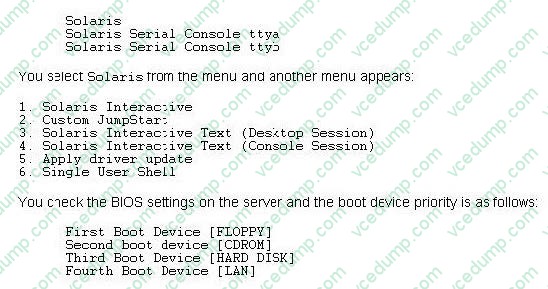
Which option can you use to fix the problem?
A. The boot device priority is fine, your hard drive must be faulty or the boot block is missing. Boot to CDROM, open a shell and run fsck on the Hard Disk.
B. Change the boot device priority so that the CDROM is the third boot device and the HARD DISK is second.
C. Make the First boot device = LAN, Second boot device= CDROM, Third boot device = HARD DISK, remove the fourth boot device.
D. You did not set the fdisk boot partition to ACTIVE and the system cannot boot to the hard disk. Boot from CDROM, open a shell and use fdisk to set the partition to ACTIVE.
E. The GRUB menu is not correct and Solaris is not pointing to the hard disk that you installed the Solaris OS on. Edit the GRUB menu and. The GRUB menu is not correct and Solaris is not pointing to the hard disk that you have installed the Solaris OS on. Edit the GRUB menu and modify the default boot device so that it points to the correct boot drive. -
Question 214:
Your syslog configuration file contains the line:
mai1.debug ifdef(*LOGHOST', /var/1og/sys1og, @1oghost)
Which three are correct statements about this entry? (Choose three.)
A. The ifdef statement is interpreted by the m4 processor.
B. If the loghost alias is NOT set to the local host, messages are emailed to the root user at the host loghost.
C. If the loghost alias is set to be the local host, messages are sent to the /var/log/syslog file.
D. If the loghost alias is set to be the local host, messages are sent to the user loghost on the local system.
E. If the loghost alias is NOT set to the local host, messages are sent to the host defined as the loghost. -
Question 215:
When using the Preboot Execution Environment to boot and install the OS over the network on x86 / x64 based systems, there are a few parameters that need to be configured. To ensure that the client, when booted has all of the information it requires in order to boot successfully.
Which steps are required when configuring a DHCP server to support a PXE client? (Choose three.)
A. Set a lease policy.
B. Specify which profile to use for the client.
C. Selecting a router address or router discovery.
D. in.rarpd must be running on the DHCP server.
E. Determine what configuration macro to assign to clients. -
Question 216:
At boot up, this service calls the startup scripts which are used to configure each network interface with an IP address and other required network information. Which service is it?
A. svc:/network/service:default
B. svc:/network/physical:default
C. svc:/network/ifconfig:default
D. svc:/network/inetd:default -
Question 217:
Given this output from the who(1) command:
$ who
ann console Jan 27 07:25 dave pts/8 Jan 24 15:11 (:0.0) fred term/a Jan 27 08:00 lisa pts/6 Jan 27 08:28 (physical)
Which two users are physically connected to the system? (Choose two.)
A. Lisa
B. Dave
C. Fred
D. Ann -
Question 218:
When you try to NFS mount a directory from the NFS server pepper to the NFS client paprika, the following error occurs: # mount -F nfs pepper:/export/home /data NFS server pepper not responding, still trying
Which troubleshooting step is used to correct this error?
A. on the NFS server pepper, run the command: # dfmounts
B. on the NFS client paprika, ping the NFS server: # ping pepper
C. on the NFS client paprika, run the command: # dfshares paprika
D. on the NFS client paprika, run the command: # ps -ef |grep nfsd
E. on the NFS client paprika, run the command: # ps -ef |grep mountd -
Question 219:
You have a large number of systems in your organization which are currently running either Solaris 2.6 OS or Solaris 7 OS. You also have a mix of both x86 and SPARC system hardware architectures. You need to ensure that all of these
systems are running Solaris 10 OS. You are considering using the Flash installation feature to achieve this.
What is a requirement for using the Flash installation feature?
A. You can use a Flash archive file generated on a SPARC system to install both SPARC and x86 systems.
B. You must replace the x86 systems with SPARC systems, because x86 systems are NOT supported by Flash install.
C. You can use only a Flash archive file generated on a SPARC Sun Blade 150 or more recent system to install other SPARC systems.
D. You must create two Flash archive files, one generated on x86 to install x86, and one generated on the SPARC systems to install SPARC. -
Question 220:
A user from the Stores department reports that the system has become extremely slow. You log in to the system and determine that a process, chewsystem, is using the CPU.
Given:
# ps -ef | grep chewsystem root 1733 1 0 16:17:17 ? 0:00 /bin/ksh ./chewsystem Which two commands can you use to stop the process? (Choose two.)
A. pkill 1
B. pkill -KILL chewsystem
C. kill -KILL chewsystem
D. pkill %1733
E. kill -KILL 1733
Related Exams:
-
1Z0-020
Oracle8i: New Features for Administrators -
1Z0-023
Architecture and Administration -
1Z0-024
Performance Tuning -
1Z0-025
Backup and Recovery -
1Z0-026
Network Administration -
1Z0-034
Upgrade Oracle9i/10g OCA to Oracle Database OCP -
1Z0-036
Managing Oracle9i on Linux -
1Z0-041
Oracle Database 10g: DBA Assessment -
1Z0-052
Oracle Database 11g: Administration Workshop I -
1Z0-053
Oracle Database 11g: Administration II
Tips on How to Prepare for the Exams
Nowadays, the certification exams become more and more important and required by more and more enterprises when applying for a job. But how to prepare for the exam effectively? How to prepare for the exam in a short time with less efforts? How to get a ideal result and how to find the most reliable resources? Here on Vcedump.com, you will find all the answers. Vcedump.com provide not only Oracle exam questions, answers and explanations but also complete assistance on your exam preparation and certification application. If you are confused on your 1Z0-879 exam preparations and Oracle certification application, do not hesitate to visit our Vcedump.com to find your solutions here.