A non-global zone named testzone is currently running.
Which option would you choose to dynamically set the CPU shares for the zone to two shares?
Show answer and explanation
Correct answer: D
1Z0-820 Real Exam Questions
133 questions available · Page 1 of 14
Updated Exam DumpsVerified AnswersPass Guarantee
A non-global zone named testzone is currently running.
Which option would you choose to dynamically set the CPU shares for the zone to two shares?
Correct answer: D
The COMSTAR framework provides support for the iSCSI protocol.
Identify three true statements describing the COMSTAR framework. (Choose three.)
Correct answers: A, C, D
ServerA contains two ISO images of a package repository named so1.repo.iso-a and so1.repo.iso-b respectively. You need to create a single local package repository on server that clients can connect to.
The package repository will be stored on the /export/IPS file system and named repo. The preferred publisher will be named solaris and the publisher URL will be http://serverA.example.com.
Which is the correct procedure to perform on ServerA to create the local Package repository?
Correct answer: D
Explanation: Concatenate the files into one file using the cat command. Make the contents of the repository .iso file available using the mount command. To increase the performance of repository accesses and to avoid the need to remount the .iso image each time the system restarts, copy the repository files from /mnt/repo/to a ZFS file system. You can do this copy with rsync or with tar.
References:
Copying and Creating Oracle Solaris 11 Package Repositories, Copying a Repository From a
File
Select the five tasks that need to be performed on the Automated Installer (AI) install server before setting up the client.
Correct answers: B, D, F, G, I
Explanation: B: Configure the AI install server to use a static IP address and default route.
D: The create-service command can set up DHCP on the AI install server. If you want to set up a separate DHCP server or configure an existing DHCP server for use with AI. The DHCP server must be able to provide DNS information to the systems to be installed.
E: An automated installation of a client over the network consists of the following high-level steps:
1. The client system boots over the network and gets its network configuration and the location of the install server from the DHCP server.
2. The install server provides a boot image to the client.
3. Characteristics of the client determine which installation instructions and which system configuration instructions are used to install the client.
4. The Oracle Solaris 11 OS is installed on the client, pulling packages from the package repository specified by the installation instructions in the AI install service.
G: Install the AI tool set.
Use the installadm create-service command to create an AI install service. Give the service a meaningful name, and specify the path where you want the service created. Specify the source of the network boot image (net image) package or ISO file.
installadm create-service [-n svcname]
[-s FMRI_or_ISO] [-d imagepath]
-d imagepath
The imagepath is the location of the new install service. The install-image/solaris-auto-install package is installed to this location, or the specified ISO file is expanded at this location.
References:
Installing Oracle Solaris 11 Systems, Create an AI Install Service
Which three statements accurately describe the Automated Installation (Al) client? (Choose three.)
Correct answers: A, C, E
Your task is to convert a JumpStart sysidcfg file to an Automated Installer (AI) sc_profile.xml file, using js2ai.
Select two unsupported items that will require changes.
Correct answers: A, D
Explanation: A: terminal
The js2ai tool does not perform any translation. Make sure the terminal type speciied in the sysidcfg ile is supported in Oracle Solaris 11.
D: system_locale
The js2ai tool does not perform any translation. Make sure the locale specified in the sysidcfg ile is supported in Oracle Solaris 11.
References:
Overview of Installation Options, Comparing sysidcfg File Keywords to SC Proile Directives
The current ZFS configuration on serverA is:
Pool1
c3t2d0
c3t3d0
Pool2
c3t4d0
c3t5d0
The ZFS configuration on serverB is: Pool1
mirror-0
c3t2d0
c3t3d0
mirror-1
c3t4d0
c3t5d0
You need to change serverA's ZFS configuration to match serverB's configuration.
Which option should you choose to modify the configuration on serverA so that it matches serverB's configuration?
Correct answer: F
Explanation: We destroy both pools. Then we recreate the mirror.
Note:
zpool attach [-f] pool device new_device
Attaches new_device to an existing zpool device. The existing device cannot be part of a raidz configuration. If device is not currently part of a mirrored configuration, device automatically transforms into a two-way mirror of device and new_device. If device is part of a two-way mirror, attaching new_device creates a three-way mirror, and so on. In either case, new_device begins to resilver immediately.
References:
man zpool
ServerA contains two ISO images of a package repository, named sol.repo.iso-a and sol.repo.iso-b respectively. You need to create a single local package repository on serverA that clients can connect to.
The package repository will be stored in the /export/IPS file system and named repo. The prefered publisher will be named solans and the publisher URL will be http://serverA.example.com.
Which is correct procedure to perform on ServerA to create the local package repository?
Correct answer: A
The core dump configuration for your system is:
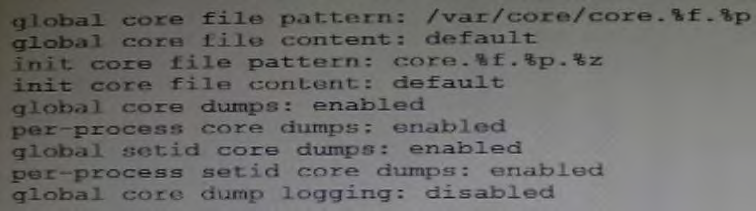
A user is running a process in the global zone and the process crashes. The process information is:
User1 2663 2618 0 17:46:42 pts/2 0:00 /usr/bin/bash
The server host name is: zeus
What will the per-process core file be named?
Correct answer: C
Explanation: Note the first line:
global core file pattern: /globalcore/core.%f.%p
The program name is bash
The runtime process ID is 2663
Note: By default, the global core dump is disabled. You need to use the coreadm command with the -e global option to enable it. The -g option causes the command to append the program name(%f) and the runtime process ID (%p) to the core file name.
References:
Core Dump Management on the Solaris OS
You want to configure an iSCSI target device on your system.
Select the group package required to install this functionality on your system.
Correct answer: A
Explanation: How to Create an iSCSI LUN
The disk volume provided by the server is referred to as the target. When the LUN is associated with an iSCSI target, it can be accessed by an iSCSI initiator. The following tasks are completed on the system that is providing the storage device.
1. Install the COMSTAR storage server software.
target# pkg install storage-server
Etc.