1Z0-803 Exam Details
-
Exam Code
:1Z0-803 -
Exam Name
:Java SE 7 Programmer I -
Certification
:Oracle Certifications -
Vendor
:Oracle -
Total Questions
:216 Q&As -
Last Updated
:Oct 18, 2021
Oracle 1Z0-803 Online Questions & Answers
-
Question 201:
Which three statements are benefits of encapsulation?
A. Allows a class implementation to change without changing t he clients
B. Protects confidential data from leaking out of the objects
C. Prevents code from causing exceptions
D. Enables the class implementation to protect its invariants
E. Permits classes to be combined into the same package
F. Enables multiple instances of the same class to be created safely -
Question 202:
Given the code fragment:
A. Super Sub Sub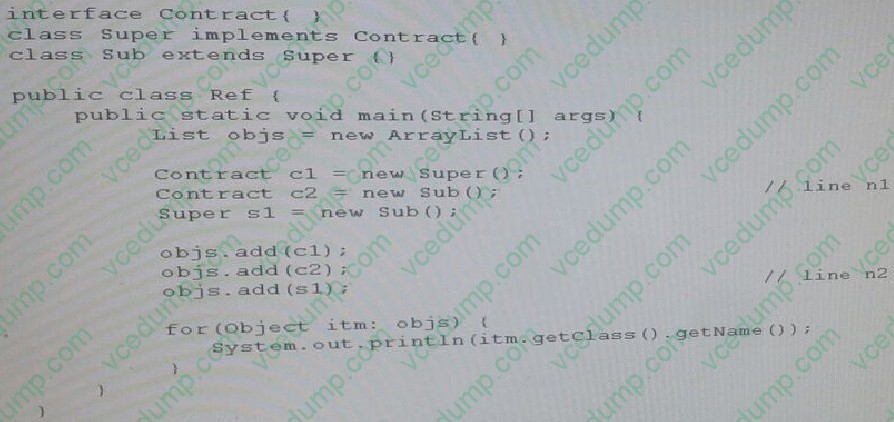
B. Contract Contract Super
C. Compilation fails at line n1
D. Compilation fails at line n2 -
Question 203:
Given:
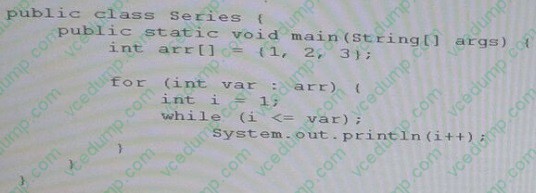
What is the result?
A. 1
B. 1
C. 2
D. Compilation fails
E. The loop executes infinite times -
Question 204:
Given:
class Mid {
public int findMid(int n1, int n2) {
return (n1 + n2) / 2;
}
}
public class Calc extends Mid {
public static void main(String[] args) {
int n1 = 22, n2 = 2;
// insert code here
System.out.print(n3);
}
}
Which two code fragments, when inserted at // insert code here, enable the code to compile and print 12?
A. Calc c = new Calc(); int n3 = c.findMid(n1,n2);
B. int n3 = super.findMid(n1,n3);
C. Calc c = new Mid(); int n3 = c.findMid(n1, n2);
D. Mid m1 = new Calc(); int n3 = m1.findMid(n1, n2);
E. int n3 = Calc.findMid(n1, n2); -
Question 205:
Given the fragments: Which line causes a compilation error?
A. Line n1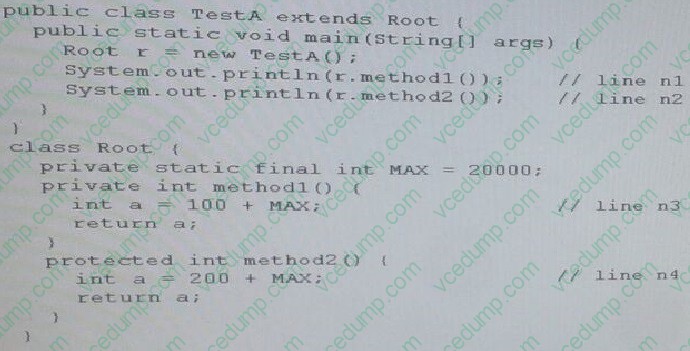
B. Line n2
C. Line n3
D. Line n4 -
Question 206:
Given:
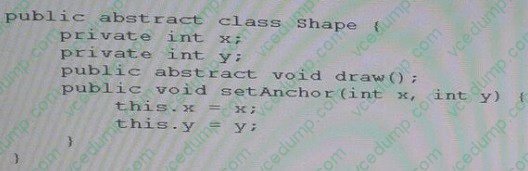
Which two classes use the shape class correctly?
A. Option A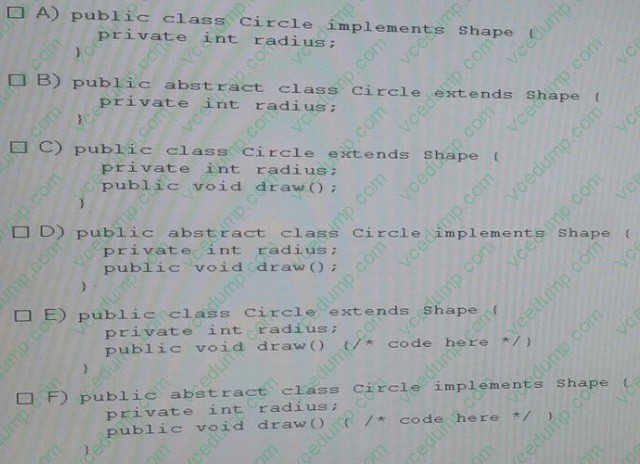
B. Option B
C. Option C
D. Option D
E. Option E
F. Option F -
Question 207:
Given:
abstract class A1 {
public abstract void m1();
public void m2() { System.out.println("Green"); }
}
abstract class A2 extends A1 {
public abstract void m3();
public void m1() { System.out.println("Cyan"); }
public void m2() { System.out.println("Blue"); }
}
public class A3 extends A2 {
public void m1() { System.out.println("Yellow"); } public void m2() { System.out.println("Pink"); } public void m3() { System.out.println("Red"); }
public static void main(String[] args) {
A2 tp = new A3();
tp.m1();
tp.m2();
tp.m3();
}
}
What is the result?
A. Yellow Pink Red
B. Cyan Blue Red
C. Cyan Green Red
D. Compilation Fails -
Question 208:
Given:
public class Painting {
private String type;
public String getType() {
return type;
}
public void setType(String type) {
this.type = type;
}
public static void main(String[] args) {
Painting obj1 = new Painting();
Painting obj2 = new Painting();
obj1.setType(null);
obj2.setType("Fresco");
System.out.print(obj1.getType() + " : " + obj2.getType()); }
}
What is the result?
A. : Fresco
B. null : Fresco
C. Fresco : Fresco
D. A NullPointerException is thrown at runtime -
Question 209:
Given:
public class Test {
public static void main(String[] args) {
int arr[] = new int[4];
arr[0] = 1;
arr[1] = 2;
arr[2] = 4;
arr[3] = 5;
int sum = 0;
try {
for (int pos = 0; pos <= 4; pos++) {
sum = sum + arr[pos];
}
} catch (Exception e) {
System.out.println("Invalid index");
}
System.out.println(sum);
}
}
What is the result?
A. 12
B. Invalid Index
C. Invalid Index D. Compilation fails -
Question 210:
Given:
public class Test {
static boolean bVar;
public static void main(String[] args) {
boolean bVar1 = true;
int count =8;
do {
System.out.println("Hello Java! " +count);
if (count >= 7) {
bVar1 = false;
}
} while (bVar != bVar1 andand count > 4);
count -= 2;
}
}
What is the result?
A. Hello Java! 8 Hello Java! 6 Hello Java! 4
B. Hello Java! 8 Hello Java! 6
C. Hello Java! 8
D. Compilation fails
Related Exams:
-
1Z0-020
Oracle8i: New Features for Administrators -
1Z0-023
Architecture and Administration -
1Z0-024
Performance Tuning -
1Z0-025
Backup and Recovery -
1Z0-026
Network Administration -
1Z0-034
Upgrade Oracle9i/10g OCA to Oracle Database OCP -
1Z0-036
Managing Oracle9i on Linux -
1Z0-041
Oracle Database 10g: DBA Assessment -
1Z0-052
Oracle Database 11g: Administration Workshop I -
1Z0-053
Oracle Database 11g: Administration II
Tips on How to Prepare for the Exams
Nowadays, the certification exams become more and more important and required by more and more enterprises when applying for a job. But how to prepare for the exam effectively? How to prepare for the exam in a short time with less efforts? How to get a ideal result and how to find the most reliable resources? Here on Vcedump.com, you will find all the answers. Vcedump.com provide not only Oracle exam questions, answers and explanations but also complete assistance on your exam preparation and certification application. If you are confused on your 1Z0-803 exam preparations and Oracle certification application, do not hesitate to visit our Vcedump.com to find your solutions here.