What three artifacts are created as a result of running the JeOS tool?
Show answer and explanation
Correct answers: A, D, E
1Z0-590 Real Exam Questions
82 questions available · Page 1 of 9
Updated Exam DumpsVerified AnswersPass Guarantee
What three artifacts are created as a result of running the JeOS tool?
Correct answers: A, D, E
There is an issue booting into a virtual machine. The log files show that there is an issue during the Linux boot process of the guest.
What two methods will best help determine the problem?
Correct answers: A, B
What command will show the current status of all Oracle VM Agent components?
Correct answer: C
What two attributes of a virtual machine are not available on the Oracle VM Manager Home screen when the virtual machine is currently powered down?
Correct answers: B, C
Explanation: If you properly shutdown the virtual machine then you will not get the Server Name surely . So that one correct answer is Server Name. Let's find another correct answer.
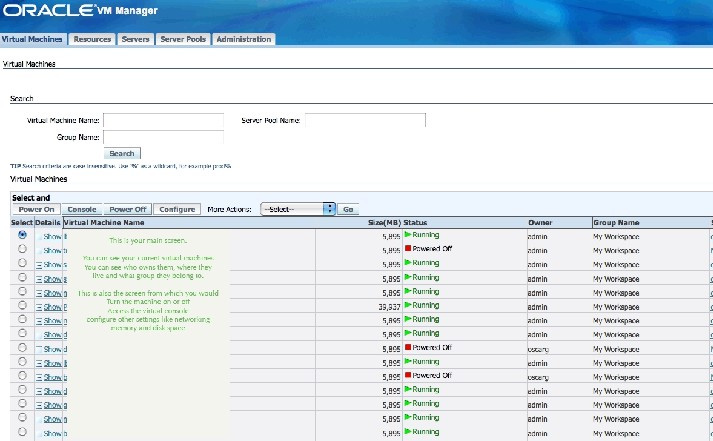
Follow the picture and you will find that the virtual machines which are shutdowed and there is available of Owner and Server Pool Name. But if the machine is not up there so how will you get the vnc port for that machine :D?
Correct answer is B and C.
Which two are characteristics of block I/O in a fully hardware virtualized configuration?
Correct answers: B, C
Which two are true of an NFS repository when used with Oracle VM?
Correct answers: A, B
Explanation:
First of all here you have to select two options but answer shows one. A is ok. A performance comparison of NFS and iSCSI for IP-Networked Storage showed that iSCSI is faster than NFS because iSCSI caches and updates meta-data asynchronously and transfers blocks rather than files. So the options B is right.
A customer is running an existing server farm of open source Xen servers running the same version of Xen as Oracle VM 2.2. The customer would like to manage these servers with Oracle VM.
What is the best reason that this will not be possible?
Correct answer: B
In a paravirtualized environment, which answer best describes the drivers that are used in domO and the guest to communicate block I/O requests?
Correct answer: A
What component of Oracle VM Product is specifically responsible for the automatic failover process?
Correct answer: B
http://docs.oracle.com/cd/E11081_01/doc/doc.21/e10898/ha.htm
To enable HA, you must first make sure all Virtual Machine Servers in the server pool:
Use the same shared storage.
Are in the same OCFS2 or NFS cluster.
Are Oracle VM Server Release 2.1.2 or above.
Have the same cluster root, which is a specially designated shared storage used for heatbeating in the cluster. For example, the cluster root might be example.com:/OVS for an NFS cluster, or /dev/sdd6 for an OCFS2 cluster. The heartbeat file would be located at example.com:/OVS/.server_pool_hb for an NFS cluster. There is no heartbeat file for an OCFS2 cluster as one is in-built in the file system.
Have the cluster root mounted at /OVS. All other storage may be mounted at the standard location of /
OVS/uuid.
Have moved any /OVS mount points (set in FSTAB for Releases 2.1 or 2.1.1) to the /etc/ovs/repositories file. All storage, even that mounted at /OVS, must be maintained in the /etc/ovs/repositories file. You can move the mount points to the /etc/ovs/repositories file with the following command:
# /usr/lib/ovs/ovs-cluster-check --alter-fstab
Have a shared cluster root at /OVS, and not local, using clustered OCFS2 on SAN, or ISCSI storage, or NFS on NAS. The default local storage is OCFS2, and is not supported with HA.
A RedHat Enterprise Linux installation with three installation CDs needs to be created.
What is the proper way to set up the ISO images?
Correct answer: A