1Z0-520 Exam Details
-
Exam Code
:1Z0-520 -
Exam Name
:Oracle E-Business Suite R12.1 Purchasing Essentials -
Certification
:Oracle Certifications -
Vendor
:Oracle -
Total Questions
:285 Q&As -
Last Updated
:Jul 09, 2026
Oracle 1Z0-520 Online Questions & Answers
-
Question 151:
Select two conditions which will permit the transfer of lot-controlled items between inventory organizations. (Choose two.)
A. Item is lot-controlled at the subinventory level.
B. Item is lot-controlled in either the shipping or receiving organizations.
C. Item is lot-controlled in both the shipping and receiving organizations.
D. Item is lot-controlled in the receiving organization, but not the shipping organization.
E. Item is lot-controlled in the shipping organization, but not the receiving organization. -
Question 152:
The on-hand quantity balance for item A is 100 and item B is 200. A shipment of 50 for item A and 50 for item B arrived today. The receiving clerk created a receipt for the shipment. After the receipt, the on-hand quantity of items A and B are
150 and 200 respectively.
Which one of the possible receipt routing options for items A and B is correct?
A. Item A = Direct Delivery; Item B = Standard Receipt
B. Item A = Standard Receipt; Item B = Direct Delivery
C. Item A = Inspection Required; Item B = Direct Delivery
D. Item A = Inspection Required; Item B = Standard Receipt
E. Item A = Standard Receipt; Item B = Inspection Required -
Question 153:
The following transactions occurred at BUY Co., where you implemented the ERS functionality in Oracle Purchasing:
Purchase order unit price: $10
Receipt #1001: 150 units (gross of 50 units returned at the time of receiving)
Receipt #1002: 250 units
The Pay on Receipt process is run nightly, with the summary level set to Pay Site at the supplier site. The aging period is 0.
What would the Pay on Receipt process generate for these transactions?
A. a $3500 invoice
B. a $4000 invoice
C. a $50 invoice and a $2500 invoice
D. a $1500 invoice, a $2500 invoice, and a $50 debit memo
E. a $1000 invoice, a $2500 invoice, and a $50 debit memo -
Question 154:
An approved supplier list (ASL) is being defined in a multiorganization environment. Which two statements are valid? (Choose two.)
A. Setting up a Global ASL is mandatory.
B. If a supplier item has a local ASL setup, you cannot set it up on a Global ASL.
C. The supplier for an item-supplier association must be global, while the supplier site can be local.
D. Company X has set up Planning and would source planned orders. The approval status of the supplier can be set to New or Approved. -
Question 155:
Your company often orders Items that are sourced from multiple suppliers. At any given time, the supplier varies depending on the supplier's current production capability and price offering. The price varies throughout the year. For a particular
item, there is no single supplier that receives the majority of the orders.
What is the best way to set up this item?
A. Create blanket purchase agreements, a sourcing rule identifying all the possible suppliers, and approved supplier list entries.
B. Create contract purchase agreements, a sourcing rule identifying all the possible suppliers, and approved supplier list entries.
C. Do not create blanket or contract purchase agreements or sourcing rules. Manually AutoCreate requisitions onto standard purchase orders.
D. Create a blanket purchase agreement for only one supplier, a sourcing rule for just that supplier, and an approved supplier list entry for that supplier.
E. Create a contract purchase agreement for only one supplier, a sourcing rule for just that supplier, and an approved supplier list entry for that supplier. -
Question 156:
Select three features that Multi-Org provides to satisfy business needs. (Choose three.)
A. secures user access to data
B. supports fixed asset management
C. procures from one Legal Entity and receives in another
D. supports multiple language installations of Oracle Applications
E. supports any number of business units within a single installation -
Question 157:
Your client has inventory organizations that belong to different operating units. All items are manufactured in one operating unit and shipped to distribution warehouses that belong to other operating units. On an exception basis, transfers may be arranged between distribution warehouses in different operating units. All transfers between operating units are at the shipping organization's standard cost plus a transfer charge percentage. Identify three inventory setup steps that are required for allowing the receiving inventory organization to correctly process receipts from inventory organizations belonging to another operating unit. (Choose three.)
A. Define an Intercompany Price List.
B. Define the correct Unit of Measure conversions for Dual UOM.
C. Define Intercompany Relations for each pair of operating units.
D. Define a separate Item Master Organization for each operating unit.
E. Define Receiving Options for each inventory organization in each operating unit.
F. Define Shipping Networks for each pair of shipping and receiving inventory organizations.
G. Ensure that the Receiving Options are uniform for all inventory organizations in each operating unit. -
Question 158:
Review the organization structure regarding the inventory organizations (IO) and sales organizations (SO). The company has defined shipping networks based on these policies:
Inventory Organizations within an Operating Unit (OU) can perform shipments to the Sales Organizations only within the same OU.
An Inventory Organization can ship to any other Inventory Organization in the company.
The only exception to the rule is China, which can ship to any US organization.
Which sites can IO 3 ship to?
A. IO 2, IO 4, IO 5, SO 3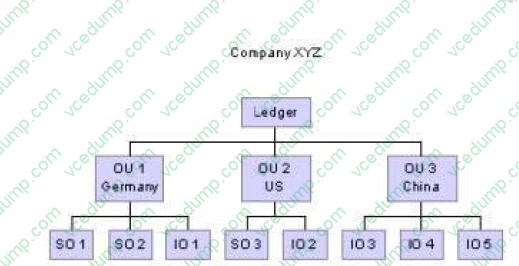
B. IO 1, IO 2, IO 3, IO 4, IO 5
C. IO 1, IO 2, IO 4, IO 5, SO 3
D. IO 2, IO 3, IO 4, IO 5, SO 3
E. IO 1, IO 2, IO 4, IO 5, SO 1, SO 2, SO 3 -
Question 159:
The Requisition Open Interface is loaded from a variety of sources. Identify five. (Choose five.)
A. Oracle Inventory
B. Oracle Purchasing
C. Oracle iProcurement
D. Oracle Order Management
E. Internal Requisitions
F. Oracle WIP (Work in Process)
G. Flat files from non-Oracle systems
H. Oracle MRP (Material Requirements Planning) -
Question 160:
Identify three true statements about the use of the Material Workbench. (Choose three.)
A. Authorized users can create move orders in the Material Workbench.
B. Authorized users can change material statuses in the Material Workbench.
C. Authorized users can perform miscellaneous issues in the Material Workbench.
D. Authorized users can perform miscellaneous receipts in the Material Workbench.
E. Authorized users can perform pick confirm transactions in the Material Workbench.
F. Authorized users can perform ship confirm transactions in the Material Workbench.
G. Authorized users can view material across organizations in the Material Workbench.
Related Exams:
-
1Z0-020
Oracle8i: New Features for Administrators -
1Z0-023
Architecture and Administration -
1Z0-024
Performance Tuning -
1Z0-025
Backup and Recovery -
1Z0-026
Network Administration -
1Z0-034
Upgrade Oracle9i/10g OCA to Oracle Database OCP -
1Z0-036
Managing Oracle9i on Linux -
1Z0-041
Oracle Database 10g: DBA Assessment -
1Z0-052
Oracle Database 11g: Administration Workshop I -
1Z0-053
Oracle Database 11g: Administration II
Tips on How to Prepare for the Exams
Nowadays, the certification exams become more and more important and required by more and more enterprises when applying for a job. But how to prepare for the exam effectively? How to prepare for the exam in a short time with less efforts? How to get a ideal result and how to find the most reliable resources? Here on Vcedump.com, you will find all the answers. Vcedump.com provide not only Oracle exam questions, answers and explanations but also complete assistance on your exam preparation and certification application. If you are confused on your 1Z0-520 exam preparations and Oracle certification application, do not hesitate to visit our Vcedump.com to find your solutions here.