1Z0-148 Exam Details
-
Exam Code
:1Z0-148 -
Exam Name
:Oracle Database: Advanced PL/SQL -
Certification
:Oracle Certifications -
Vendor
:Oracle -
Total Questions
:243 Q&As -
Last Updated
:May 28, 2026
Oracle 1Z0-148 Online Questions & Answers
-
Question 171:
Examine this query executed as SYS and its output:
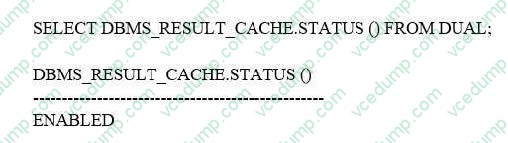
Which two observations are true based on the output?
A. The client-side result cache and the server-side result cache are enabled.
B. All distinct query results are cached for the duration of a SYS user session.
C. Repetitive SQL queries and PL/SQL function results are cached and automatically used from the cache across all SYS user sessions.
D. The result cache exists but which SQL queries are cached depends on the value of the RESULT_CACHE_MODE parameter.
E. Repetitive SQL queries executed on permanent non-dictionary objects may have faster response times. -
Question 172:
Which two conditions must be true for a PL/SQL function to be result cached? (Choose two.)
A. It must be part of a package.
B. It must be a pipelined table function.
C. It must not be defined in an anonymous block.
D. It must have at least one OUT or IN OUT parameter. -
Question 173:
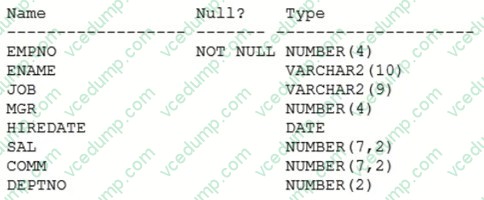
You are connected as SCOTT who has an EMP table with this structure:
Examine this code:
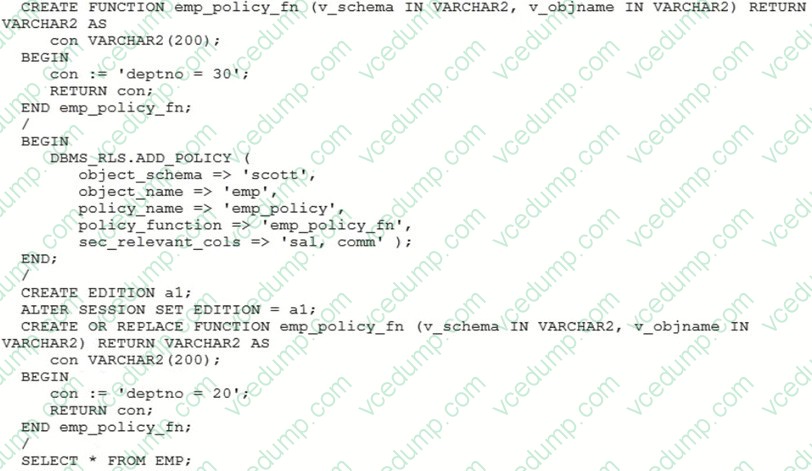
Assuming the default edition is ORA$BASE, which is correct?
A. The query will return records pertaining to department 30 with SAL and COMM values displayed as NULL.
B. The query will return records pertaining to department 20.
C. The query will return records pertaining to department 20 with SAL and COMM values displayed as NULL.
D. The query will return records pertaining to department 30. -
Question 174:
Which two PL/SQL blocks give the output “this is a test message”? (Choose two.)
A. BEGIN DBMS_OUTPUT.PUT_LINE (DBMS_ASSERT.ENQUOTE_NAME (‘this is a test message’, TRUE)); END;
B. BEGIN DBMS_OUTPUT.PUT_LINE (DBMS_ASSERT.ENQUOTE_NAME (‘this is a “ “test” ” message’, TRUE)); END;
C. BEGIN DBMS_OUTPUT.PUT_LINE (DBMS_ASSERT.ENQUOTE_NAME (‘ “this is a “test” message” ’, TRUE)); END;
D. BEGIN DBMS_OUTPUT.PUT_LINE (DBMS_ASSERT.ENQUOTE_NAME (‘ “this is a test message” ’, TRUE)); END;
E. BEGIN DBMS_OUTPUT.PUT_LINE (DBMS_ASSERT.ENQUOTE_NAME (‘this is a test message ’, FALSE)); END; -
Question 175:
Which two statements are true about the SQL Query Result Cache? (Choose two.)
A. It can store the query results for temporary tables.
B. It can be set at the system, session, or query level.
C. It is used only across statements in the same session.
D. Cached query results become invalid when the data accessed by the query is modified. -
Question 176:
Examine this code:
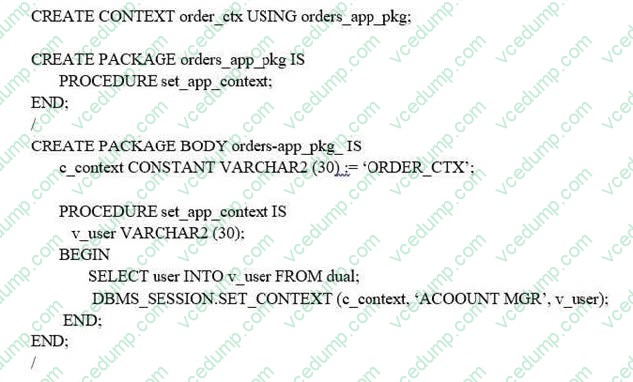
What is the correct statement to get the value of attribute ACCOUNT_MGR after the procedure has been executed?
A. SELECT USERENV (`ACCOUNT_MGR') FROM dual;
B. SELECT SYS_CONTEXT (`USERENV', `ACCOUNT_MGR') FROM dual;
C. SELECT SYS_CONTEXT (`ORDER_CTX', `ACCOUNT_MGR') FROM dual;
D. SELECT SYS_CONTEXT (`ACCOUNT_MGR', `ORDER_CTX') FROM dual;
E. SELECT USERENV (`ORDER_CTX') FROM dual; -
Question 177:
The database instance was started up with the following initialization parameter values:
MEMORY_TARGET = 500M
RESULT_CACHE_MODE = FORCE
RESULT_CACHE_MAX_SIZE = 0
After the database startup, to enable the result cache, you issued the following command:
SQL> ALTER SYSTEM SET result_cache_max_size = 2M SCOPE = MEMORY;
Which is the effect of this command?
A. The query result cache is enabled and 2 MB of the memory target is allocated to the result cache.
B. The query result cache is enabled and 0.25% of the memory target is allocated to the result cache.
C. The command produces an error because the database instance is started up with the RESULT_CACHE_MAX_SIZE parameter set to 0.
D. The query result cache is not enabled because the database instance is started up with the RESULT_CACHE_MAX_SIZE parameter set to 0. -
Question 178:
Examine these statements:
1.
A function with invoker's rights can be result cached by using both AUTHID CURRENT_USER and RESULT_CACHE in its declaration.
2.
A function with invoker's rights cannot be result cached because it may allow a user to retrieve data cached by another user.
3.
Results in the result cache for an invoker's rights function will be cached by the value of CURRENT_SCHEMA in the invoking environment.
4.
By default, declaring a function with RESULT_CACHE makes it an invoker's rights result cached function.
5.
A function with invoker's rights can be result cached because the function result cache is created per user for invoker's rights functions.
Identify the set of correct statements with respect to invoker's rights and function result caching.
A. 1, 3, 4 and 5
B. 1 and 3
C. 1, 3 and 5
D. 2 only
E. 1, 3 and 4 -
Question 179:
Which statements are true about the SecureFile storage paradigm? (Choose two.)
A. SecureFile storage can be used for internal and external LOBs.
B. Automatic Segment Space Management must be enabled for a tablespace to store SecureFile LOBs.
C. SecureFile options enabled for a LOB column can be overridden on a per-LOB basis within the column.
D. SecureFile is the default storage paradigm for all LOBs that are stored in locally managed tablespaces if the DB_SECUREFILE parameter is set to ALWAYS. -
Question 180:
There is a Java class file in your system and you publish it using the following command:
CREATE OR REPLACE PROCEDURE ccformat
(x IN OUT VARCHAR2)
AS LANGUAGE JAVA
NAME 'FormatCreditCardNo.formatCard(java.lang.String[])';
However, you receive the following error when executing the CCFORMAT procedure:
ERROR at line 1:
ORA-29540: class FormatCreditCardNo does not exist
ORA-06512: at "SH.CCFORMAT", line 1
ORA-06512: at line 1
What would you do to execute the procedure successfully?
A. Change the listener configuration.
B. Create a directory object and link it to the Java class file.
C. Rebuild the Java class file when the database instance is running.
D. Use the loadjava utility to load the Java class file into the database.
Related Exams:
-
1Z0-020
Oracle8i: New Features for Administrators -
1Z0-023
Architecture and Administration -
1Z0-024
Performance Tuning -
1Z0-025
Backup and Recovery -
1Z0-026
Network Administration -
1Z0-034
Upgrade Oracle9i/10g OCA to Oracle Database OCP -
1Z0-036
Managing Oracle9i on Linux -
1Z0-041
Oracle Database 10g: DBA Assessment -
1Z0-052
Oracle Database 11g: Administration Workshop I -
1Z0-053
Oracle Database 11g: Administration II
Tips on How to Prepare for the Exams
Nowadays, the certification exams become more and more important and required by more and more enterprises when applying for a job. But how to prepare for the exam effectively? How to prepare for the exam in a short time with less efforts? How to get a ideal result and how to find the most reliable resources? Here on Vcedump.com, you will find all the answers. Vcedump.com provide not only Oracle exam questions, answers and explanations but also complete assistance on your exam preparation and certification application. If you are confused on your 1Z0-148 exam preparations and Oracle certification application, do not hesitate to visit our Vcedump.com to find your solutions here.