1Z0-148 Exam Details
-
Exam Code
:1Z0-148 -
Exam Name
:Oracle Database: Advanced PL/SQL -
Certification
:Oracle Certifications -
Vendor
:Oracle -
Total Questions
:243 Q&As -
Last Updated
:May 28, 2026
Oracle 1Z0-148 Online Questions & Answers
-
Question 161:
Examine the following structure: SQL> DESCRIBE user_identifiers Name Null? Type
NAME VARCHAR2(30)
SIGNATURE VARCHAR2(32)
TYPE VARCHAR2(18)
OBJECT_NAME NOT NULL VARCHAR2(30)
OBJECT_TYPE VARCHAR2(13)
USAGE VARCHAR2(11)
USAGE_ID NUMBER
LINE NUMBER
COL NUMBER
USAGE_CONTEXT_ID NUMBER
Identify two scenarios in which information is stored in the USAGE column. (Choose two.)
A. an assignment made to VARIABLE
B. declaration of a variable or formal parameter
C. an identifier passed to a subprogram in IN OUT mode
D. execution of the GOTO statement or raise of an exception -
Question 162:
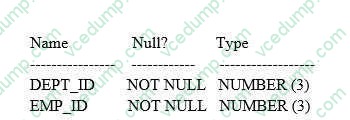
Examine the structure of the DEPT table which exists in both BRANCH1 and BRANCH2 schemas:
Examine this code:
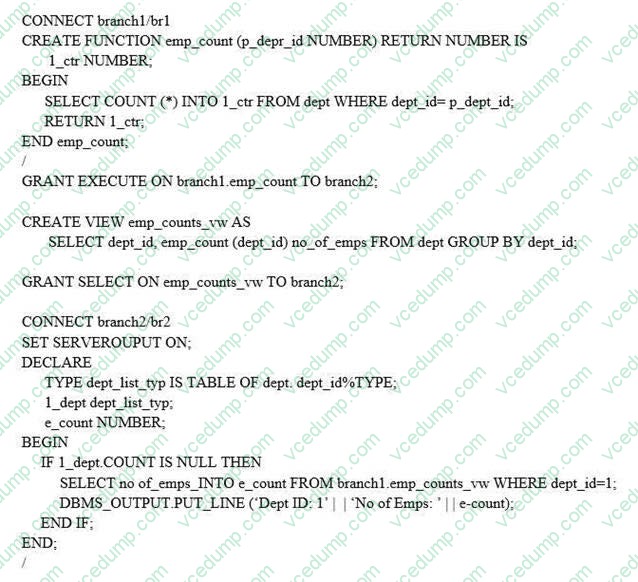
Which three modifications must be done to endure the anonymous block displays the output form the BRANCH2.DEF DEPT table?
A. Change the IF condition in the anonymous block to 1_dept IS EMPTY.
B. Change the IF condition in the anonymous block to CARDINALITY (1_dept) IS NULL.
C. Add BEQUEATH DEFINER to the EMP_COUNT_VW view.
D. Add BEQUEATH CURRENT_USER to the EMP_COUNTS_VW view.
E. IN BRANCH2 execute GRANT INHERIT PRIVILEGES ON USER branch2 TO branch1;
F. Add AUTHID CURRENT_USER to the EMP_COUNT function. -
Question 163:
Which two statements are true about cursor variables? (Choose two.)
A. Cursor variables can be parameterized like cursors.
B. The query associated with a cursor variable cannot reference host variables and PL/SQL variables.
C. The FETCH statement executes the query associated with a cursor variable and identifies the result set.
D. Cursor attributes (%FOUND, %NOTFOUND, %ISOPEN, and %ROWCOUNT) can be applied to a cursor variable.
E. The OPEN FOR statement executes the query associated with a cursor variable and identifies the result set. -
Question 164:
Your company decided to update its employees' contact information as a one-time event. With thousands of employees' records to be updated, the project manager hoped to achieve substantial performance gains using the DBMS_PARALLEL_EXECUTE package and identified these four actions to be executed. 1) dbms_parallel_execute.create_task 2) GRANT system privilege CREATE JOB to the user executing this task 3) dbms_parallel_execute.run_task 4) dbms_parallel_execute.create_chunks_by_rowid Select the correct order of actions to implement the parallel execution of PL/SQL blocks.
A. 2, 1, 3 and 4
B. 1, 2, 4 and 3
C. 2, 1, 4 and 3
D. 1, 2, 3 and 4
E. 2, 4, 1 and 3 -
Question 165:
Which tablespace is used to store the data collected by PL/Scope?
A. UNDOTBS1
B. SYSAUX
C. SYSTEM
D. TEMP
E. USERS -
Question 166:
Which two statements are true about the query results stored in the query result cache? (Choose two.)
A. If any of the tables used to build a query is modified by an ongoing transaction in the current session, the query result is not cached.
B. A query result based on a read-consistent snapshot of data that is older than the latest committed version of the data is not cached.
C. Adding the RESULT_CACHE hint to inline views enables optimizations between the outer query and the inline view, and the query result is cached.
D. A query result for a query that has a bind variable is stored in the cache and is reused if the query is equivalent even when the bind variable has a different value. -
Question 167:
Which two statements are true about the initialization of internal LOBs? (Choose two.)
A. The EMPTY_CLOB() and EMPTY_BLOB() functions can be used to initialize only null internal LOBs.
B. The EMPTY_CLOB() and EMPTY_BLOB() functions can be used to initialize only non- NULL internal LOBs.
C. The EMPTY_CLOB() and EMPTY_BLOB() functions can be used to initialize both null and non-NULL internal LOBs.
D. The CLOB and BLOB columns can be initialized only by using the EMPTY_CLOB() and EMPTY_BLOB() functions, respectively.
E. The CLOB and BLOB columns can be initialized with a character or raw string, respectively, provided they are less than 4000 bytes in size. -
Question 168:
Which two statements are true about the usage of the DBMS_DESCRIBE.DESCRIBE_PROCEDURE procedure? (Choose two.)
A. You can describe remote objects.
B. You can describe anonymous PL/SQL blocks.
C. You can describe a stored procedure, stored function, packaged procedure, or packaged function.
D. You can obtain information about the position, name, and data type of the arguments of a procedure. -
Question 169:
View the Exhibit and examine the structure of the EMPLOYEES table.
Examine the following PL/SQL block:
DECLARE
TYPE EmpList
IS VARRAY(2) OF employees.employee_id%TYPE NOT NULL;
v_employees EmpList := EmpList();
BEGIN
DBMS_OUTPUT.PUT_LINE(v_employees.COUNT);
v_employees.EXTEND;
v_employees(1) := 30;
END;
/
Which statement is true about the outcome on executing the above PL/SQL block?
A. It executes successfully and displays the value 2.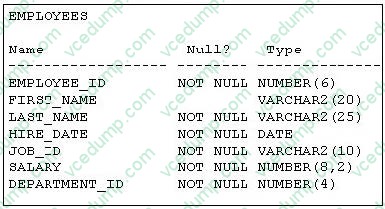
B. It executes successfully and displays the value 0.
C. It generates an error because EXTEND cannot be used for varrays.
D. It generates an error because the declaration of the varray is not valid. -
Question 170:
Examine the DBMS_LOB.LOADCLOBFROMFILE procedure:
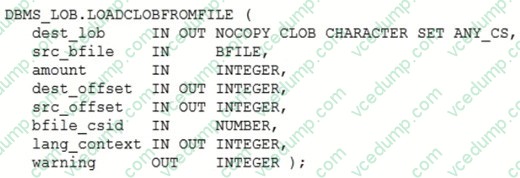
Which statement is true about DBMS_LOB.LOADCLOBFROMFILE?
A. The amount parameter can be set to NULL to indicate to load to the end of the BFILE.
B. The amount parameter can be set to DBMS_LOB.LOBMAXSIZE to indicate to load to the end of the BFILE.
C. If any error occurs when calling the procedure then it is written to the warning parameter and DBMS_LOB.LOADCLOBFROMFILE finishes successfully.
D. An exception will always be raised if amount plus src_offset exceeds the length of the BFILE.
Related Exams:
-
1Z0-020
Oracle8i: New Features for Administrators -
1Z0-023
Architecture and Administration -
1Z0-024
Performance Tuning -
1Z0-025
Backup and Recovery -
1Z0-026
Network Administration -
1Z0-034
Upgrade Oracle9i/10g OCA to Oracle Database OCP -
1Z0-036
Managing Oracle9i on Linux -
1Z0-041
Oracle Database 10g: DBA Assessment -
1Z0-052
Oracle Database 11g: Administration Workshop I -
1Z0-053
Oracle Database 11g: Administration II
Tips on How to Prepare for the Exams
Nowadays, the certification exams become more and more important and required by more and more enterprises when applying for a job. But how to prepare for the exam effectively? How to prepare for the exam in a short time with less efforts? How to get a ideal result and how to find the most reliable resources? Here on Vcedump.com, you will find all the answers. Vcedump.com provide not only Oracle exam questions, answers and explanations but also complete assistance on your exam preparation and certification application. If you are confused on your 1Z0-148 exam preparations and Oracle certification application, do not hesitate to visit our Vcedump.com to find your solutions here.