1Z0-147 Exam Details
-
Exam Code
:1Z0-147 -
Exam Name
:Oracle9i program with pl/sql -
Certification
:Oracle Certifications -
Vendor
:Oracle -
Total Questions
:132 Q&As -
Last Updated
:Dec 06, 2021
Oracle 1Z0-147 Online Questions & Answers
-
Question 121:
Which three statements are true regarding database triggers? (Choose three.)
A. A database trigger is a PL/SQL block, C, or Java procedure associated with a table, view, schema, or the database.
B. A database trigger needs to be executed explicitly whenever a particular event takes place.
C. A database trigger executes implicitly whenever a particular event takes place.
D. A database trigger fires whenever a data event (such as DML) or system event (such as logon, shutdown) occurs on a schema or database.
E. With a schema, triggers fire for each event for all users; with a database, triggers fire for each event for that specific user. -
Question 122:
Examine this code:
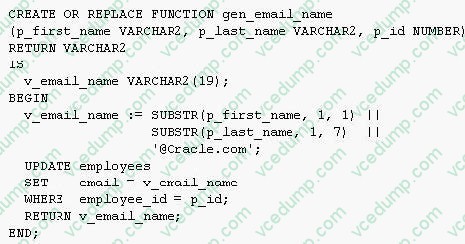
Which statement removes the function?
A. DROP gen_email_name;
B. REMOVE gen_email_name;
C. DELETE gen_email_name;
D. TRUNCATE gen_email_name;
E. DROP FUNCTION gen_email_name;
F. ALTER FUNCTION gen_email_name REMOVE; -
Question 123:
Examine this package:
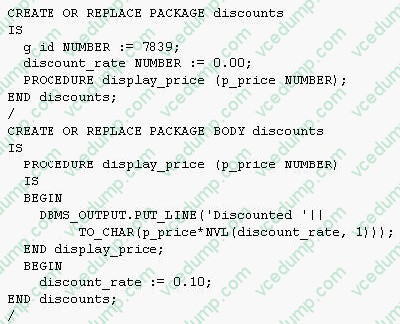
Which statement is true?
A. The value of DISCOUNT_RATE always remains 0.00 in a session.
B. The value of DISCOUNT_RATE is set to 0.10 each time the package is invoked in a session.
C. The value of DISCOUNT_RATE is set to 1.00 each time the procedure DISPLAY_PRICE is invoked.
D. The value of DISCOUNT_RATE is set to 0.10 when the package is invoked for the first time in a session. -
Question 124:
Why do you use an INSTEAD OF trigger?
A. to perform clean up actions when ending a user session
B. to insert data into a view that normally does not accept inserts
C. to insert into an audit table when data is updated in a sensitive column
D. to modify data in which the DML statement has been issued against an inherently non-updateable view -
Question 125:
Examine this code:
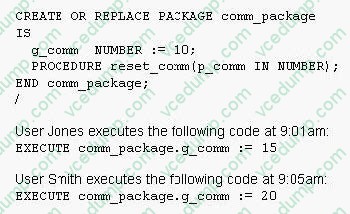
Which statement is true?
A. g_comm has a value of 15 at 9:06am for Smith.
B. g_comm has a value of 15 at 9:06am for Jones.
C. g_comm has a value of 20 at 9:06am for both Jones and Smith.
D. g_comm has a value of 15 at 9:03am for both Jones and Smith.
E. g_comm has a value of 10 at 9:06am for both Jones and Smith.
F. g_comm has a value of 10 at 9:03 for both Jones and Smith. -
Question 126:
Examine this package:
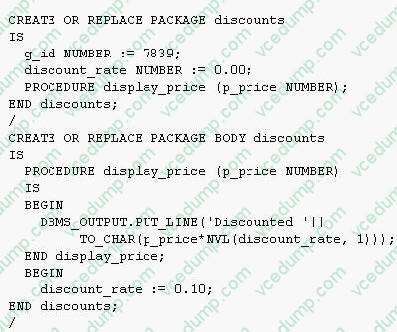
The SQL*Plus SERVEROUTPUT setting is turned on in your session. You execute the procedure DISPLAY_PRICE from SQL*Plus with the command: EXECUTE discounts.display_price (100); What is the result?
A. Discounted 10
B. Discounted 100
C. Discounted 0.00
D. Discounted NULL
E. Discounted 0.10 -
Question 127:
What happens during the execute phase with dynamic SQL for INSERT, UPDATE, and DELETE operations?
A. The rows are selected and ordered.
B. The validity of the SQL statement is established.
C. An area of memory is established to process the SQL statement.
D. The SQL statement is run and the number of rows processed is returned.
E. The area of memory established to process the SQL statement is released. -
Question 128:
Examine the trigger:
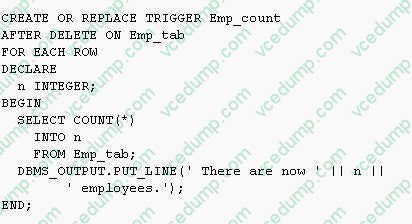
This trigger results in an error after this SQL statement is entered:
DELETE FROM Emp_tab WHERE Empno = 7499;
How do you correct the error?
A. Change the trigger type to a BEFORE DELETE .
B. Take out the COUNT function because it is not allowed in a trigger.
C. Remove the DBMS_OUTPUT statement because it is not allowed in a trigger.
D. Change the trigger to a statement-level trigger by removing FOR EACH ROW. -
Question 129:
What can you do with the DBMS_LOB package?
A. Use the DBMS_LOB.WRITE procedure to write data to a BFILE.
B. Use the DBMS_LOB.BFILENAME function to locate an external BFILE.
C. Use the DBMS_LOB.FILEEXISTS function to find the location of a BFILE.
D. Use the DBMS_LOB.FILECLOSE procedure to close the file being accessed. -
Question 130:
Which three are true regarding error propagation? (Choose three.)
A. An exception cannot propagate across remote procedure calls.
B. An exception raised inside a declaration immediately propagates to the current block.
C. The use of the RAISE; statement in an exception handler reraises the current exception.
D. An exception raised inside an exception handler immediately propagates to the enclosing block.
Related Exams:
-
1Z0-020
Oracle8i: New Features for Administrators -
1Z0-023
Architecture and Administration -
1Z0-024
Performance Tuning -
1Z0-025
Backup and Recovery -
1Z0-026
Network Administration -
1Z0-034
Upgrade Oracle9i/10g OCA to Oracle Database OCP -
1Z0-036
Managing Oracle9i on Linux -
1Z0-041
Oracle Database 10g: DBA Assessment -
1Z0-052
Oracle Database 11g: Administration Workshop I -
1Z0-053
Oracle Database 11g: Administration II
Tips on How to Prepare for the Exams
Nowadays, the certification exams become more and more important and required by more and more enterprises when applying for a job. But how to prepare for the exam effectively? How to prepare for the exam in a short time with less efforts? How to get a ideal result and how to find the most reliable resources? Here on Vcedump.com, you will find all the answers. Vcedump.com provide not only Oracle exam questions, answers and explanations but also complete assistance on your exam preparation and certification application. If you are confused on your 1Z0-147 exam preparations and Oracle certification application, do not hesitate to visit our Vcedump.com to find your solutions here.