1Z0-147 Exam Details
-
Exam Code
:1Z0-147 -
Exam Name
:Oracle9i program with pl/sql -
Certification
:Oracle Certifications -
Vendor
:Oracle -
Total Questions
:132 Q&As -
Last Updated
:Dec 06, 2021
Oracle 1Z0-147 Online Questions & Answers
-
Question 111:
You have a row level BEFORE UPDATE trigger on the EMP table. This trigger contains a SELECT statement on the EMP table to ensure that the new salary value falls within the minimum and maximum salary for a given job title. What happens when you try to update a salary value in the EMP table?
A. The trigger fires successfully.
B. The trigger fails because it needs to be a row level AFTER UPDATE trigger.
C. The trigger fails because a SELECT statement on the table being updated is not allowed.
D. The trigger fails because you cannot use the minimum and maximum functions in a BEFORE UPDATE trigger. -
Question 112:
Which statement is valid when removing procedures?
A. Use a drop procedure statement to drop a standalone procedure.
B. Use a drop procedure statement to drop a procedure that is part of a package. Then recompile the package specification.
C. Use a drop procedure statement to drop a procedure that is part of a package. Then recompile the package body.
D. For faster removal and re-creation, do not use a drop procedure statement. Instead, recompile the procedure using the alter procedure statement with the REUSE SETTINGS clause. -
Question 113:
What is a conditional predicate in a DML trigger?
A. A conditional predicate allows you to specify a WHEN-LOGGING-ON condition in the trigger body.
B. A conditional predicate means you use the NEW and OLD qualifiers in the trigger body as a condition.
C. A conditional predicate allows you to combine several DML triggering events into one in the trigger body.
D. A conditional predicate allows you to specify a SHUTDOWN or STARTUP condition in the trigger body. -
Question 114:
Which statements are true? (Choose all that apply.)
A. If errors occur during the compilation of a trigger, the trigger is still created.
B. If errors occur during the compilation of a trigger you can go into SQL*Plus and query the USER_TRIGGERS data dictionary view to see the compilation errors.
C. If errors occur during the compilation of a trigger you can use the SHOW ERRORS command within iSQL*Plus to see the compilation errors.
D. If errors occur during the compilation of a trigger you can go into SQL*Plus and query the USER_ERRORS data dictionary view to see compilation errors. -
Question 115:
Which two statements about the overloading feature of packages are true? (Choose two.)
A. Only local or packaged subprograms can be overloaded.
B. Overloading allows different functions with the same name that differ only in their return types.
C. Overloading allows different subprograms with the same name number, type and order of parameters.
D. Overloading allows different subprograms with the same name and same number or type of parameters.
E. Overloading allows different subprograms with same name, but different in either number, type or order of parameters. -
Question 116:
You want to create a PL/SQL block of code that calculates discounts on customer orders. This code will be invoked from several places, but only within the program unit ORDERTOTAL . What is the most appropriate location to store the code that calculates the discount?
A. a stored procedure on the server
B. a block of code in a PL/SQL library
C. a standalone procedure on the client machine
D. a block of code in the body of the program unit ORDERTOTAL
E. a local subprogram defined within the program unit ORDERTOTAL -
Question 117:
Examine this function:
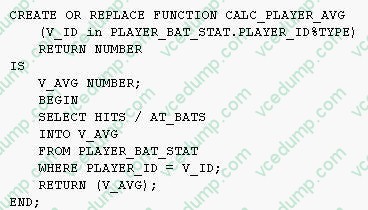
Which statement will successfully invoke this function in SQL*Plus?
A. SELECT CALC_PLAYER_AVG(PLAYER_ID) FROM PLAYER_BAT_STAT;
B. EXECUTE CALC_PLAYER_AVG(31);
C. CALC_PLAYER('Ruth');
D. CALC_PLAYER_AVG(31);
E. START CALC_PLAYER_AVG(31) -
Question 118:
You disabled all triggers on the EMPLOYEES table to perform a data load. Now, you need to enable all triggers on the EMPLOYEES table. Which command accomplishes this?
A. You cannot enable multiple triggers on a table in one command.
B. ALTER TRIGGERS ON TABLE employees ENABLE;
C. ALTER employees ENABLE ALL TRIGGERS;
D. ALTER TABLE employees ENABLE ALL TRIGGERS; -
Question 119:
Examine this procedure: CREATE OR REPLACE PROCEDURE INSERT_TEAM (V_ID in NUMBER, V_CITY in VARCHAR2 DEFAULT 'AUSTIN', V_NAME in VARCHAR2) IS BEGIN INSERT INTO TEAM (id, city, name) VALUES (v_id, v_city, v_name); COMMIT; END; Which two statements will successfully invoke this procedure in SQL*Plus? (Choose two.)
A. EXECUTE INSERT_TEAM;
B. EXECUTE INSERT_TEAM(3, V_NAME=andgt;'LONGHORNS', V_CITY=andgt;'AUSTIN');
C. EXECUTE INSERT_TEAM(3,'AUSTIN','LONGHORNS');
D. EXECUTE INSERT_TEAM (V_ID := 3, V_NAME := 'LONGHORNS', V_CITY := 'AUSTIN');
E. EXECUTE INSERT_TEAM (3,'LONGHORNS'); -
Question 120:
Which two statements about object dependencies are accurate? (Choose two.)
A. When referencing a package procedure or function from a stand-alone procedure or function, if the package specification changes, the package body remains valid but the stand-alone procedure becomes invalid.
B. When referencing a package procedure or function from a stand-alone procedure or function, if the package body changes and the package specification does not change, the stand-alone procedure referencing a package construct remains valid.
C. When referencing a package procedure or function from a stand-alone procedure or function, if the package body changes and the package specification does not change, the stand-alone procedure referencing a package construct becomes invalid.
D. When referencing a package procedure or function from a stand-alone procedure or function, If the package specification changes, the stand-alone procedure referencing a package construct as well as the package body become invalid.
Related Exams:
-
1Z0-020
Oracle8i: New Features for Administrators -
1Z0-023
Architecture and Administration -
1Z0-024
Performance Tuning -
1Z0-025
Backup and Recovery -
1Z0-026
Network Administration -
1Z0-034
Upgrade Oracle9i/10g OCA to Oracle Database OCP -
1Z0-036
Managing Oracle9i on Linux -
1Z0-041
Oracle Database 10g: DBA Assessment -
1Z0-052
Oracle Database 11g: Administration Workshop I -
1Z0-053
Oracle Database 11g: Administration II
Tips on How to Prepare for the Exams
Nowadays, the certification exams become more and more important and required by more and more enterprises when applying for a job. But how to prepare for the exam effectively? How to prepare for the exam in a short time with less efforts? How to get a ideal result and how to find the most reliable resources? Here on Vcedump.com, you will find all the answers. Vcedump.com provide not only Oracle exam questions, answers and explanations but also complete assistance on your exam preparation and certification application. If you are confused on your 1Z0-147 exam preparations and Oracle certification application, do not hesitate to visit our Vcedump.com to find your solutions here.