1Z0-146 Exam Details
-
Exam Code
:1Z0-146 -
Exam Name
:Oracle Database 11g: Advanced PL/SQL -
Certification
:Oracle Certifications -
Vendor
:Oracle -
Total Questions
:136 Q&As -
Last Updated
:Dec 09, 2021
Oracle 1Z0-146 Online Questions & Answers
-
Question 21:
View the Exhibit and examine the structure of the EMPLOYEES table.
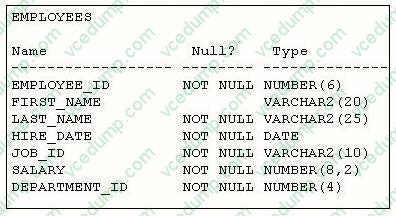
Examine the following PL/SQL block:
DECLARE
TYPE EmpList
IS VARRAY(2) OF employees.employee_id%TYPE NOT NULL;
v_employees EmpList := EmpList();
BEGIN
DBMS_OUTPUT.PUT_LINE(v_employees.COUNT);
v_employees.EXTEND;
v_employees(1) := 30;
END;
/
Which statement is true about the outcome on executing the above PL/SQL block?
A. It executes successfully and displays the value 2.
B. It executes successfully and displays the value 0.
C. It generates an error because EXTEND cannot be used for varrays.
D. It generates an error because the declaration of the varray is not valid. -
Question 22:
Which two statements are true about the query results stored in the query result cache? (Choose two.)
A. If any of the tables used to build a query is modified by an ongoing transaction in the current session, the query result is not cached.
B. A query result based on a read-consistent snapshot of data that is older than the latest committed version of the data is not cached.
C. Adding the RESULT_CACHE hint to inline views enables optimizations between the outer query and the inline view, and the query result is cached.
D. A query result for a query that has a bind variable is stored in the cache and is reused if the query is equivalent even when the bind variable has a different value. -
Question 23:
Examine the PL/SQL code for the GET_TABLE_MD function given below:
CREATE OR REPLACE FUNCTION get_table_md RETURN CLOB IS
h NUMBER;
th NUMBER;
doc CLOB;
BEGIN
h := DBMS_METADATA.OPEN('TABLE');
DBMS_METADATA.SET_FILTER(h,'SCHEMA','HR');
DBMS_METADATA.SET_FILTER(h,'NAME','TIMECARDS');
th := DBMS_METADATA.ADD_TRANSFORM(h,'DDL');
doc := DBMS_METADATA.FETCH_CLOB(h);
DBMS_METADATA.CLOSE(h);
RETURN doc;
END;
Which statement is true about the compilation and execution of the function?
A. The function retrieves the metadata in Extensible Markup Language (XML) format for creating the TIMECARDS table in the HR schema.
B. The compilation produces an error because DBMS_METADATA.SET_FILTER(h,'SCHEMA','HR')is not placed in the correct order.
C. The function retrieves the metadata as a data definition language (DDL) statement for creating the TIMECARDS table in the HR schema.
D. The execution of the function produces an error because multiple objects are fetched and DBMS_METADATA.FETCH_CLOB is not called in a LOOP. -
Question 24:
Which statements are true about temporary LOBs? (Choose all that apply.)
A. They can be created only for CLOB and NCLOB data.
B. They can be accessed only by the user who creates them.
C. They generate more redo information than persistent LOBs.
D. They exist for the duration of the session in which they are created.
E. They are stored temporarily in the default tablespace of the user who creates them. -
Question 25:
Which two are major approaches that can be used to reduce the SQL injection by limiting user input? (Choose two.)
A. Restrict users accessing specified web page.
B. Use NUMBER data type if only positive integers are needed.
C. Use dynamic SQL and construct it through concatenation of input values.
D. In PL/SQL API, expose only those routines that are intended for customer use. -
Question 26:
The result cache is enabled for the database instance.
Examine the following code for a PL/SQL function:
CREATE OR REPLACE FUNCTION get_hire_date (emp_id NUMBER) RETURN VARCHAR
RESULT_CACHE RELIES_ON (HR.EMPLOYEES)
IS
date_hired DATE;
BEGIN
SELECT hire_date INTO date_hired
FROM HR.EMPLOYEES
WHERE EMPLOYEE_ID = emp_id;
RETURN TO_CHAR(date_hired);
END;
Which statement is true in this scenario?
A. If sessions have different NLS_DATE_FORMAT settings, cached results have different formats.
B. The function results are not cached because the query used in the function returns the DATE data type.
C. If sessions have different NLS_DATE_FORMAT settings, cached results have same formats because the function's return type is VARCHAR.
D. If a function is executed with same argument value but different NLS_DATE_FORMAT for the session, the cached result is overwritten with the new function result. -
Question 27:
Examine the section of code taken from a PL/SQL program:
PROCEDURE p1 (x PLS_INTEGER) IS
... ...
PRAGMA INLINE (p1, 'NO');
x:= p1(1) + p1(2) + 17; -- Call 1
...
x:= p1(3) + p1(4) + 17; -- Call 2
Call 1 and Call 2 are the comments for distinguishing the code. The PLSQL_OPTIMIZE_LEVEL
parameter is set to 3. Which two statements are true in this scenario? (Choose two.)
A. The calls to the P1 procedure are not inlined in the section commented as Call 1.
B. The calls to the P1 procedure might be inlined in the section commented as Call 2.
C. The calls to the P1 procedure are inlined in both the sections commented as Call 1 and Call 2.
D. The calls to the P1 procedure are never inlined in both the sections commented as Call 1 and Call 2. -
Question 28:
Which two statements are true about nested tables and varrays? (Choose two.)
A. Only varrays must have consecutive numbers as subscripts.
B. Only nested tables can be used as column types in database tables.
C. Both nested tables and varrays must have consecutive numbers as subscripts.
D. Both nested tables and varrays can be used as column types in database tables. -
Question 29:
View Exhibit1 and examine the structure of the EMPLOYEES table.
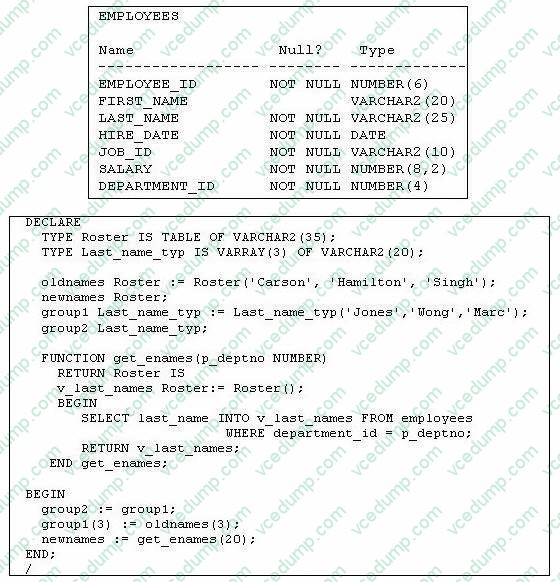
View Exhibit2 and examine the code in the PL/SQL block.
The PL/SQL block fails to execute.
What could be the reason?
A. Nested tables cannot be returned by a function.
B. The NEWNAMES nested table has not been initialized.
C. The assignment operator cannot be used to transfer all the element values from GROUP1 to GROUP2.
D. The third element of OLDNAMES cannot be assigned to the third element of GROUP1 because they are of inconsistent data types.
E. LAST_NAME values cannot be assigned to the V_LAST_NAMES nested table because local collection types are not allowed in SQL statements. -
Question 30:
Examine the structure of the TEST_DETAILS table: Name Null? Type
TEST_ID NUMBER
DESCRIPTION CLOB
DESCRIPTION data was entered earlier and saved for TEST_ID 12.
You execute this PL/SQL block to add data to the end of the existing data in the DESCRIPTION
column for TEST_ID 12:
DECLARE
clob_loc CLOB;
buf CHAR(12);
BEGIN
SELECT description INTO clob_loc FROM test_details WHERE test_id = 12 ;
buf := '0123456789';
DBMS_LOB.WRITEAPPEND(clob_loc,DBMS_LOB.GETLENGTH(buf), buf); COMMIT;
END;
/
It generates an error on execution.
What correction should you do to achieve the required result?
A. WRITEAPPEND must be replaced with APPEND.
B. The BUF variable data type must be changed to CLOB.
C. FOR UPDATE must be added to the SELECT statement.
D. The GETLENGTH routine must be replaced with the LENGTH built-in function in WRITEAPPEND.
Related Exams:
-
1Z0-020
Oracle8i: New Features for Administrators -
1Z0-023
Architecture and Administration -
1Z0-024
Performance Tuning -
1Z0-025
Backup and Recovery -
1Z0-026
Network Administration -
1Z0-034
Upgrade Oracle9i/10g OCA to Oracle Database OCP -
1Z0-036
Managing Oracle9i on Linux -
1Z0-041
Oracle Database 10g: DBA Assessment -
1Z0-052
Oracle Database 11g: Administration Workshop I -
1Z0-053
Oracle Database 11g: Administration II
Tips on How to Prepare for the Exams
Nowadays, the certification exams become more and more important and required by more and more enterprises when applying for a job. But how to prepare for the exam effectively? How to prepare for the exam in a short time with less efforts? How to get a ideal result and how to find the most reliable resources? Here on Vcedump.com, you will find all the answers. Vcedump.com provide not only Oracle exam questions, answers and explanations but also complete assistance on your exam preparation and certification application. If you are confused on your 1Z0-146 exam preparations and Oracle certification application, do not hesitate to visit our Vcedump.com to find your solutions here.