1Z0-146 Exam Details
-
Exam Code
:1Z0-146 -
Exam Name
:Oracle Database 11g: Advanced PL/SQL -
Certification
:Oracle Certifications -
Vendor
:Oracle -
Total Questions
:136 Q&As -
Last Updated
:Dec 09, 2021
Oracle 1Z0-146 Online Questions & Answers
-
Question 91:
View the Exhibit and examine the code in the PL/SQL block.
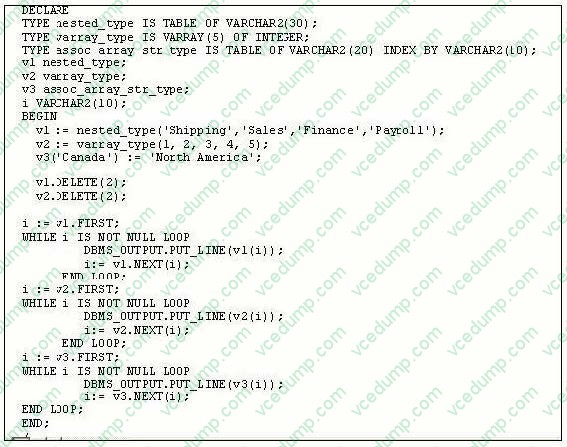
The PL/SQL block generates an error on execution. What is the reason?
A. The DELETE(n) method cannot be used with varrays.
B. The DELETE(n) method cannot be used with nested tables.
C. The NEXT method cannot be used with an associative array with VARCHAR2 key values.
D. The NEXT method cannot be used with a nested table from which an element has been deleted. -
Question 92:
You executed this command to gather information about the memory allocation for storing query results:
SQL> execute dbms_result_cache.memory_report
View the Exhibit and examine the output for the execution of the
DBMS_RESULT_CACHE.MEMORY_REPORT procedure.
Which two statements are true about the output in the Exhibit? (Choose two.)
A. In total, four blocks are used by the result cache.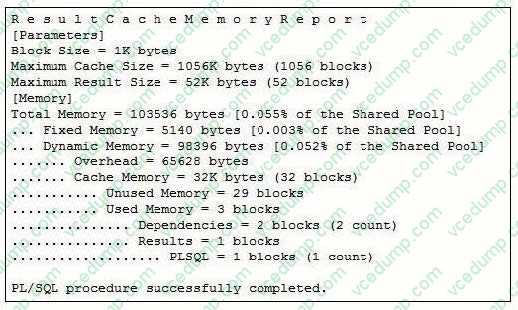
B. Currently 52 KB is allocated to the result cache.
C. Currently 32 KB is allocated to the result cache.
D. The result cache can be increased by 65628 bytes. -
Question 93:
View the Exhibit.
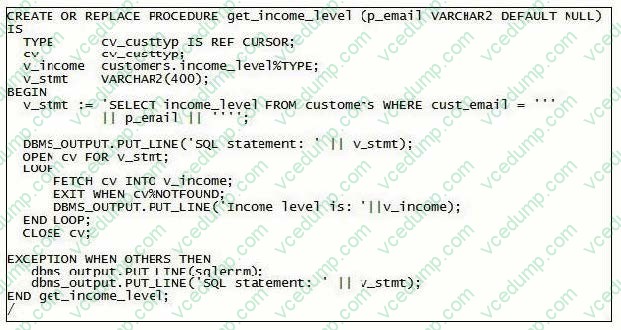
How do you reduce the chances of SQL injection for the procedure?
A. Execute the SQL statement in V_STMT as dynamic SQL.
B. Remove the default value for the arguments in the procedure.
C. Convert the condition in the WHERE clause to be accepted from the user and concatenated.
D. Convert the SELECT statement to static SQL, placing the value of P_EMAIL into a local variable. -
Question 94:
In a user session, tracing is enabled as follows:
SQL> EXECUTE
DBMS_TRACE.SET_PLSQL_TRACE(DBMS_TRACE.TRACE_ENABLED_LINES);
PL/SQL procedure successfully completed.
You executed the procedure as follows:
SQL> EXECUTE PROC10
PL/SQL procedure successfully completed.
When you examine the PLSQL_TRACE_EVENTS table, you find that no trace information was written into it.
View the Exhibit.
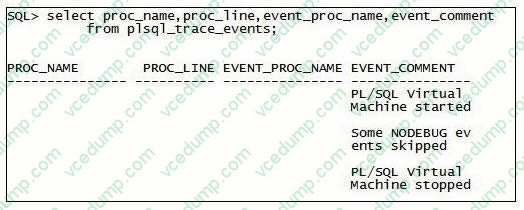
What is the reason for this?
A. The PROC10 procedure is created with the invoker's right.
B. The PROC10 procedure is not compiled with the DEBUG option.
C. Tracing is not enabled with the TRACE_ENABLED_CALLS option.
D. The TRACE_ENABLED parameter is set to FALSE for the session. -
Question 95:
Which two statements correctly describe the features of SecureFiles? (Choose two.)
A. Compression is performed only on the server side and enables random reads and writes to LOB data.
B. Deduplication stores identical data, which occurs in a LOB column in each row, as a single copy within the LOB.
C. Compression can be performed on the client side and it enables random and sequential reads and writes to LOB data.
D. Deduplication stores identical data occurring two or more times in the same LOB column as a single copy for the table. -
Question 96:
Identify two methods for immunizing PL/SQL code against SQL injection attacks. (Choose two.)
A. Use bind arguments.
B. Validate all input concatenated to dynamic SQL.
C. Use dynamic SQLs constructed using concatenation of input values.
D. Use subprograms as part of packages instead of stand-alone subprograms. -
Question 97:
Which two statements are true about the context of an application? (Choose two.)
A. It is attached to a session.
B. It is owned by the user SYS.
C. A user can change the context of his or her application.
D. The PL/SQL package associated with the context must exist before the context is created.
E. The predefined attributes in the USERENV application context can be changed as per the requirements. -
Question 98:
View the Exhibit to examine the PL/SQL code for the GET_METADATA function.
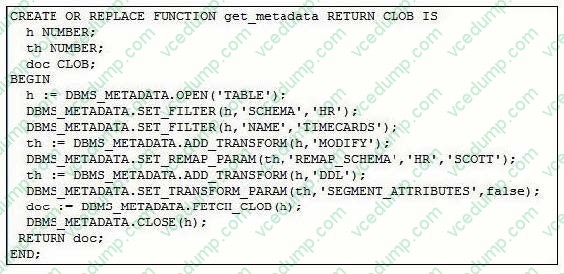
Which statement is true about the metadata gathered by the function?
A. The end result is the creation of DDL for the TIMECARDS table with all instances of the HR schema changed to SCOTT.
B. The end result is the creation of an XML document for all tables with all physical, storage, logging, and other segment attributes.
C. The end result is the creation of DDL for all tables with all instances of the HR schema changed to SCOTT along with all physical, storage, logging, and other segment attributes.
D. The end result is the creation of DDL for all tables and associated indexes with all instances of the HR schema changed to SCOTT along with all physical, storage, logging, and other segment attributes. -
Question 99:
View Exhibit1 and examine the structure of the EMPLOYEES and DEPARTMENTS tables existing in your schema.
View Exhibit2 and examine the PL/SQL block that you execute to display the department-wise incremented salary for all the departments in your company.
The code generates an error on execution.
What correction should be done to ensure the code executes successfully?
A. The cursor variable parameter should be passed in IN OUT mode.
B. The cursor variable should be defined as a strong REF CURSOR type.
C. The cursor variable name passed as actual and formal parameters should be identical.
D. The %NOTFOUND cursor attribute cannot be used with the cursor variables and should be replaced with a user defined exception. -
Question 100:
View the Exhibit and examine the structure of the EMPLOYEES table.
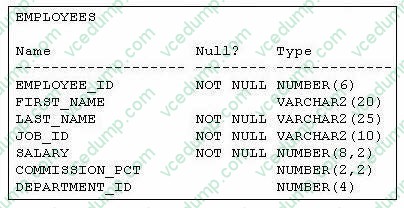
Examine the following PL/SQL block for storing the salary of all sales representatives from the EMPLOYEES table in an associative array:
1 DECLARE
2 emp_cv SYS_REFCURSOR;
3 TYPE list IS TABLE OF emp_cv;
4 sals list;
5 BEGIN
6 OPEN emp_cv FOR SELECT salary FROM employees
7 WHERE job_id = 'SA_REP';
8 FETCH emp_cv BULK COLLECT INTO sals;
9 CLOSE emp_cv;
10 END;
What should you correct in the above code to ensure that it executes successfully?
A. Replace EMP_CV in line 3 with employees.salary%TYPE.
B. Replace line 2 with TYPE refcur IS REF CURSOR; emp_cv refcur;.
C. Replace BULK COLLECT in line 8 with the OPEN, FETCH, LOOP, and CLOSE statements.
D. Replace line 2 with TYPE refcur IS REF CURSOR RETURN employees.salary%TYPE; emp_cv refcur;.
Related Exams:
-
1Z0-020
Oracle8i: New Features for Administrators -
1Z0-023
Architecture and Administration -
1Z0-024
Performance Tuning -
1Z0-025
Backup and Recovery -
1Z0-026
Network Administration -
1Z0-034
Upgrade Oracle9i/10g OCA to Oracle Database OCP -
1Z0-036
Managing Oracle9i on Linux -
1Z0-041
Oracle Database 10g: DBA Assessment -
1Z0-052
Oracle Database 11g: Administration Workshop I -
1Z0-053
Oracle Database 11g: Administration II
Tips on How to Prepare for the Exams
Nowadays, the certification exams become more and more important and required by more and more enterprises when applying for a job. But how to prepare for the exam effectively? How to prepare for the exam in a short time with less efforts? How to get a ideal result and how to find the most reliable resources? Here on Vcedump.com, you will find all the answers. Vcedump.com provide not only Oracle exam questions, answers and explanations but also complete assistance on your exam preparation and certification application. If you are confused on your 1Z0-146 exam preparations and Oracle certification application, do not hesitate to visit our Vcedump.com to find your solutions here.