1Z0-141 Exam Details
-
Exam Code
:1Z0-141 -
Exam Name
:Oracle9i forma Developer:build internet applications -
Certification
:Oracle Certifications -
Vendor
:Oracle -
Total Questions
:138 Q&As -
Last Updated
:Dec 16, 2021
Oracle 1Z0-141 Online Questions & Answers
-
Question 41:
The following On-Error trigger was written to give users a more meaningful message when they press the Up key when the cursor is in the first record (the FRM-40100 error) and to display default messages for all other errors:
IF message_code = 40100 THEN
MESSAGE('You are already at the first record');
ELSE
MESSAGE(message_type || '-' ||
to_char(message_code) || ': ' || message_text);
END IF;
When you test the form, you still get the FRM-40100 message when you press the Up key while the cursor is in the first record. Your custom message does not appear.
What corrections can you make so that the code functions properly?
A. Change all occurrences of message_code, message_type, and message_text to error_code, error_type, and error_text.
B. Eliminate the to_char function because message_code is a varchar2 value.
C. To keep the remaining code from executing, add after the second line: RAISE FORM_TRIGGER_FAILURE;
D. Change all occurrences of message_code, message_type, and message_text to DBMS_error_code, DBMS_error_type, and DBMS_error_text. -
Question 42:
You created a query Record Group at design time.
Which built-in can you use to execute the query defined in the Record Group object?
A. ADD_GROUP_ROW
B. POPULATE _GROUP
C. ADD_GROUP_COLUMN
D. SET_GROUP_SELECTION
E. CREATE_GROUP_FROM_QUERY
F. POPULATE _GROUP_WITH_QUERY -
Question 43:
An application uses a menu that contains a Check type menu item. You have programmatically obtained the menu item ID of the Check item and now you want to write code to toggle its checked/unchecked state.
Which two built-ins can you use to accomplish this? (Choose two.)
A. FIND_ITEM
B. REPLACE_MENU
C. FIND_MENU_ITEM
D. GET_ITEM_PROPERTY
E. SET_ITEM_PROPERTY
F. GET_MENU_ITEM_PROPERTY
G. SET_MENU_ITEM_PROPERTY -
Question 44:
The menu that appears by default in a Forms application does not quite meet your needs, so you decide to create a custom menu. You create and compile a menu module called Test with three submenus that contain PL/SQL code, and you attach the Test menu to a form.
How will the menu of the form appear and perform at run time?
A. You will see only the three submenus from the Test menu (plus the Window menu that is usually displayed), and you will not be able to callcode from the default menu in your form.
B. You will see the three submenus from the Test menu merged with the submenus of the default menu (plus the Window submenu that isusually displayed).
C. You will see only the submenus of the default menu (plus Window), but you will be able to call code from the Test menu in your form.
D. You will see only the Test menu submenus (plus Window), but you will be able to call code from the default menu in your form.
E. You will see only the submenus of the default menu (plus Window) until you issue the REPLACE_MENU built-in in the form. -
Question 45:
You are running a form in debug mode and you begin to step through the code of a lengthy subprogram.
After stepping through a few lines of its code, you realize that the error comes not from the code in that particular subprogram but from code that is executed after it. At this point, how can you immediately jump to the next line of code after the call to the subprogram?
A. Click Step Over to step over the execution of the subprogram.
B. Open the Stack panel, select the previous stack frame, and click Go.
C. Click Step Out to resume stepping through code after the subprogram is called.
D. You cannot do this in the same debug session. Click Stop, set a breakpoint immediately after the subprogram code is called, and run the formin debug mode again. -
Question 46:
View the Exhibit.
You have created a menu for the Summit Office Supply application that you attach to its main form.
The menu, whose Menu Editor is shown in the exhibit, contains several submenus:
Applications, displaying a choice of forms to invoke
Customers, displaying menu items for the Customers form Orders, displaying menu items for the Orders form
HR, displaying menu items for the HR form
The Main Menu property for the menu is set to Applications.
When the user chooses from the Applications submenu to invoke another form, which built-in can you use to display the appropriate menu items for that form?
A. FIND_MENU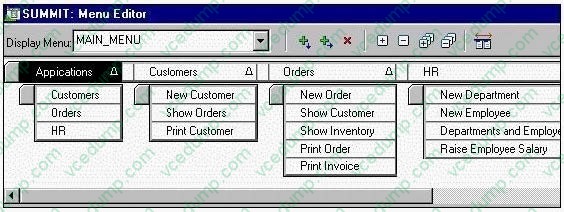
B. REPLACE_MENU
C. FIND_MENU_ITEM
D. SET_FORM_PROPERTY
E. SET_MENU_ITEM_PROPERTY -
Question 47:
You created a LOV based upon a three-column Record Group called CUST, which was created at design time.
View the Exhibit and examine the structure of the CUST Record Group.
At run time, the user sometimes requires the LOV to be populated from the PROD Record Group.
Which two built-ins will enable you to create the PROD Record Group and repopulate the LOV? (Choose two.)
A. RETRIEVE_LIST(lov_id, 'PROD');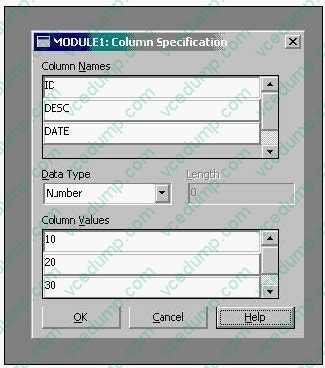
B. POPULATE_LIST(lov_id, 'PROD');
C. SET_LOV_PROPERTY(lov_id,GROUP_NAME,'PROD');
D. CREATE_GROUP_FROM_QUERY ('PROD','SELECT P_id, '||' date_sold as Date, Name as Desc '||' from products ' );
E. CREATE_GROUP_FROM_QUERY ('PROD','SELECT P_id as ID, '||' Name as Desc, date_sold as Date '||' from products ' );
F. CREATE_GROUP_FROM_QUERY ('PROD','SELECT rownum as Index, P_id as ID, '||' Name as Desc, date_sold as Date '||' from products ' ); -
Question 48:
View the Exhibit and examine the form.
The Orders form consists of a single-record master block (ORDERS) and a multirecord detail block (ORDER_ITEMS). Form-level triggers have been defined as shown in the exhibit. At run time, the focus is in the Sales Rep Id Text Item in the Orders block when the user selects a check box in the ORDER_ITEMS block that has its Mouse Navigate property set to Yes.
In what sequence will the triggers fire?
A. Pre-Form, Pre-Block, When-New-Block-Instance, Pre-Record, When-New-Item-Instance, Pre-Text-Item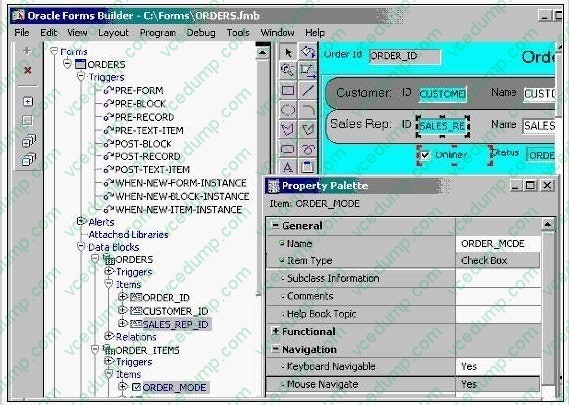
B. Post-Text-Item, Post-Record, Post-Block, Pre-Block, Pre-Record, Pre-Text-Item
C. Post-Record, Post-Block, Pre-Record, Pre-Block, When-New-Block-Instance, Pre-Text-Item, When-New-Item-Instance
D. Post-Text-Item, Post-Record, Post-Block, Pre-Block, Pre-Record, Pre-Text-Item,When-New-Block-Instance, When-New-Item-Instance
E. Post-Text-Item, Pre-Record, Pre-Block, Post-Block, Post-Record, When-New-Item-Instance
F. Post-Block, Pre-Form, Pre-Block, Pre-Record, Pre-Text-Item, When-New-Item-Instance -
Question 49:
View the Exhibit.
The Credit_Rating item in the Customers block of an Order Entry form must be restricted to three possible values: Good, Poor, or Null (the latter value indicates that the credit rating has not been determined). Order entry clerks must be able to update this item to any of these three values.
You want to change the item to a check box labeled "Credit Risk" that should be selected if the customer has poor credit. The check box should not be selected if the customer's credit rating is good or undetermined.
You change the item type to Check Box and set other properties as shown in the exhibit, then run your form and insert three records: two with good credit and the check box clear, and one with poor credit and the check box selected. You commit the data and query the records, with the following result set:
CUST_ID LAST_NAME FIRST_NAME CREDIT_RATING ------------ ------------------ ------------------- ------------------------------ 1001 Gamer Pam 1002 Wallace Sheila 1003 Maslen Glenn Poor
The first two records show an undetermined credit rating, although your intention was to set the value to Good for those customers. What change must you make in the properties of the Credit_Rating item to enable values of Good, Poor, and Null to be entered?
A. Change the Initial Value property to Good.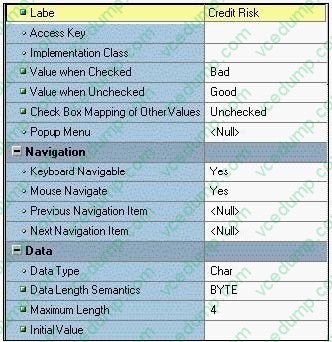
B. Change the Check Box Mapping of Other Values property to Not Allowed.
C. Change the Initial Value property to Good and the Value When Unchecked property to Null.
D. Change the Initial Value property to Good and the Check Box Mapping of Other Values property to Null.
E. Change the Initial Value property to Good and the Check Box Mapping of Other Values property to Checked.
F. Change the item type. It is not appropriate to use a check box to enable entry and update of more than two values in an item. -
Question 50:
You should enable the user to add additional values to a list item at run time. You must also ensure that the Record Group LOCATIONS, which is used to populate the list item, can be updated with any user-supplied value. What two actions could you take to accomplish this? (Choose two.)
A. Add a new value to the list item by calling the POPULATE_LIST built-in.
B. Add a new value to LOCATIONS by calling the POPULATE_GROUP built-in.
C. Add a new value to the list item by calling the ADD_LIST_ELEMENT built-in.
D. Remove duplicate values in LOCATIONS by calling the DELETE_LIST_ELEMENT built-in.
E. Add a new value to LOCATIONS by calling the ADD_GROUP_ROW and SET_GROUP_CHAR_CELL built-ins.
F. Add a new value to LOCATIONS by calling the ADD_GROUP_ROW and SET_GROUP_NUMBER_CELL built-ins.
Related Exams:
-
1Z0-020
Oracle8i: New Features for Administrators -
1Z0-023
Architecture and Administration -
1Z0-024
Performance Tuning -
1Z0-025
Backup and Recovery -
1Z0-026
Network Administration -
1Z0-034
Upgrade Oracle9i/10g OCA to Oracle Database OCP -
1Z0-036
Managing Oracle9i on Linux -
1Z0-041
Oracle Database 10g: DBA Assessment -
1Z0-052
Oracle Database 11g: Administration Workshop I -
1Z0-053
Oracle Database 11g: Administration II
Tips on How to Prepare for the Exams
Nowadays, the certification exams become more and more important and required by more and more enterprises when applying for a job. But how to prepare for the exam effectively? How to prepare for the exam in a short time with less efforts? How to get a ideal result and how to find the most reliable resources? Here on Vcedump.com, you will find all the answers. Vcedump.com provide not only Oracle exam questions, answers and explanations but also complete assistance on your exam preparation and certification application. If you are confused on your 1Z0-141 exam preparations and Oracle certification application, do not hesitate to visit our Vcedump.com to find your solutions here.