1Z0-141 Exam Details
-
Exam Code
:1Z0-141 -
Exam Name
:Oracle9i forma Developer:build internet applications -
Certification
:Oracle Certifications -
Vendor
:Oracle -
Total Questions
:138 Q&As -
Last Updated
:Dec 16, 2021
Oracle 1Z0-141 Online Questions & Answers
-
Question 1:
The Warehouse.fmb module contains two data blocks. You want to display items from each data block on separate content canvases. You must ensure that both content canvases are visible together at run time. Which two statements about content canvases are correct? (Choose two.)
A. A window cannot display more than one content canvas during a run time session.
B. A content canvas can be associated with a window by setting the Window property of the canvas.
C. Two or more content canvases can be displayed by associating each of them with a different window.
D. A content canvas can be associated with a window by setting the Primary Canvas property of the window.
E. A content canvas can be associated with two or more windows by setting the Primary Canvas property of the windows.
F. Two or more content canvases can be displayed by setting their viewports to be smaller than the window with which they are to be associated. -
Question 2:
View the Exhibit.
You are developing an account management system for First National Bank. The Layout Editor for the Customer form is shown in the exhibit.
The three buttons on the form invoke separate forms to enter deposits and withdrawals for the customer's checking, savings, and money market accounts. Often deposits and withdrawals to these accounts are accomplished as part of a
single transaction, so they must all be committed together or all rolled back if the commit fails.
How should you code the Checking button?
A. OPEN_FORM('Checking');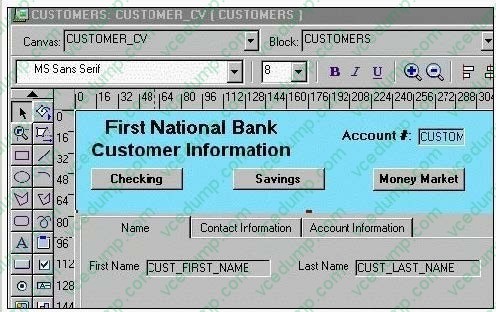
B. OPEN_FORM('Checking',SESSION);
C. OPEN_FORM('Checking',SESSION,ACTIVATE);
D. OPEN_FORM('Checking',SESSION,NO_ACTIVATE); -
Question 3:
You have been asked to define a data block based on a JOIN of multiple tables. The read-only data will be used for calculations and lookups. The DBA is on holiday and is unable to define a view on the database server.
What is the simplest way for you to continue to build the form?
A. Define a data block based on a Ref Cursor.
B. Define a data block based on a Table of Records.
C. Define a data block based on a From Clause query.
D. Define a data block based on a combination of a Ref Cursor and a Table of Records.
E. Define a data block based on a Ref Cursor and define Transactional triggers for controlling DML statements. -
Question 4:
View the Exhibit to examine the form.
The text items (Field1, Field2, and Field3) and the button (Check_Values) are in the CONTROL block. The Mouse Navigate property of the button has been set to No.
The following code has been written in a When-Button-Pressed trigger on the Check_Values button:
MESSAGE(:field1||' - '||:SYSTEM.cursor_item||
' - '||:SYSTEM.trigger_item);
With the focus in Field1, and the values 1, 2 and 3 in the text items, what message will be displayed when the button is pressed?
A. -4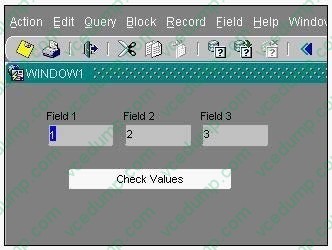
B. 1 - 2 - 3
C. 1 - field1 - Check Values
D. field1 - 1 - Check Values
E. 1 - CONTROL.FIELD1 - CONTROL.FIELD1
F. 1 - CONTROL.FIELD1 - CONTROL.CHECK_VALUES
G. :field1 - :SYSTEM.cursor_item - :SYSTEM.trigger_item -
Question 5:
Which three statements best describe a Ref Cursor in Forms Builder? (Choose three.)
A. A stored procedure that uses a Ref Cursor can be used only as a query datasource for a data block.
B. A stored procedure that uses a Ref Cursor can be used only as a DML datasource for a data block.
C. A stored procedure that uses a Ref Cursor can be used as both a query and a DML datasource for a data block.
D. A Ref Cursor is ideal for queries that are dependent only on PL/SQL, and not SQL statements.
E. A Ref Cursor enables you to query multiple tables and encapsulate logic in a PL/SQL subprogram.
F. A Ref Cursor is used by a stored procedure to return data to a data block. -
Question 6:
In the Orders form you define five LOVs, and you create one button to be used to display any of the LOVs.
The button is enabled only when the user navigates to a field with an attached LOV. If the user supplies only part of the required input data, the LOVs use that input as search criteria to automatically reduce the LOV contents. If the LOVs hold
only one value that can possibly match user-supplied input, then the LOVs auto-complete the input field and are not displayed.
Which built-in and properties should you use to display the LOVs?
A. Use the List_Values(RESTRICT) built-in, and set the Mouse Navigate property value to NO.
B. Use the List_Values(RESTRICT) built-in, and set the Mouse Navigate property value to YES.
C. Use the List_Values(NO_RESTRICT) built-in, and set the Mouse Navigate property value to NO.
D. Use the List_Values(NO_RESTRICT) built-in, and set the Mouse Navigate property value to YES.
E. Use the Show_LOV built-in, and set the Mouse Navigate property value to YES.
F. Use the Show_LOV built-in, and set the Mouse Navigate property value to NO. -
Question 7:
You designed a standard toolbar to accompany a number of forms so the code behind the buttons is written as generically as possible.
One of the features of this toolbar is that the buttons are synchronized with the state of the form. To achieve this functionality, you wrote generic procedures that are placed in an attached library and are called from various triggers.
For example, if the form is in Enter-Query mode, the procedure set_enter_query_mode will disable the Enter Query button, change the icon for the Exit button, and modify its Tooltip to read "Cancel Query" rather than "Exit".
What must you code to support this approach?
A. Form-level When-Button-Pressed triggers for each button to call the generic procedures. For example, a form-level trigger on the Enter Querybutton has the following code:set_enter_query_mode;
B. Item-level Key triggers for each button as well as item-level When-Button-Pressed triggers for each button to call the generic procedures. Forexample, the When-Button-Pressed trigger on the Enter Query button has the following code:set_enter_query_mode;The Key-Entqry trigger on the Enter-Query button has the following code:set_enter_query_mode;
C. Block-level Key triggers that call the generic procedures and item-level When-Button-Pressed triggers that call the EXECUTE_TRIGGER()built-in and pass the name of the button as a parameter. For example, the Key-Entqry trigger has the following code:set_enter_query_mode;The When-Button-Pressed trigger on the Enter Query button has the following code:EXECUTE_TRIGGER ('ENTER_QUERY');
D. Form-level Key triggers that call the generic procedures and item-level When-Button-Pressed triggers that call the DO_KEY() built-in. Forexample, Key-Entqry has the following code:set_enter_query_mode;The When-Button-Pressed trigger on the Enter Query button has the following code:DO_KEY('ENTER_QUERY'); -
Question 8:
You are developing a Human Resources form with a single block to display employees. For each employee, you look up the department name to display in a non-base-table item.
When you test the form, you discover that when you enter a new employee as the first employee in a new department that has not yet been created in the database, you get the following error when you try to navigate out of the
Department_Id item:
FRM-40735: WHEN-VALIDATE-ITEM trigger raised unhandled exception ORA-01403.
The ORA-01403 exception is the NO_DATA_FOUND exception. When this message is received, you cannot navigate out of the Department_Id item.
You add the following code to the When-Validate-Item trigger on the Department_Id item to display a meaningful message to the user:
EXCEPTION
WHEN NO_DATA_FOUND THEN
MESSAGE('You must create the department before adding employees to it');
You run the form again to test it, and you enter a new employee and a department ID that does not exist in the database. When you click into the Employee_Name item, the appropriate message is displayed, but the cursor moves to
Employee_Name.
What must you change so that the user will not be able to navigate out of the Department_Id item when entering a department ID that is not in the database?
A. If you write a handler for the exception, you will not be able to stop navigation from occurring, so you should put the following code in anOn-Error trigger instead:IF ERROR_CODE = 40735 THENMESSAGE('You must create the department before adding employees to it');END IF;
B. Add the following code at the end of the exception handler:IF DBMS_ERROR_CODE = 1403 THENRAISE FORM_TRIGGER_FAILURE;END IF;
C. Add the following line at the end of the exception handler:RAISE FORM_TRIGGER_FAILURE;
D. If you write a handler for the exception, you will not be able to stop navigation from occurring. Instead, create a Key-Next-Item trigger on the Department_Id item with the following code:NEXT_ITEM;IF NOT FORM_SUCCESS THENMESSAGE('You must create the department before adding employees to it');END IF;
E. You cannot stop navigation from occurring when displaying a custom message. You should delete the exception handler and allow Forms to display the default message. -
Question 9:
You are developing a form that serves as a front end to access the Order Entry application. Within the form you want to store the usernames of those users who have permission to run the application. This information is accessed when the form starts up to determine if the user is authorized. The list of usernames is not stored in the database and should not be visible to users.
How will you store this information?
A. In a list item
B. In a list of values
C. In a set of parameters
D. In a record group
E. You cannot store this information within a form; you must create a database table to store it and query the information at run time. -
Question 10:
Which three statements best describe a Table of Records in Forms Builder? (Choose three.)
A. A Table of Records enables you to query and update multiple tables, and perform validation, on the server side.
B. A Table of Records is not efficient in terms of network traffic, because multiple round trips are required for all the records to be returned.
C. Array processing cannot be used when a data block is based on a stored procedure that returns a Table of Records.
D. A stored procedure that uses a Table of Records can be used only as a DML block datasource.
E. A stored procedure that uses a Table of Records can be used as both a query and DML block datasource.
F. A stored procedure that uses a Table of Records can be used only as a query block datasource.
Related Exams:
-
1Z0-020
Oracle8i: New Features for Administrators -
1Z0-023
Architecture and Administration -
1Z0-024
Performance Tuning -
1Z0-025
Backup and Recovery -
1Z0-026
Network Administration -
1Z0-034
Upgrade Oracle9i/10g OCA to Oracle Database OCP -
1Z0-036
Managing Oracle9i on Linux -
1Z0-041
Oracle Database 10g: DBA Assessment -
1Z0-052
Oracle Database 11g: Administration Workshop I -
1Z0-053
Oracle Database 11g: Administration II
Tips on How to Prepare for the Exams
Nowadays, the certification exams become more and more important and required by more and more enterprises when applying for a job. But how to prepare for the exam effectively? How to prepare for the exam in a short time with less efforts? How to get a ideal result and how to find the most reliable resources? Here on Vcedump.com, you will find all the answers. Vcedump.com provide not only Oracle exam questions, answers and explanations but also complete assistance on your exam preparation and certification application. If you are confused on your 1Z0-141 exam preparations and Oracle certification application, do not hesitate to visit our Vcedump.com to find your solutions here.