
1Z0-1085-24 Real Exam Questions

Oracle Cloud Infrastructure 2024 Foundations Associate

139 questions available · Page 1 of 14

Updated Exam DumpsVerified AnswersPass Guarantee

Get Complete Exam Dumps
Question 1 Single choice

Which pricing model is NOT supported by Oracle Cloud Infrastructure?

  1. A

    Reserved Infrastructure

  2. B

    Universal Credits - Monthly Flex

  3. C

    Bring your own license

  4. D

    Pay-as-you-go

Show answer and explanation

Correct answer: A

Explanation

The available purchase models are:

Pay As You Go (PAYG): Billed in arrears based on consumption. Recommended for organizations who are trying new services, rapid prototyping, or for elastic scaling.

Monthly Flex:
Billed in advance with a 12-month minimum. Use monthly or forfeit that month's credits.

Recommended for customers with predictable production workloads or large long-running applications, such as HR, payroll, analytics, and more.

Monthly Flex maximizes cost reduction with predictable monthly spend, similar to your monthly phone plan.
Delivers faster time to market by offering customers the choice of using any IaaS and PaaS services.
Oracle's current PaaS offering is "license-included PaaS." It includes:
1. Compute and compute support
2. Automation 3. License entitlement and license support

Bring your own license
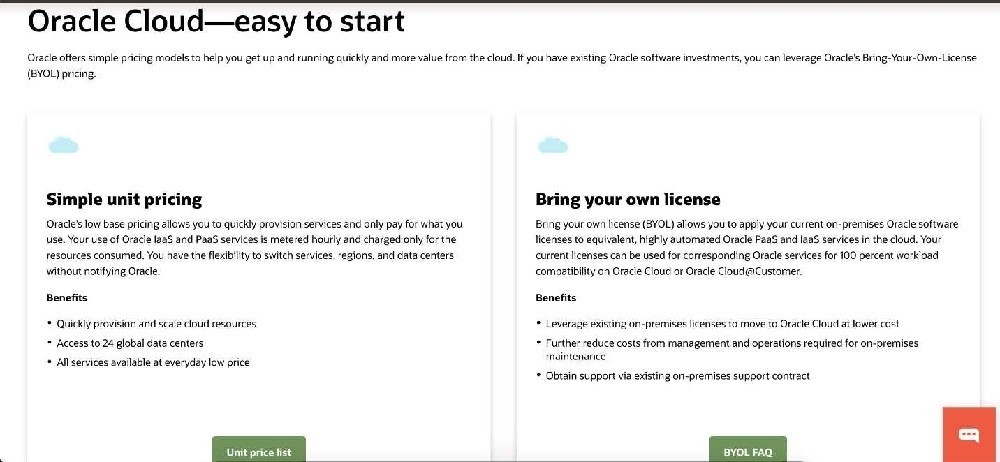
BYOL stands for "bring your own license." Previously, you could bring your own licenses to Oracle IaaS, but to get the benefits of PaaS automation, you couldn't leverage existing licenses. This has been changed. We're offering Oracle BYOL to PaaS, enabling our customers to leverage their investment in existing on-premises licenses in their journey to the cloud.
Oracle BYOL to PaaS includes:
1. Compute and compute support
2. Automation 3. Customers bring their on-premises license entitlement and get license support via their existing on-premises support contract.
4. As customers leverage their existing on-premises license entitlement, they can move to the cloud at a lower cost.

References:
https://www.oracle.com/in/cloud/bring-your-own-license/faq/universal-credit-pricing.html
OCI doesn't offer Reserved instances. Enterprise users and technology vendors alike require cost predictability to plan their budgets and run their business. The cost for running applications, databases, and large workloads in the cloud can be extremely difficult to forecast leading to unforeseen expenses. Not with Oracle Cloud. Oracle has simple rate structures that eliminate the cost surprises associated with hard-to-estimate usage elements like data egress and storage performance. Oracle also charges the same rates for all regions, so going global on Oracle Cloud means no hidden cost variances. Thus, Oracle's cloud will provide you with industry leading price-performance and tremendous business value.
References:
https://www.oracle.com/in/cloud/pricing.html
Question 2 Single choice

What service is NOT available as part of Oracle Cloud Free Tier?

  1. A

    Oracle Cloud Infrastructure Monitoring

  2. B

    Oracle Cloud Infrastructure Exadata DB Systems

  3. C

    Oracle Cloud Infrastructure Autonomous Data Warehouse

  4. D

    Oracle Cloud Infrastructure Compute

Show answer and explanation

Correct answer: B

Explanation

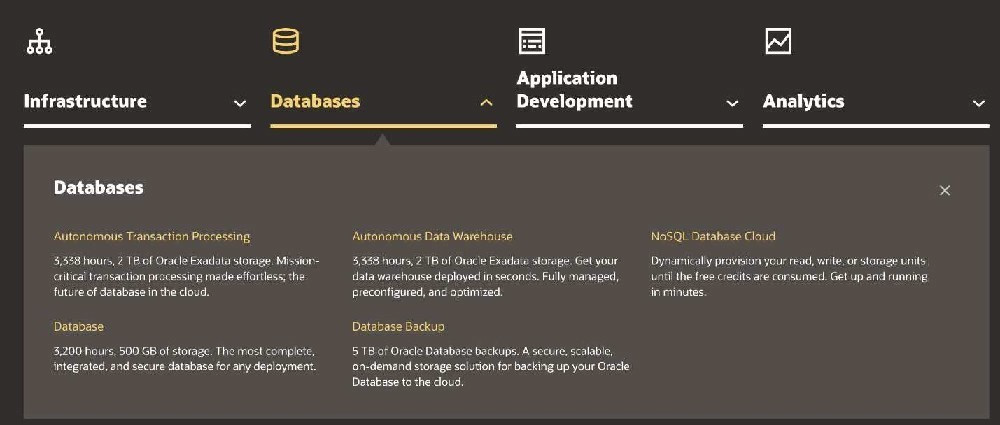
For more information on Oracle Cloud Infrastructure Free Tier refer below official documentation https://docs.cloud.oracle.com/en-us/iaas/Content/FreeTier/freetier.htm?Highlight=Free%20Tier Exadata
DB Systems aren't a part of the free tier:

References:
https://www.oracle.com/in/cloud/free/

Question 3 Single choice

Which type of workload is NOT suitable for using the Oracle Cloud Infrastructure File Storage service?

  1. A

    Big data and analytics

  2. B

    Media processing

  3. C

    Content management

  4. D

    Running small personal websites

Show answer and explanation

Correct answer: D

Explanation

Running small personal websites typically do not require the scalability and performance capabilities provided by Oracle Cloud Infrastructure File Storage service. It may be more cost-effective and efficient to use other storage solutions for such workloads.

Question 4 Single choice

Which component of the Oracle Cloud Infrastructure Networking service allows resources in a VCN to access Oracle Cloud services without traversing the public Internet?

  1. A

    Network Address Translation (NAT) Gateway

  2. B

    Dynamic Routing Gateway (DRG)

  3. C

    Service Gateway

  4. D

    Internet Gateway

Show answer and explanation

Correct answer: C

Explanation

A Service Gateway provides secure access to Oracle Cloud services from within a VCN without the need to traverse the public Internet. It facilitates private and efficient communication between resources and cloud services.

Question 5 Single choice

Which describes a key benefit of using Oracle Cloud Infrastructure (OCI)?

  1. A

    With OCI, you can only run Java based workloads on bare metal.

  2. B

    With OCI, you can run only cloud-native workloads.

  3. C

    Only bare metal workloads are supported on OCI.

  4. D

    OCI offers consistent performance with a predictable pricing model.

Show answer and explanation

Correct answer: D

Explanation

https://www.oracle.com/in/cloud/pricing.html
- OCI offers consistent performance with a predictable pricing model - is the best suited answer.
- Only bare metal workloads are supported in OCI - False, since you can work with VMs etc too
- With OCI, you can run cloud native workloads - False, since you can work with on-premise by connecting it to OCI too.
- With OCI, you can only run Java based workloads on bare metal - False since Java is not the only programming language supported by OCI.

Question 6 Single choice

Which should you use to distribute Incoming traffic between a set of web servers?

  1. A

    Load Balances

  2. B

    Internet Gateway

  3. C

    Autoscallng

  4. D

    Dynamic Routing Gateway

Show answer and explanation

Correct answer: A

Explanation

The Oracle Cloud Infrastructure Load Balancing service provides automated traffic distribution from one entry point to multiple servers reachable from your virtual cloud network (VCN). The service offers a load balancer with your choice of a public or private IP address, and provisioned bandwidth. A load balancer improves resource utilization, facilitates scaling, and helps ensure high availability. You can configure multiple load balancing policies and application-specific health checks to ensure that the load balancer directs traffic only to healthy instances. The load balancer can reduce your maintenance window by draining traffic from an unhealthy application server before you remove it from service for maintenance.
HOW LOAD BALANCING WORKS:
The Load Balancing service enables you to create a public or private load balancer within your VCN. A public load balancer has a public IP address that is accessible from the internet. A private load balancer has an IP address from the hosting subnet, which is visible only within your VCN. You can configure multiple listeners for an IP address to load balance transport Layer 4 and Layer 7 (TCP and HTTP) traffic. Both public and private load balancers can route data traffic to any backend server that is reachable from the VCN.
1) Public Load Balancer
To accept traffic from the internet, you create a public load balancer. The service assigns it a public IP address that serves as the entry point for incoming traffic. You can associate the public IP address with a friendly DNS name through any DNS vendor.
A public load balancer is regional in scope. If your region includes multiple availability domains, a public load balancer requires either a regional subnet (recommended) or two availability domain-specific (AD-specific) subnets, each in a separate availability domain. With a regional subnet, the Load Balancing service creates a primary load balancer and a standby load balancer, each in a different availability domain, to ensure accessibility even during an availability domain outage. If you create a load balancer in two AD-specific subnets, one subnet hosts the primary load balancer and the other hosts a standby load balancer. If the primary load balancer fails, the public IP address switches to the secondary load balancer.
The service treats the two load balancers as equivalent and you cannot specify which one is "primary".
Whether you use regional or AD-specific subnets, each load balancer requires one private IP address from its host subnet. The Load Balancing service supplies a floating public IP address to the primary load balancer. The floating public IP address does not come from your backend subnets. If your region includes only one availability domain, the service requires just one subnet, either regional or AD-specific, to host both the primary and standby load balancers. The primary and standby load balancers each require a private IP address from the host subnet, in addition to the assigned floating public IP address. If there is an availability domain outage, the load balancer has no failover.
2) Private Load Balancer
To isolate your load balancer from the internet and simplify your security posture, you can create a private load balancer. The Load Balancing service assigns it a private IP address that serves as the entry point for incoming traffic. When you create a private load balancer, the service requires only one subnet to host both the primary and standby load balancers. The load balancer can be regional or AD-specific, depending on the scope of the host subnet. The load balancer is accessible only from within the VCN that contains the host subnet, or as further restricted by your security rules. The assigned floating private IP address is local to the host subnet. The primary and standby load balancers each require an extra private IP address from the host subnet. If there is an availability domain outage, a private load balancer created in a regional subnet within a multi-AD region provides failover capability. A private load balancer created in an AD-specific subnet, or in a regional subnet within a single availability domain region, has no failover capability in response to an availability domain outage.
References:
https://docs.cloud.oracle.com/en-us/iaas/Content/Balance/Concepts/balanceoverview.htm

Question 7 Single choice

Where are cryptographic operations performed for a Vault Master Encryption Key protected by a Hardware Security Module (HSM)?

  1. A

    On the client

  2. B

    On the HSM

  3. C

    On the cloud

  4. D

    On the server

Show answer and explanation

Correct answer: B

Explanation

Cryptographic operations for a Vault Master Encryption Key protected by an HSM are performed directly on the HSM. The HSM is a specialized hardware device designed to securely generate, store, and perform cryptographic operations, ensuring the confidentiality and integrity of the encryption keys.

Question 8 Multiple choice

Which three components are part of Oracle Cloud Infrastructure Identity and Access Management service?

  1. A

    Virtual Cloud Networks

  2. B

    Policies

  3. C

    Regional Subnets

  4. D

    Dynamic Groups

  5. E

    Roles

  6. F

    Compute Instances

  7. G

    Users

Show answer and explanation

Correct answers: B, D, G

Explanation

IAM components are
RESOURCE
The cloud objects that your company's employees create and use when interacting with Oracle Cloud Infrastructure. For example: compute instances, block storage volumes, virtual cloud networks (VCNs),
subnets, route tables, etc.
USER
An individual employee or system that needs to manage or use your company's Oracle Cloud Infrastructure resources. Users might need to launch instances, manage remote disks, work with your virtual cloud network, etc. End users of your application are not typically IAM users. Users have one or more IAM credentials (see User Credentials).
POLICY
A document that specifies who can access which resources, and how. Access is granted at the group and compartment level, which means you can write a policy that gives a group a specific type of access within a specific compartment, or to the tenancy itself. If you give a group access to the tenancy, the group automatically gets the same type of access to all the compartments inside the tenancy. For more information, see Example Scenario and How Policies Work. The word "policy" is used by people in different ways: to mean an individual statement written in the policy language; to mean a collection of
statements in a single, named "policy" document (which has an Oracle Cloud ID (OCID) assigned to it);
and to mean the overall body of policies your organization uses to control access to resources.
GROUP
A collection of users who all need the same type of access to a particular set of resources or compartment.
DYNAMIC GROUP
A special type of group that contains resources (such as compute instances) that match rules that you define (thus the membership can change dynamically as matching resources are created or deleted).
These instances act as "principal" actors and can make API calls to services according to policies that you write for the dynamic group.

NETWORK SOURCE
A group of IP addresses that are allowed to access resources in your tenancy. The IP addresses can be public IP addresses or IP addresses from a VCN within your tenancy. After you create the network source, you use policy to restrict access to only requests that originate from the IPs in the network source.
COMPARTMENT
A collection of related resources. Compartments are a fundamental component of Oracle Cloud Infrastructure for organizing and isolating your cloud resources. You use them to clearly separate resources for the purposes of measuring usage and billing, access (through the use of policies), and isolation (separating the resources for one project or business unit from another). A common approach is to create a compartment for each major part of your organization. For more information, see Setting Up
Your Tenancy.
TENANCY
The root compartment that contains all of your organization's Oracle Cloud Infrastructure resources. Oracle automatically creates your company's tenancy for you. Directly within the tenancy are your IAM entities (users, groups, compartments, and some policies; you can also put policies into compartments inside the
tenancy). You place the other types of cloud resources (e.g., instances, virtual networks, block storage volumes, etc.) inside the compartments that you create.
HOME REGION
The region where your IAM resources reside. All IAM resources are global and available across all regions, but the master set of definitions reside in a single region, the home region. You must make changes to your IAM resources in your home region. The changes will be automatically propagated to all regions. For more information, see Managing Regions.
FEDERATION
A relationship that an administrator configures between an identity provider and a service provider. When you federate Oracle Cloud Infrastructure with an identity provider, you manage users and groups in the identity provider. You manage authorization in Oracle Cloud Infrastructure's IAM service. Oracle Cloud Infrastructure tenancies are federated with Oracle Identity Cloud Service by default.
References:
https://docs.cloud.oracle.com/en-us/iaas/data-safe/doc/iam-components.html

Question 9 Single choice

Which Oracle Cloud Infrastructure (OCI) offering allows you to run cloud services in your owndata center while maintaining regulatory compliance?

  1. A

    Oracle Database@Azure

  2. B

    Oracle Database Service for Azure

  3. C

    OCI Dedicated Region

  4. D

    MySQL HeatWave Database Service

Show answer and explanation

Correct answer: C

Explanation

OCI Dedicated Region provides a fully managed Oracle Cloud Infrastructure region in a customer's data center, allowing them to meet regulatory compliance while running cloud services on-premises.

Question 10 Single choice

Which service is the most effective for moving large amounts of data from your on-premises to OCI?

  1. A

    Data Transfer appliance

  2. B

    Data Safe

  3. C

    Internal Gateway

  4. D

    Dynamic Routing Gateway

Show answer and explanation

Correct answer: A