1Z0-1085-20 Real Exam Questions

Oracle Cloud Infrastructure Foundations 2020 Associate

99 questions available · Page 1 of 10

Updated Exam DumpsVerified AnswersPass Guarantee

Get Complete Exam Dumps
Question 1 Multiple choice

Which two should be considered when designing a fault tolerant solution in Oracle Cloud Infrastructure (OCI)?

  1. A

    ensuring your solution components are distributed across OCI Fault Domains

  2. B

    performing data integrity check when using OCI File Storage Service

  3. C

    writing custom scripts that will monitor your solution

  4. D

    using multiple OCI Availability Domains (AD), where available, to deploy your solution

  5. E

    creating a manual cluster of compute instances

Show answer and explanation

Correct answers: A, D

Explanation

Creating a manual cluster of compute instances, and Writing custom scripts that will monitor your solution are not valid ways to ensure fault tolerance at all. Also, Performing Data Integrity check when using OCI File Storage Service is not valid since OCI takes care of it.
Therefore, we are left with:
1) Using multiple OCI Availibility Domains (AD), where available, to deploy your solution - Which is excellent because we have multiple AD's so that if one fails, we have a backup AD!
2) Ensuring your solution components are distributed across OCI Fault Domains - So that we can protect our deployment against unexpected power failures, AD failure etc.
References:
https://blogs.oracle.com/cloud-infrastructure/using-availibility-domains-and-fault-domains-to-
improve-application-resiliency

Question 2 Single choice

Which statement below is not true for Oracle Cloud infrastructure Compartments?

  1. A

    Resources can be moved from one compartment to another

  2. B

    Compartments cannot be nested

  3. C

    Each OCI resource belongs to a single compartment

  4. D

    Resources and compartments can be added and deleted anytime

Show answer and explanation

Correct answer: B

Explanation

When creating a compartment, you must provide a name for it (maximum 100 characters, including letters, numbers, periods, hyphens, and underscores) that is unique within its parent compartment. You must also provide a description, which is a non-unique, changeable description for the compartment, from 1 through 400 characters. Oracle will also assign the compartment a unique ID called an Oracle Cloud ID.
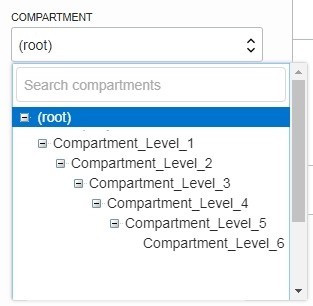
You can create subcompartments in compartments to create hierarchies that are six levels deep.

References:
https://docs.cloud.oracle.com/en-us/iaas/Content/Identity/Tasks/managingcompartments.htm
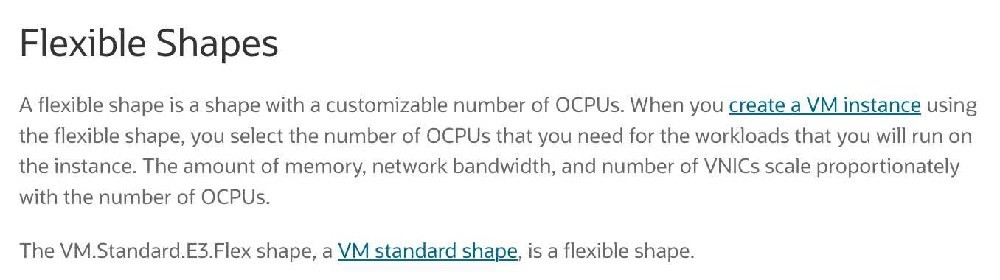
When you first start working with Oracle Cloud Infrastructure, you need to think carefully about how you want to use compartments to organize and isolate your cloud resources. Compartments are fundamental to that process. Most resources can be moved between compartments. However, it's important to think through your compartment design for your organization up front, before implementing anything. For more information, see Setting Up Your Tenancy. The Console is designed to display your resources by compartment within the current region. When you work with your resources in the Console, you must choose which compartment to work in from a list on the page. That list is filtered to show only the compartments in the tenancy that you have permission to access. If you're an administrator, you'll have permission to view all compartments and work with any compartment's resources, but if you're a user with limited access, you probably won't. Compartments are tenancy-wide, across regions. When you create a compartment, it is available in every region that your tenancy is subscribed to. You can get a cross-region view of your resources in a specific compartment with the compartment explorer. See Viewing All Resources in a Compartment. You can create subcompartments in compartments to create hierarchies that are six levels deep.
References:
https://docs.cloud.oracle.com/en-us/iaas/Content/Identity/Tasks/managingcompartments.htm
Question 3 Multiple choice

Which two situations incur costs in Oracle Cloud Infrastructure (OCI)?

  1. A

    Data ingress from the internet

  2. B

    Transferring data across regions

  3. C

    Transferring data from one instance to another in the same Availibility Domain

  4. D

    Data egress to the internet

  5. E

    Transferring data from one instance to another across different Availibility Domains in a Region

Show answer and explanation

Correct answers: B, D

Question 4 Single choice

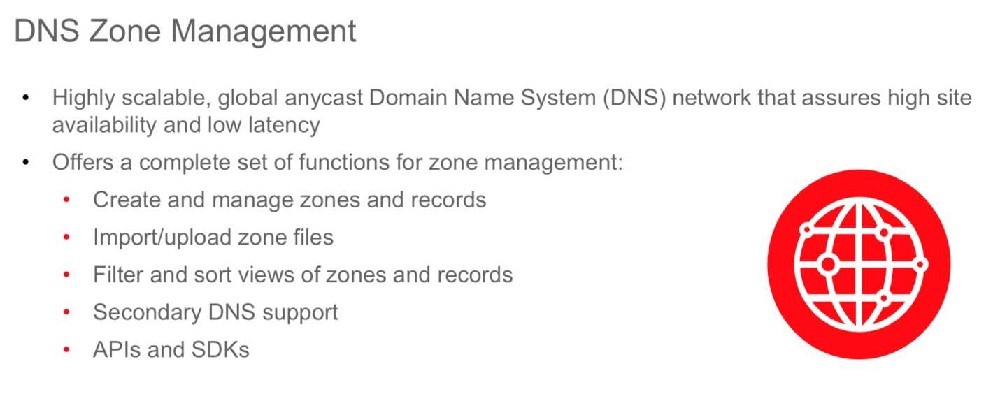
Which of the following is an example of an edge service in OCI?

  1. A

    DNS Zone Management

  2. B

    Virtual Machines

  3. C

    OCI compute instances

  4. D

    Oracle Data Guard

Show answer and explanation

Correct answer: A

Explanation

The Oracle Cloud Infrastructure Domain Name System (DNS) service lets you create and manage your DNS zones. You can create zones, add records to zones, and allow Oracle Cloud Infrastructure's edge network to handle your domain's DNS queries.

References:
https://www.oracle.com/a/ocom/docs/cloud/edge-services-100.pdf

Question 5 Single choice

A banking platform has been re-designed to a microservices based architecture using Docker containers for deployment.

Which service can you use to deploy containers on Oracle Cloud Infrastructure (OCI)?

  1. A

    Container Engine for Kubernetes (OKE)

  2. B

    Streaming Service

  3. C

    API Gateway

  4. D

    File Storage Service

Show answer and explanation

Correct answer: A

Explanation

Oracle Cloud Infrastructure Container Engine for Kubernetes is a fully-managed, scalable, and highly available service that you can use to deploy your containerized applications to the cloud. Use Container Engine for Kubernetes (sometimes abbreviated to just OKE) when your development team wants to reliably build, deploy, and manage cloud-native applications. You specify the compute resources that your applications require, and Container Engine for Kubernetes provisions them on Oracle Cloud Infrastructure in an existing OCI tenancy. Container Engine for Kubernetes uses Kubernetes - the open-source system for automating deployment, scaling, and management of containerized applications across clusters of hosts. Kubernetes groups the containers that make up an application into logical units (called pods) for easy management and discovery. You can access Container Engine for Kubernetes to define and create Kubernetes clusters using the Console and the REST API. You can access the clusters you create using the Kubernetes command line (kubectl), the Kubernetes Dashboard, and the Kubernetes API. Container Engine for Kubernetes is integrated with Oracle Cloud Infrastructure Identity and Access Management (IAM), which provides easy authentication with native Oracle Cloud Infrastructure identity functionality.

References:
https://docs.cloud.oracle.com/en-us/iaas/Content/ContEng/Concepts/contengoverview.htm

Question 6 Single choice

___________________ is a fully-managed, scalable, and highly available service that you can use to deploy your containerized applications to the cloud.

  1. A

    Oracle Cloud Infrastructure Container Engine for Kubernetes

  2. B

    Oracle Cloud Infrastructure Container Engine for Containerization

  3. C

    Oracle Cloud Infrastructure Container Engine for Deployment

  4. D

    Oracle Cloud Infrastructure Container Engine for Docker

Show answer and explanation

Correct answer: A

Explanation

Oracle Cloud Infrastructure Container Engine for Kubernetes is a fully-managed, scalable, and highly available service that you can use to deploy your containerized applications to the cloud. Use Container Engine for Kubernetes (sometimes abbreviated to just OKE) when your development team wants to reliably build, deploy, and manage cloud-native applications. You specify the compute resources that your applications require, and Container Engine for Kubernetes provisions them on Oracle Cloud Infrastructure in an existing OCI tenancy. You can access Container Engine for Kubernetes to define and create Kubernetes clusters using the Console and the REST API. You can access the clusters you create using the Kubernetes command line (kubectl), the Kubernetes Dashboard, and the Kubernetes API. Container

Engine for Kubernetes is integrated with Oracle Cloud Infrastructure Identity and Access Management (IAM), which provides easy authentication with native Oracle Cloud Infrastructure identity functionality.
References:
https://docs.cloud.oracle.com/en-us/iaas/Content/ContEng/Concepts/contengoverview.htm

Question 7 Multiple choice

Oracle cloud Infrastructure is compliant with which three industry standards?

  1. A

    SOC 1 Type 2 and SOC 2 Type 2 attestations

  2. B

    NERC Critical Infrastructure Protection Standards

  3. C

    Health Insurance Portability and Accountability Act (HIPAA)

  4. D

    ISO 27001:2013 certification

  5. E

    Health Care Compliance Association (HCCA)

Show answer and explanation

Correct answers: A, C, D

Explanation

Here is the official list of all industry standards that OCI complies with :
https://www.oracle.com/in/cloud/cloud-infrastructure-compliance/

Question 8 Single choice

Your company has deployed a business critical application in Oracle Cloud Infrastructure.

What should you do to ensure that your application has the highest level of resilience and availability?

  1. A

    Deploy the application across multiple Availability Domains and Subnets

  2. B

    Deploy the application across multiple Virtual Cloud Networks

  3. C

    Deploy the application across multiple Regions and Availability Domains

  4. D

    Deploy the application across multiple Availability Domains and Fault Domains

Show answer and explanation

Correct answer: C

Explanation

To design a high availability architecture, three key elements should be considered-- redundancy, monitoring, and failover:
1) Redundancy means that multiple components can perform the same task. The problem of a single point of failure is eliminated because redundant components can take over a task performed by a component that has failed.
2) Monitoring means checking whether or not a component is working properly.
3) Failover is the process by which a secondary component becomes primary when the primary
component fails.
The best practices introduced here focus on these three key elements. Although high availability can be achieved at many different levels, including the application level and the cloud infrastructure level, here we will focus on the cloud infrastructure level. An Oracle Cloud Infrastructure region is a localized geographic area composed of one or more availability domains, each composed of three fault domains. High availability is ensured by a redundancy of fault domains within the availability domains. An availability domain is one or more data centers located within a region. Availability domains are isolated from each other, fault tolerant, and unlikely to fail simultaneously. Because availability domains do not share physical infrastructure, such as power or cooling, or the internal availability domain network, a failure that impacts one availability domain is unlikely to impact the availability of others. A fault domain is a grouping of hardware and infrastructure within an availability domain. Each availability domain contains three fault domains. Fault domains let you distribute your instances so that they are not on the same physical hardware within a single availability domain. As a result, an unexpected hardware failure or a Compute hardware maintenance that affects one fault domain does not affect instances in other fault domains. You can optionally specify the fault domain for a new instance at launch time, or you can let the system select one for you. All the availability domains in a region are connected to each other by a low-latency, high bandwidth network. This predictable, encrypted interconnection between availability domains provides the building blocks for both high availability and disaster recovery.
References:
https://docs.oracle.com/en/solutions/design-ha/index.html#GUID-76ECDDB4-4CB1-4D93-9A6D-A8B620F72369

Question 9 Single choice

How is total network throughput allocated to a Virtual Machine (VM) Instance?

  1. A

    Network bandwidth is variable

  2. B

    Network bandwidth is proportional to the number of OCPUs in the Instance shape

  3. C

    When launching a compute instance, customers may select the desired maximum network bandwidth

  4. D

    Each VM is allocated 10 Gbps of network bandwidth regardless of the selected shape

Show answer and explanation

Correct answer: B

Explanation

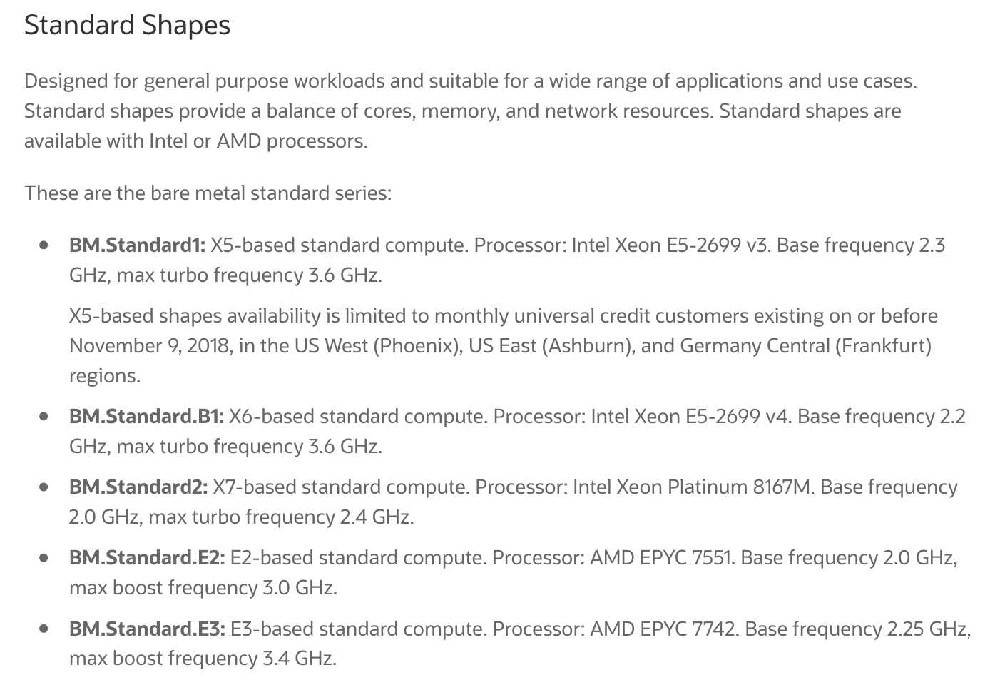
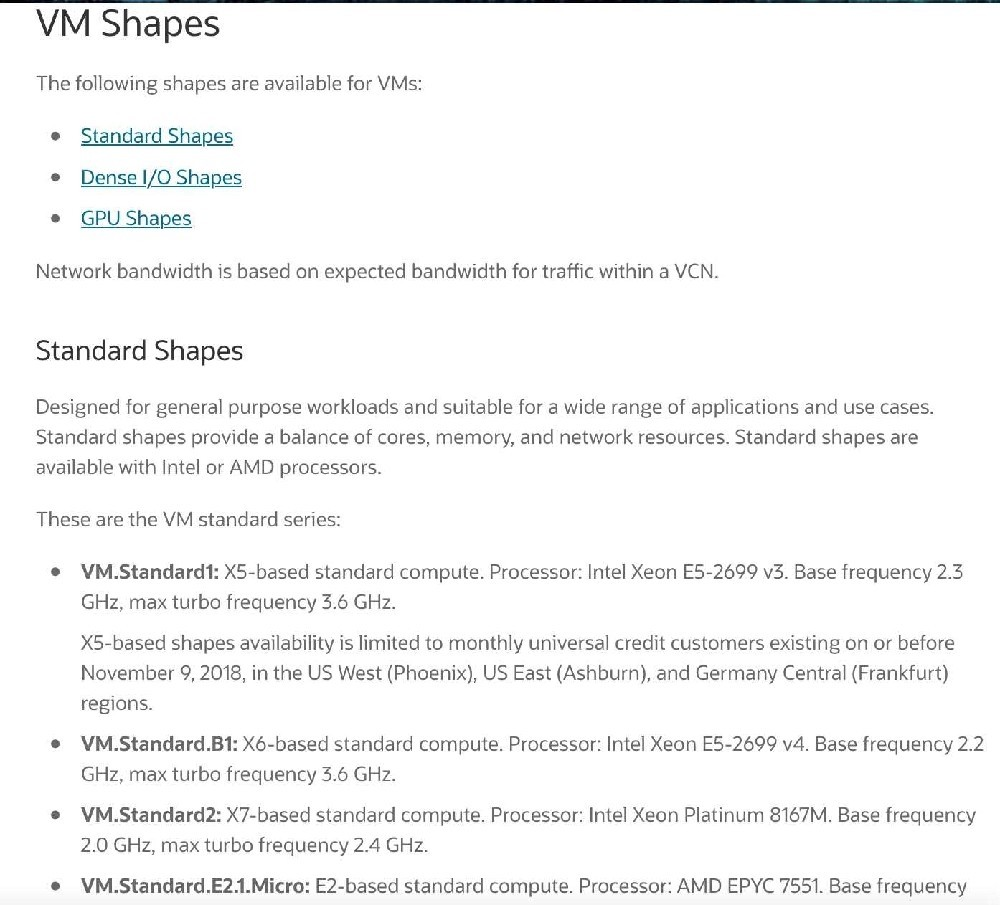
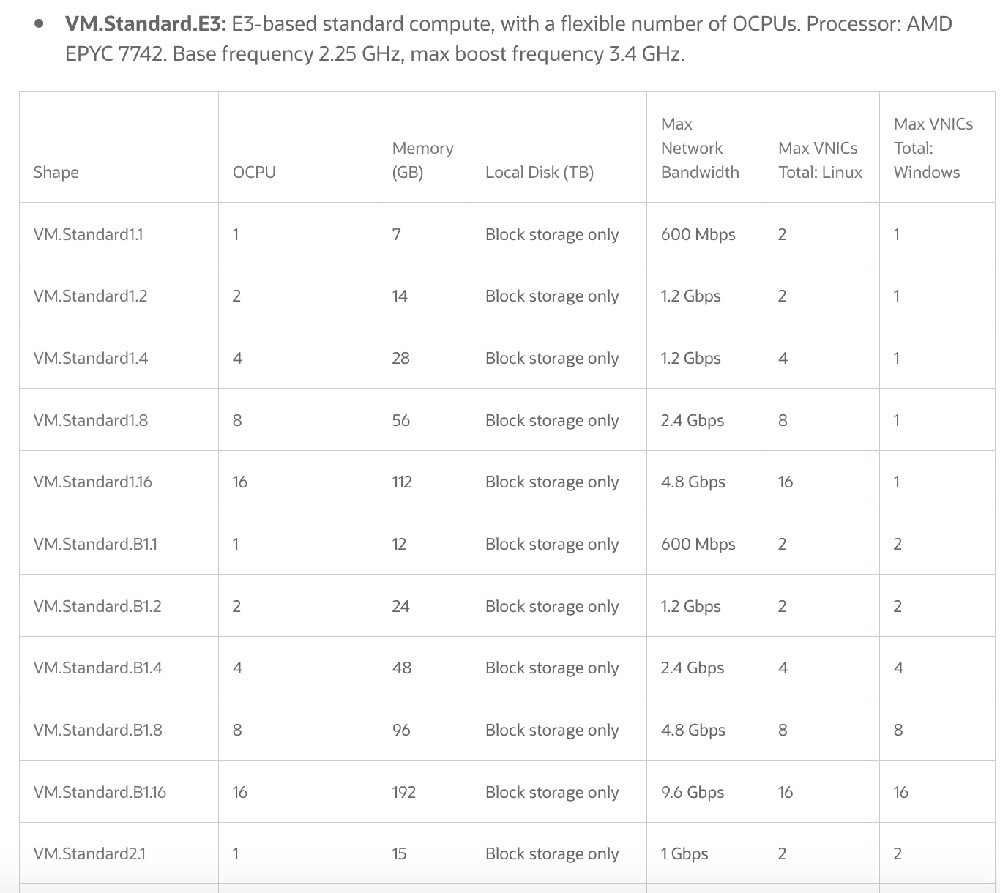
A shape is a template that determines the number of CPUs, amount of memory, and other resources that are allocated to an instance.
The network bandwidth is directly proportional to the number of OCPUs in the instance shape!

References:
https://docs.cloud.oracle.com/en-us/iaas/Content/Compute/References/computeshapes.htm

Question 10 Single choice

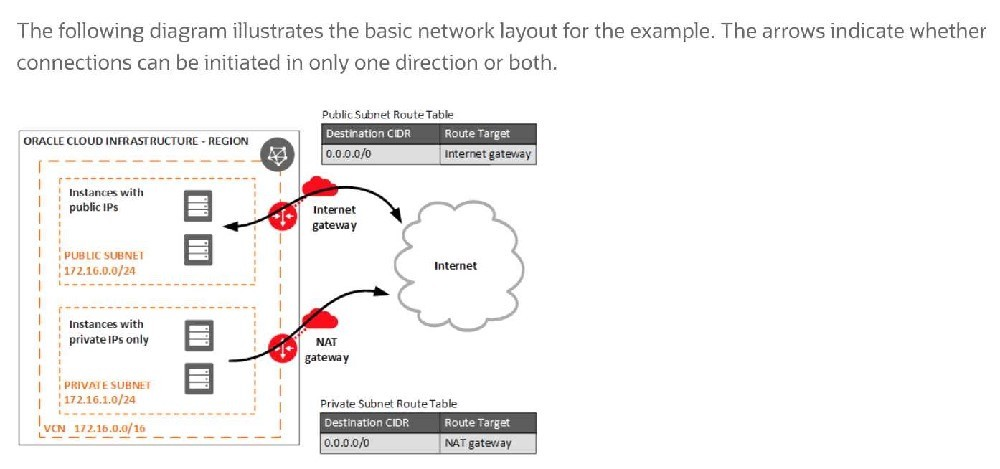
Which gateway can be used to provide internet access to an Oracle Cloud Infrastructure compute instance in a private subnet?

  1. A

    NAT Gateway

  2. B

    Service Gateway

  3. C

    Dynamic Routing Gateway

  4. D

    Internet Gateway

Show answer and explanation

Correct answer: A

Explanation

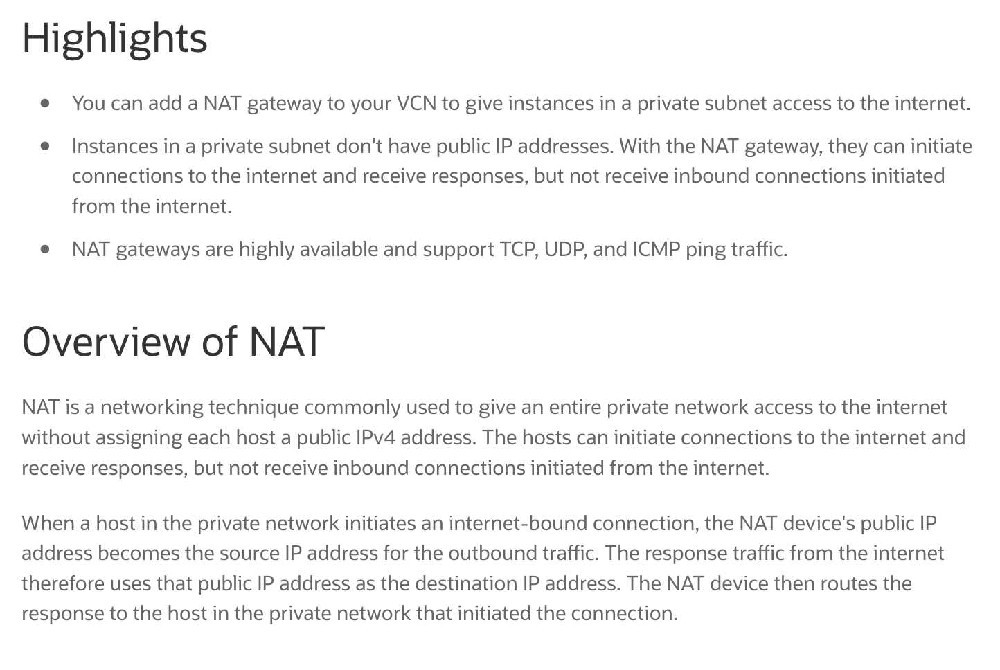
A NAT gateway gives cloud resources without public IP addresses access to the internet without exposing those resources to incoming internet connections.

References:
https://docs.cloud.oracle.com/en-us/iaas/Content/Network/Tasks/NATgateway.htm