
1Z0-1084-21 Real Exam Questions

Oracle Cloud Infrastructure Developer 2021 Associate

72 questions available · Page 1 of 8

Updated Exam DumpsVerified AnswersPass Guarantee

Get Complete Exam Dumps
Question 1 Single choice

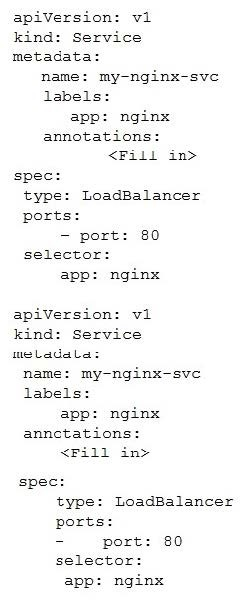
In the sample Kubernetes manifest file below, what annotations should you add to create a private load balancer In oracle Cloud infrastructure Container Engine for Kubermetes?
  1. A

    service.beta.kubernetes.io/oci-load-balancer-private:"true"

  2. B

    service.beta.kubernetes.io/oci-load-balancer-private: "true"
    service.beta.kubernetes.io/oci-load-balancer-subnet1: "ocid1.subnet.oc1..aaaaa....vdfw"

  3. C

    service.beta.kubernetes.io/oci-load-balancer-internal: "true"

  4. D

    service.beta.kubernetes.io/oci-load-balancer-internal: "true"
    service.beta.kubernetes.io/oci-load-balancer-subnet1: "ocid1.subnet.oc1..aaaaa....vdfw"

Show answer and explanation

Correct answer: D

Explanation

https://docs.cloud.oracle.com/en-us/iaas/Content/ContEng/Tasks/contengcreatingloadbalancer.htm?TocPath=Services%7CExample%20Network%20Resource%20Configuration%7CUpgrading%20the%20Version%20of%20Kubernetes%20Running%20on%20a%20Master%20Node%7C_____2

Creating Internal Load Balancers in Public and Private Subnets You can create Oracle Cloud Infrastructure load balancers to control access to services running on a cluster: When you create a 'custom' cluster, you select an existing VCN that contains the network resources to be used by the new cluster. If you want to use load balancers to control traffic into the VCN, you select existing public or private subnets in that VCN to host the load balancers. When you create a 'quick cluster', the VCN that's automatically created contains a public regional subnet to host a load balancer. If you want to host load balancers in private subnets, you can add private subnets to the VCN later.

Alternatively, you can create an internal load balancer service in a cluster to enable other programs running in the same VCN as the cluster to access services in the cluster. You can host internal load balancers in public subnets and private subnets.
To create an internal load balancer hosted on a public subnet, add the following annotation in the metadata section of the manifest file:
service.beta.kubernetes.io/oci-load-balancer-internal: "true"
To create an internal load balancer hosted on a private subnet, add both following annotations in the metadata section of the manifest file:
service.beta.kubernetes.io/oci-load-balancer-internal: "true" service.beta.kubernetes.io/oci-load-balancer- subnet1: "ocid1.subnet.oc1..aaaaaa....vdfw" where ocid1.subnet.oc1..aaaaaa....vdfw is the OCID of the private subnet.
Question 2 Single choice

You are working on a cloud native e-commerce application on Oracle Cloud Infrastructure (OCI). Your application architecture has multiple OCI services, including Oracle Functions. You need to trigger these functions directly from other OCI services, without having to run custom code.

Which OCI service cannot trigger your functions directly?

  1. A

    OCI Events Service

  2. B

    OCI Registry

  3. C

    OCI API Gateway

  4. D

    Oracle Integration

Show answer and explanation

Correct answer: B

Explanation

Oracle Functions is a fully managed, multi-tenant, highly scalable, on-demand, Functions-as-a- Service platform. It is built on enterprise-grade Oracle Cloud Infrastructure and powered by the Fn Project open source engine. Use Oracle Functions (sometimes abbreviated to just Functions) when you want to focus on writing code to meet business needs. The serverless and elastic architecture of Oracle Functions means there's no infrastructure administration or software administration for you to perform. You don't provision or maintain compute instances, and operating system software patches and upgrades are applied automatically. Oracle Functions simply ensures your app is highly-available, scalable, secure, and monitored. With Oracle Functions, you can write code in Java, Python, Node, Go, and Ruby (and for advanced use cases, bring your own Dockerfile, and Graal VM).

You can invoke a function that you've deployed to Oracle Functions from:
- The Fn Project CLI.
- The Oracle Cloud Infrastructure SDKs.
- Signed HTTP requests to the function's invoke endpoint. Every function has an invoke endpoint.
- Other Oracle Cloud services (for example, triggered by an event in the Events service) or from external
services.
so You can then deploy your code, call it directly or trigger it in response to events, and get billed only for the resources consumed during the execution.
Below are the oracle services that can trigger Oracle functions -Events Service
-Notification Service
-API Gateway Service
-Oracle Integration service(using OCI Signature Version 1 security policy) so OCI Registry services cannot
trigger your functions directly

Question 3 Single choice

You have two microservices, A and B running in production. Service A relies on APIs from service B. You want to test changes to service A without deploying all of its dependencies, which includes service B.

Which approach should you take to test service A?

  1. A

    Test against production APIs.

  2. B

    Test using API mocks.

  3. C

    There is no need to explicitly test APIs.

  4. D

    Test the APIs in private environments.

Show answer and explanation

Correct answer: B

Explanation

Testing using API mocks
Developers are frequently tasked with writing code that integrates with other system components via APIs.
Unfortunately, it might not always be desirable or even possible to actually access those systems during development. There could be security, performance or maintenance issues that make them unavailable ? or they might simply not have been developed yet. This is where mocking comes in: instead of developing code with actual external dependencies in place, a mock of those dependencies is created and used instead. Depending on your development needs this mock is made "intelligent" enough to allow you to make the calls you need and get similar results back as you would from the actual component, thus enabling development to move forward without being hindered by eventual unavailability of external systems you depend on

Question 4 Single choice

Which is NOT a valid option to execute a function deployed on Oracle Functions?

  1. A

    Send a signed HTTP requests to the function's invoke endpoint

  2. B

    Invoke from Oracle Cloud Infrastructure CLI

  3. C

    Invoke from Docker CLI

  4. D

    Trigger by an event in Oracle Cloud Infrastructure Events service

  5. E

    Invoke from Fn Project CLI

Show answer and explanation

Correct answer: C

Explanation

You can invoke a function that you've deployed to Oracle Functions in different ways: Using the Fn Project CLI.
Using the Oracle Cloud Infrastructure CLI.
Using the Oracle Cloud Infrastructure SDKs.
Making a signed HTTP request to the function's invoke endpoint. Every function has an invoke endpoint.
Each of the above invokes the function via requests to the API. Any request to the API must be authenticated by including a signature and the OCID of the compartment to which the function belongs in the request header. Such a request is referred to as a 'signed' request. The signature includes Oracle Cloud Infrastructure credentials in an encrypted form.

Question 5 Multiple choice

Which two statements are true for service choreography?

  1. A

    Service choreographer is responsible for invoking other services.

  2. B

    Services involved in choreography communicate through messages/messaging systems.

  3. C

    Service choreography relies on a central coordinator.

  4. D

    Service choreography should not use events for communication.

  5. E

    Decision logic in service choreography is distributed.

Show answer and explanation

Correct answers: B, E

Explanation

Service Choreography
Service choreography is a global description of the participating services, which is defined by exchange of messages, rules of interaction and agreements between two or more endpoints. Choreography employs a decentralized approach for service composition. the decision logic is distributed, with no centralized point.

Choreography, in contrast, does not rely on a central coordinator. and all participants in the choreography need to be aware of the business process, operations to execute, messages to exchange, and the timing of message exchanges.

Question 6 Single choice

What is the minimum amount of storage that a persistent volume claim can obtain In Oracle Cloud Infrastructure Container Engine for Kubemetes (OKE)?

  1. A

    1 TB

  2. B

    10 GB

  3. C

    1 GB

  4. D

    50 GB

Show answer and explanation

Correct answer: D

Explanation

https://docs.cloud.oracle.com/en-us/iaas/Content/ContEng/Concepts/contengprerequisites.htm

Question 7 Single choice

You have deployed a Python application on Oracle Cloud Infrastructure Container Engine for Kubernetes.
However, during testing you found a bug that you rectified and created a new Docker image. You need to make sure that if this new Image doesn't work then you can roll back to the previous version.
Using kubectl, which deployment strategies should you choose?

  1. A

    Rolling Update

  2. B

    Canary Deployment

  3. C

    Blue/Green Deployment

  4. D

    A/B Testing

Show answer and explanation

Correct answer: C

Explanation

Canary deployments are a pattern for rolling out releases to a subset of users or servers. The idea is to first deploy the change to a small subset of servers, test it, and then roll the change out to the rest of the servers. The canary deployment serves as an early warning indicator with less impact on downtime: if the canary deployment fails, the rest of the servers aren't impacted. Blue-green deployment is a technique that reduces downtime and risk by running two identical production environments called Blue and Green. At any time, only one of the environments is live, with the live environment serving all production traffic. For this example, Blue is currently live and Green is idle. A/B testing is a way to compare two versions of a single variable, typically by testing a subject's response to variant A against variant B, and determining which of the two variants is more effective A rolling update offers a way to deploy the new version of your application gradually across your cluster.

Question 8 Single choice

What is the difference between blue/green and canary deployment strategies?

  1. A

    In blue/green, application Is deployed In minor increments to a select group of people. In canary, both old and new applications are simultaneously in production.

  2. B

    In blue/green, both old and new applications are in production at the same time. In canary, application

    is deployed Incrementally to a select group of people.

  3. C

    In blue/green, current applications are slowly replaced with new ones. In < MW y, Application ll
    deployed incrementally to a select group of people.

  4. D

    In blue/green, current applications are slowly replaced with new ones. In canary, both old and new applications are In production at the same time.

Show answer and explanation

Correct answer: B

Explanation

Blue-green deployment is a technique that reduces downtime and risk by running two identical production environments called Blue and Green. At any time, only one of the environments is live, with the live environment serving all production traffic. For this example, Blue is currently live and Green is idle.
https://docs.cloudfoundry.org/devguide/deploy-apps/blue-green.html
Canary deployments are a pattern for rolling out releases to a subset of users or servers. The idea is to first deploy the change to a small subset of servers, test it, and then roll the change out to the rest of the servers. ... Canaries were once regularly used in coal mining as an early warning system.
https://octopus.com/docs/deployment-patterns/canary-deployments

Question 9 Single choice

Who is responsible for patching, upgrading and maintaining the worker nodes in Oracle Cloud Infrastructure Container Engine for Kubernetes (OKE)?

  1. A

    It Is automated

  2. B

    Independent Software Vendors

  3. C

    Oracle Support

  4. D

    The user

Show answer and explanation

Correct answer: D

Explanation

After a new version of Kubernetes has been released and when Container Engine for Kubernetes supports the new version, you can use Container Engine for Kubernetes to upgrade master nodes running older versions of Kubernetes. Because Container Engine for Kubernetes distributes the Kubernetes Control Plane on multiple Oracle-managed master nodes (distributed across different availability domains in a region where supported) to ensure high availability, you're able to upgrade the Kubernetes version running on master nodes with zero downtime. Having upgraded master nodes to a new version of Kubernetes, you can subsequently create new node pools running the newer version. Alternatively, you can continue to create new node pools that will run older versions of Kubernetes (providing those older versions are compatible with the Kubernetes version running on the master nodes). Note that you upgrade master
nodes by performing an `in-place' upgrade, but you upgrade worker nodes by performing an `out-of-place' upgrade. To upgrade the version of Kubernetes running on worker nodes in a node pool, you replace the original node pool with a new node pool that has new worker nodes running the appropriate Kubernetes version. Having 'drained' existing worker nodes in the original node pool to prevent new pods starting and to delete existing pods, you can then delete the original node pool.

Question 10 Single choice

Which concept is NOT related to Oracle Cloud Infrastructure Resource Manager?

  1. A

    Job

  2. B

    Stack

  3. C

    Queue

  4. D

    Plan

Show answer and explanation

Correct answer: C

Explanation

https://docs.cloud.oracle.com/en-us/iaas/Content/ResourceManager/Concepts/resourcemanager.htm
Following are brief descriptions of key concepts and the main components of Resource Manager.
CONFIGURATION
Information to codify your infrastructure. A Terraform configuration can be either a solution or a file that you write and upload.
JOB
Instructions to perform the actions defined in your configuration. Only one job at a time can run on a given stack; further, you can have only one set of Oracle Cloud Infrastructure resources on a given stack. To
provision a different set of resources, you must create a separate stack and use a different configuration.
Resource Manager provides the following job types: Plan: Parses your Terraform configuration and creates an execution plan for the associated stack. The execution plan lists the sequence of specific actions planned to provision your Oracle Cloud Infrastructure resources. The execution plan is handed off to the apply job, which then executes the instructions.
Apply. Applies the execution plan to the associated stack to create (or modify) your Oracle Cloud Infrastructure resources. Depending on the number and type of resources specified, a given apply job can take some time. You can check status while the job runs. Destroy. Releases resources associated with a stack. Released resources are not deleted. For example, terminates a Compute instance controlled by a stack. The stack's job history and state remain after running a destroy job. You can monitor the status and review the results of a destroy job by inspecting the stack's log files.
Import State. Sets the provided Terraform state file as the current state of the stack. Use this job to migrate local Terraform environments to Resource Manager.
STACK
The collection of Oracle Cloud Infrastructure resources corresponding to a given Terraform configuration.
Each stack resides in the compartment you specify, in a single region; however, resources on a given stack can be deployed across multiple regions. An OCID is assigned to each stack.