1Z0-1072-21 Exam Details
-
Exam Code
:1Z0-1072-21 -
Exam Name
:Oracle Cloud Infrastructure 2021 Architect Associate -
Certification
:Oracle Certifications -
Vendor
:Oracle -
Total Questions
:239 Q&As -
Last Updated
:May 27, 2026
Oracle 1Z0-1072-21 Online Questions & Answers
-
Question 201:
Which two choices are true for Autonomous Data Warehouse (ADW)? (Choose two.)
A. Billing stops only when the ADW is terminated
B. Billing stops for both CPU usage and storage usage when ADW is stopped
C. Billing for compute stops when ADW is stopped
D. Billing for storage continues when ADW is stopped -
Question 202:
You have compartments C and D under the root compartment in your Oracle Cloud Infrastructure (OCI) tenancy; compartment C contains a sub-compartment also named D. You are trying to move this sub-compartment D to the parent compartment D like shown in the picture, but the move fails.
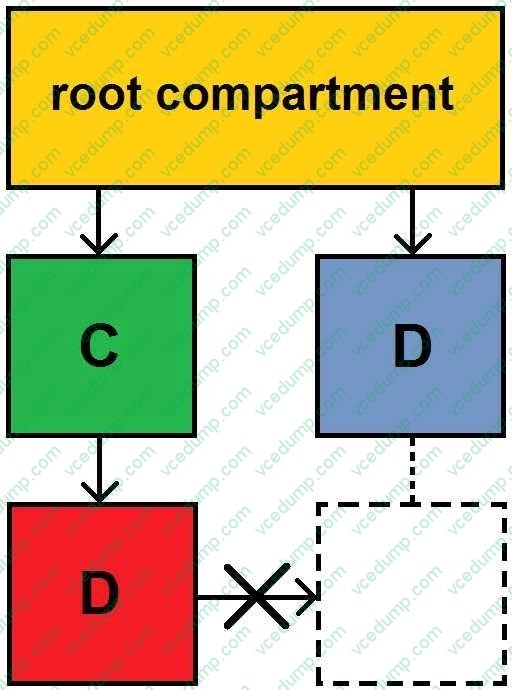
What is the reason for this error?
A. You need to move all the compartments in the hierarchy to the new parent compartment.
B. You cannot move a subcompartment to another parent compartment.
C. Both parent and child compartments cannot have the same name.
D. Sub-compartment D needs to be empty before it can be moved. -
Question 203:
Which two statements define the types of DNS resolvers that exist? (Choose two.)
A. A custom resolver allows instances to use the host names of the hosts in your on-prem network that are connected to your VCN by an IPSec VPN connection.
B. A VCN resolver allows instances to use the host names of the hosts in your on-prem network that are connected to your VCN by an IPSec VPN connection.
C. A VCN resolver allows instances to use host names to communicate with instances on other VCNs in your tenancy.
D. An Internet resolver allows instances to use the host names that are published on the Internet. -
Question 204:
Which three actions need to be performed before attempting a data transfer service job?
A. Obtain an available host machine which can run the dts utility on-premise with SATA or USB drives attached for the transfer job.
B. Get access to a high-speed internet connection
C. Data Transfer Service and Storage Service Limits should be checked and raised if required.
D. Set up SSH access to a host on OCI to coordinate the transfer job.
E. Create an object bucket to receive the job. -
Question 205:
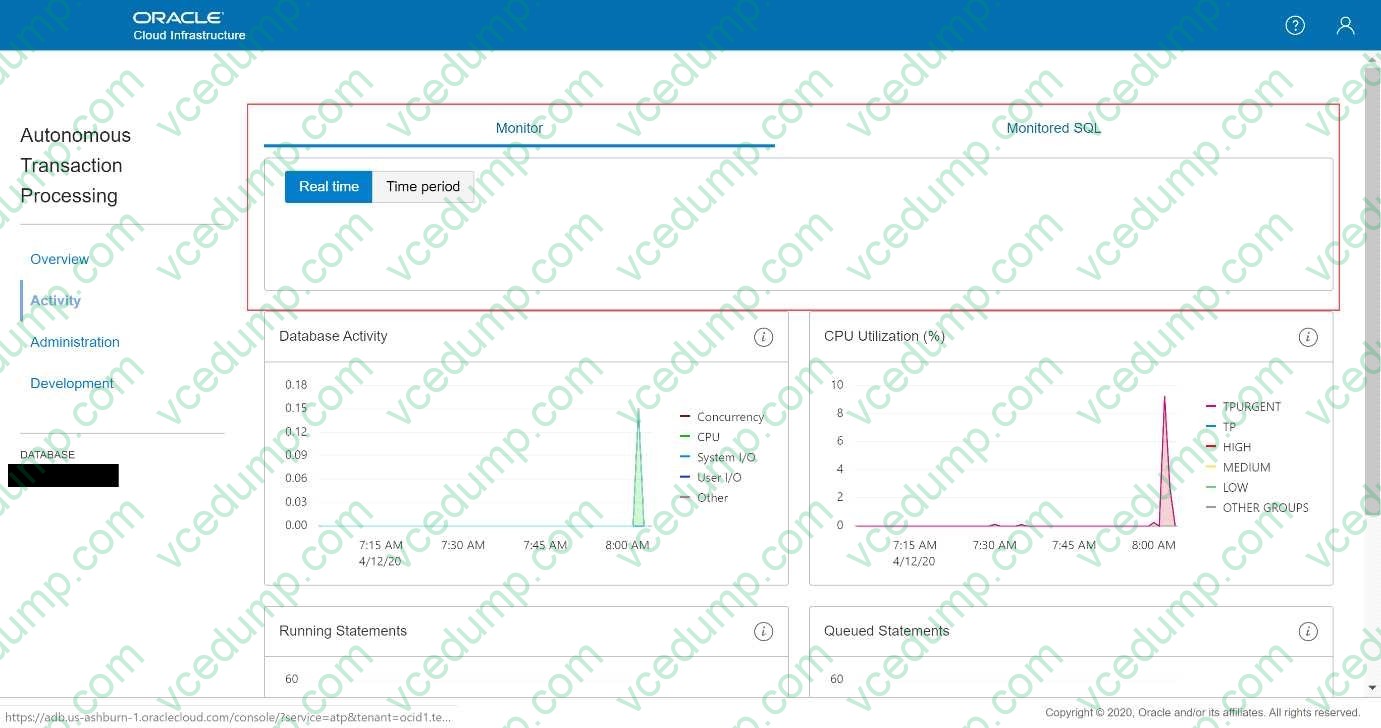
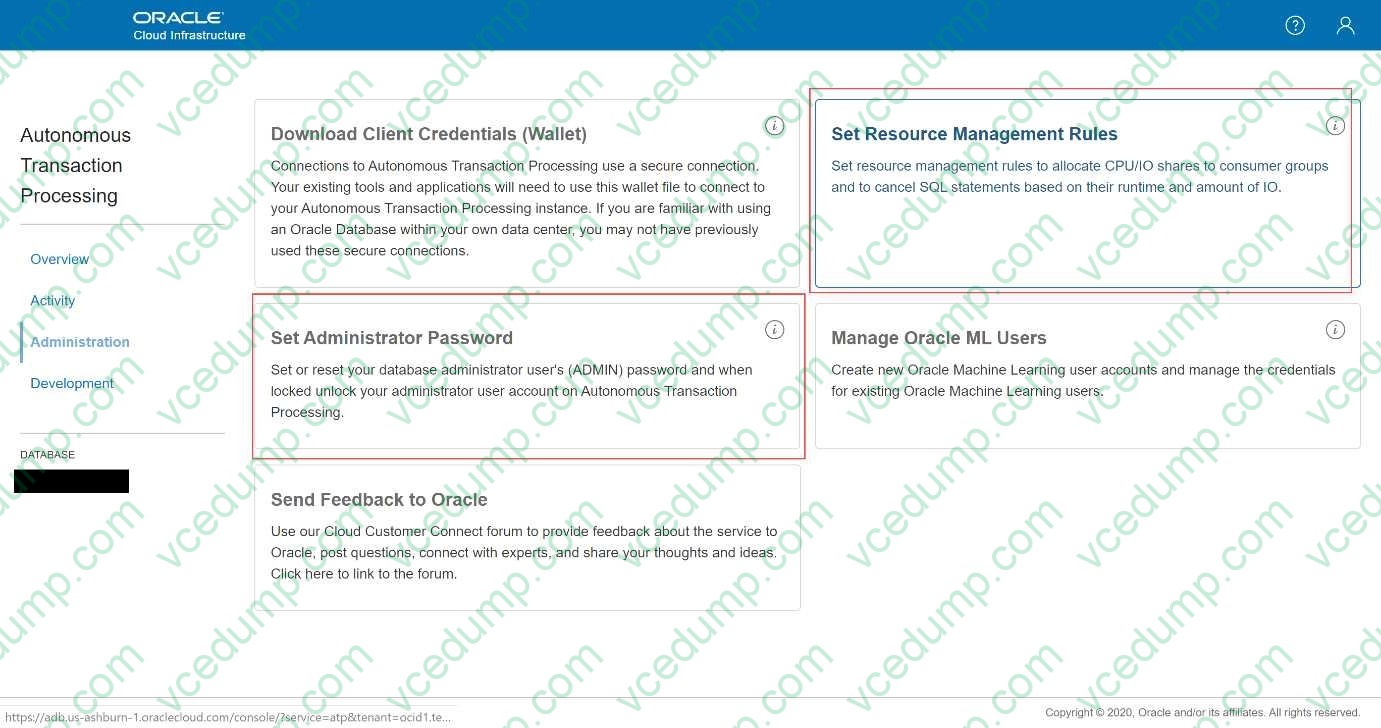
Which of the following two tasks can be performed in the Oracle Cloud Infrastructure Console for Autonomous Data Warehouse?
A. Adjust Network Bandwidth
B. Scale up/down Memory
C. Increase Storage allocated for Database
D. Scale up/down CPU -
Question 206:
You are designing a lab exercise for your team that has a large number of graphics with large file sizes. The application becomes unresponsive if the graphics are embedded in the application. You have uploaded the graphics to Oracle Cloud
Infrastructure and only added the URL in the application. You need to ensure these graphics are accessible without requiring any authentication for an extended period of time.
How can you achieve these requirements?
A. Create pre-authenticated requests (PAR) and specify 00:00:0000 as the expiration time.
B. Make the object storage bucket private and all objects public and use the URL found in the Object "Details".
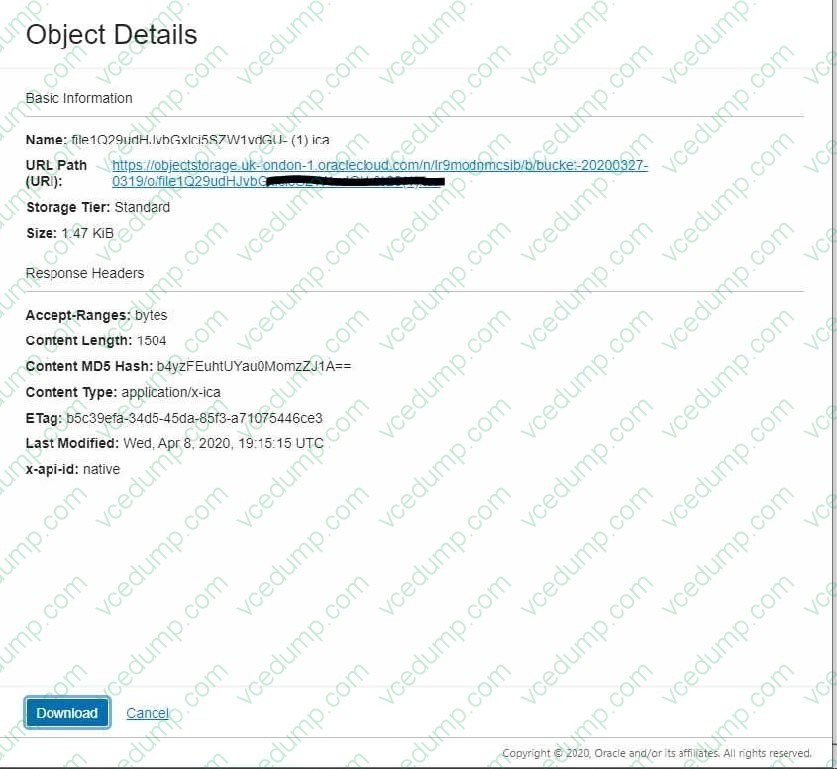
C. Make the object storage bucket public and use the URL found in the Object "Details".
D. Create PARs and do not specify an expiration date. -
Question 207:
You have provisioned an Autonomous Transaction Processing (ATP) database and logged into the ATP service console. What are three abilities that can be performed from this service console? (Choose three.)
A. scale up/down the CPUs
B. create ATP database users
C. reset the admin password
D. set resource management rules
E. monitor database activity and SQL queries -
Question 208:
You are implementing Oracle Cloud Infrastructure (OCI) FastConnect to access OCI public access points (e.g. ?object storage). You want other Internet traffic from your on-premises environment to use your existing connection with your ISP. What is the correct way to establish OCI FastConnect to access these OCI public endpoints?
A. Configure private peering on your FastConnect link. Redistribute BGP routes learned into your existing routing table and advertise a default from your network infrastructure to OCI.
B. Configure private peering on your FastConnect link with a static route that points to OCI object storage service.
C. Configure public peering on your FastConnect link with a static route that points to OCI object storage service.
D. Configure public peering on your FastConnect link. Redistribute BGP routes learned into your existing routing table and advertise a specific route for your network infrastructure to OCI. -
Question 209:
You are deploying a highly available web application In Oracle Cloud Infrastructure and have decided to use a public load balancer. The back-end web servers will be distributed across all three availability domains (ADs). How many subnets should you create to deliver a secure, highly available application?
A. two subnets in total; one regional private subnet to host your back-end web servers and one regional public subnet to host your public load load balancer.
B. two subnets in total; one regional public subnet to host your back-end web servers and one regional private subnet to host your public load load balancer.
C. three subnets in total; one regional public subnet to host your back-end web servers and two AD specific private subnets to host your private load load balancer.
D. one subnet in total; one regional private subnet to host your back-end web servers and your public load balancer. -
Question 210:
When deploying a highly available, Internet-facing, 2-tier web application on Oracle Cloud Infrastructure (OCI), which design option would you use?
A. Deploy all web servers into one Availability Domain and behind a public load balancer, and deploy two single-node OCI database systems in the same Availability Domain with Data Guard enabled.
B. Deploy all web servers into multiple Availability Domains and behind a public load balancer, and deploy two single-node OCI database systems across two Availability Domains with Data Guard enabled.
C. Deploy all web servers into multiple Availability Domains and behind a private load balancer, and deploy two single-node OCI database systems across two Availability Domains with Data Guard enabled.
D. Deploy all web servers into one Availability Domain, and deploy a single-node OCI database system into a different Availability Domain.
Related Exams:
-
1Z0-020
Oracle8i: New Features for Administrators -
1Z0-023
Architecture and Administration -
1Z0-024
Performance Tuning -
1Z0-025
Backup and Recovery -
1Z0-026
Network Administration -
1Z0-034
Upgrade Oracle9i/10g OCA to Oracle Database OCP -
1Z0-036
Managing Oracle9i on Linux -
1Z0-041
Oracle Database 10g: DBA Assessment -
1Z0-052
Oracle Database 11g: Administration Workshop I -
1Z0-053
Oracle Database 11g: Administration II
Tips on How to Prepare for the Exams
Nowadays, the certification exams become more and more important and required by more and more enterprises when applying for a job. But how to prepare for the exam effectively? How to prepare for the exam in a short time with less efforts? How to get a ideal result and how to find the most reliable resources? Here on Vcedump.com, you will find all the answers. Vcedump.com provide not only Oracle exam questions, answers and explanations but also complete assistance on your exam preparation and certification application. If you are confused on your 1Z0-1072-21 exam preparations and Oracle certification application, do not hesitate to visit our Vcedump.com to find your solutions here.