
1Z0-1072-21 Real Exam Questions

Oracle Cloud Infrastructure 2021 Architect Associate

239 questions available · Page 1 of 24

Updated Exam DumpsVerified AnswersPass Guarantee

Get Complete Exam Dumps
Question 1 Multiple choice

You have multiple applications installed on a compute instance and these applications generate a large amount of log files. These log files must reside on the boot volume for a minimum of 15 days and must be retained for at least 60 days. The 60-day retention requirement is causing an issue with available disk space.

What are the two recommended methods to provide additional boot volume space for this compute instance? (Choose two.)

  1. A

    Terminate the instance while preserving the boot volume. Create a new instance from the boot volume and select a DenseIO shape to take advantage of local NVMe storage.

  2. B

    Create an object storage bucket and use a script that runs daily to move log files older than 15 days to the bucket.

  3. C

    Create and attach a block volume to the compute instance and copy the log files.

  4. D

    Create a custom image and launch a new compute instance with a larger boot volume size.

  5. E

    Write a custom script to remove the log files on a daily basis and free up the space on the boot volume.

Show answer and explanation

Correct answers: B, D

Explanation

These log files must reside on the boot volume for a minimum of 15 days so you have to increase the boot Volume
Question 2 Multiple choice

Which three methods can you use to manage Oracle Cloud Infrastructure services? (Choose three.)

  1. A

    Oracle Cloud Infrastructure Desktop Client

  2. B

    Oracle Cloud Infrastructure Console

  3. C

    SSH or RDP

  4. D

    Command-line Interface

  5. E

    REST API

Show answer and explanation

Correct answers: B, D, E

Explanation

https://docs.cloud.oracle.com/iaas/Content/GSG/Concepts/baremetalintro.htm

Question 3 Multiple choice

Which two statements are true about Oracle Cloud Infrastructure (OCI) DB Systems Data Guard service?

  1. A

    Both DB systems must use the same VCN, and port 1521 must be open

  2. B

    Data guard configuration on the OCI is limited to a virtual machine only

  3. C

    Data guard implementation for Bare Metal shapes requires two DB Systems, one containing the primary database and one containing the standby database.

  4. D

    Data guard implementation requires two DB Systems, one running the primary database on a virtual machine and the standby database running on bare metal.

Show answer and explanation

Correct answers: A, C

Explanation

An Oracle Data Guard implementation requires two DB systems, one containing the primary database and one containing the standby database. When you enable Oracle Data Guard for a virtual machine DB system database, a new DB system with the standby database is created and associated with the primary database. For a bare metal DB system, the DB system with the database that you want to use as the standby must already exist before you enable Oracle Data Guard.
Requirement details are as follows:
- Both DB systems must be in the same compartment.
- The DB systems must be the same shape type (for example, if the shape of the primary database is a virtual machine, then the shape of the standby database can be any other virtual machine shape).
- If your primary and standby databases are in different regions, then you must peer the virtual cloud networks (VCNs) for each database.
- Configure the security list ingress and egress rules for the subnets of both DB systems in the Oracle Data
Guard association to enable TCP traffic to move between the applicable ports. Ensure that the rules you create are stateful (the default).

Question 4 Multiple choice

Which three load-balancing policies can be used with a backend set?

  1. A

    throughput

  2. B

    least connections

  3. C

    IP hash

  4. D

    CPU utilization

  5. E

    weighted round robin

Show answer and explanation

Correct answers: B, C, E

Question 5 Single choice

Which of the following statements is true about the Oracle Cloud Infrastructure (OCI) Object Storage serverside encryption?

  1. A

    Encryption of data encryption keys with a master encryption key is optional.

  2. B

    Customer-provided encryption keys are always stored in OCI Vault service.

  3. C

    Encryption is enabled by default and cannot be turned off.

  4. D

    Each object in a bucket is always encrypted with the same data encryption key.

Show answer and explanation

Correct answer: B

Explanation

References:
https://docs.cloud.oracle.com/en-us/iaas/Content/Object/Tasks/usingyourencryptionkeys.htm

Question 6 Single choice

Your company has been running several small applications in Oracle Cloud Infrastructure and is planning a proof-of-concept (POC) to deploy PeopleSoft.
If your existing resources are being maintained in the root compartment, what is the recommended approach for defining security for the upcoming POC?

  1. A

    Create a new compartment for the POC and grant appropriate permissions to create and manage resources within the compartment.

  2. B

    Provision all new resources into the root compartment. Grant permissions that only allow for creation and management of resources specific to the POC.

  3. C

    Provision all new resources into the root compartment. Use defined tags to separate resources that belong to different applications.

  4. D

    Create a new tenancy for the POC. Provision all new resources into the root compartment. Grant appropriate permissions to create and manage resources within the root compartment.

Show answer and explanation

Correct answer: A

Explanation

If your organization is small, or if you are still in the proof-of-concept stage of evaluating Oracle Cloud Infrastructure, consider placing all of your resources in the root compartment (tenancy). This approach makes it easy for you to quickly view and manage all your resources. You can still write policies and create groups to restrict permissions on specific resources to only the users who need access.
If you plan to maintain all your resources in the root compartment, we recommend setting up a separate sandbox compartment to give users a dedicated space to try out features. In the sandbox compartment, you can grant users permissions to create and manage resources, while maintaining stricter permissions on the resources in your tenancy (root) compartment.
https://www.oracle.com/a/ocom/docs/best-practices-for-iam-on-oci.pdf

Question 7 Single choice

You must implement a backup solution for your Autonomous Data Warehouse (ADW) that will enable you to restore data as old as one year with a recovery point objective (RPO) of 10 days.

Which database backup strategy would you select?

  1. A

    Take weekly manual backups to supplement the automated backups and preserve them for 12 months.

  2. B

    Use the automated backups.

  3. C

    Take monthly manual backups to supplement the automated backups and preserve them for 12 months.

  4. D

    Take quarterly manual backups to supplement the automated backups and preserve them for 12 months.

Show answer and explanation

Correct answer: B

Explanation

Oracle Cloud Infrastructure automatically backs up your Autonomous Databases and retains these backups for 60 days. Automatic backups are weekly full backups and daily incremental backups. You can also create manual backups to supplement your automatic backups. Manual backups are stored in an Object Storage bucket that you create, and are retained for 60 days The retention period for manual backups is the same as automatic backups which is 60 days. So we cannot preserve the backup for 12 months
https://docs.oracle.com/en/cloud/paas/autonomous-data-warehouse-cloud/user/backup-manual.html#GUID-D95E5D6A-C470-4A68-9545-CC99D937E7D1

Question 8 Multiple choice

Which two statements are true about Oracle Cloud Infrastructure (OCI) DB Systems?

  1. A

    Customers have no control over database patching.

  2. B

    The database and backups are encrypted by default.

  3. C

    Customers can consolidate multiple database homes on a single virtual machine database host.

  4. D

    Customers can manage the TDE Wallet after DB Systems is provisioned.

Show answer and explanation

Correct answers: B, D

Explanation

All databases created in Oracle Cloud Infrastructure are encrypted using transparent data encryption (TDE).
Oracle Cloud Infrastructure encrypts all managed backups in the object store. Oracle uses the Database Transparent Encryption feature by default for encrypting the backups. and the customers can manage the TDE Wallet after DB Systems are provisioned.

Question 9 Single choice

You are designing a lab exercise for your team that has a large number of graphics with large file sizes.
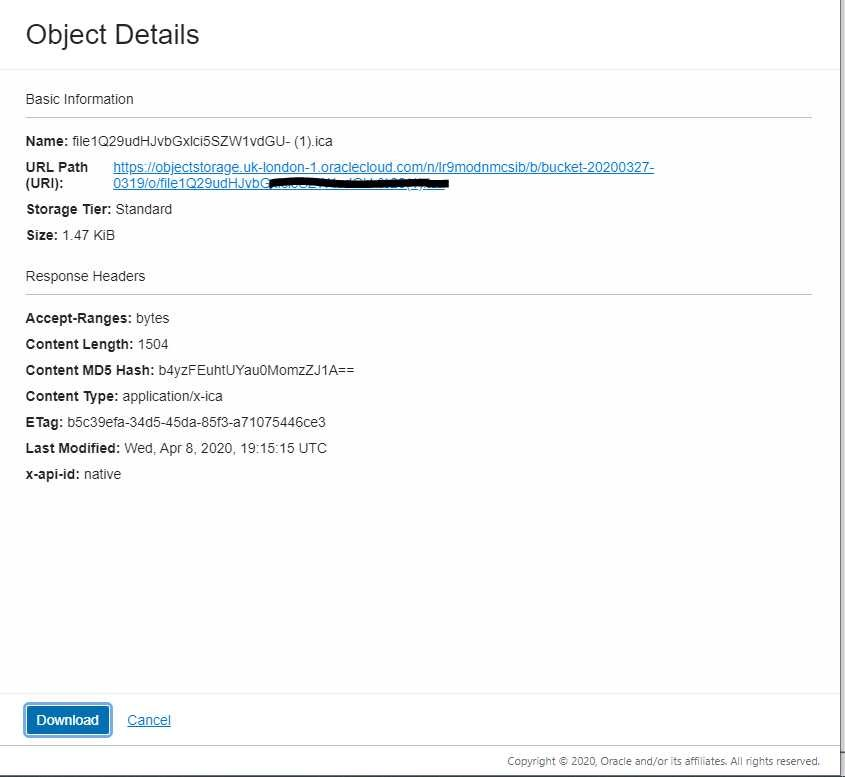
The application becomes unresponsive if the graphics are embedded in the application. You have uploaded the graphics to Oracle Cloud Infrastructure and only added the URL in the application. You need to ensure these graphics are accessible without requiring any authentication for an extended period of time.

How can you achieve these requirements?

  1. A

    Create pre-authenticated requests (PAR) and specify 00:00:0000 as the expiration time.

  2. B

    Make the object storage bucket private and all objects public and use the URL found in the Object
    "Details".

  3. C

    Make the object storage bucket public and use the URL found in the Object "Details".

  4. D

    Create PARs and do not specify an expiration date.

Show answer and explanation

Correct answer: C

Explanation

Pre-authenticated requests provide a way to let you access a bucket or an object without having your own credentials. For example, you can create a request that lets you upload backups to a bucket without owning API keys.
When you create a bucket, the bucket is considered a private bucket and the access to the bucket and bucket contents requires authentication and authorization. However, Object Storage supports anonymous, unauthenticated access to a bucket. You make a bucket public by enabling read access to the bucket. pre-authenticated requests have to select expiration date

Question 10 Multiple choice

You have provisioned an Autonomous Data Warehouse (ADW) database with 16 enabled OCPUs and need to configure the consumer group for your application.

Which two are true when deciding the number of sessions for each application? (Choose two.)

  1. A

    The MEDIUM and LOW consumer group can run up to 16 concurrent SQL statements if HIGH
    consumer group has 0 SQL statements

  2. B

    The HIGH consumer group can run up to 16 concurrent SQL statements as long as MEDIUM and LOW
    consumer groups have 0 SQL statements

  3. C

    The MEDIUM consumer group can run 20 concurrent SQL statements when HIGH consumer group has 0 SQL statements

  4. D

    The HIGH consumer group can run up to 16 concurrent SQL statements in addition to 32 concurrent SQL statements in MEDIUM and LOW consumer group each

  5. E

    The HIGH consumer group can run 3 concurrent SQL statements when MEDIUM consumer group has
    0 SQL statements

Show answer and explanation

Correct answers: C, E

Explanation

References:
https://docs.oracle.com/en/cloud/paas/autonomous-data-warehouse-cloud/user/connect-predefined.html#GUID-9747539B-FD46-44F1-8FF8-F5AC650F15BE