
1Z0-100 Real Exam Questions

Oracle Linux 5 and 6 System Administration

141 questions available · Page 1 of 15

Updated Exam DumpsVerified AnswersPass Guarantee

Get Complete Exam Dumps
Question 1 Multiple choice

Which two actions are the required steps to prevent: non-root ssh access to the system?

  1. A

    Ensuring that /etc/pam.d/sshd includes:
    account sufficient pam_nologin.so

  2. B

    Create the /etc/nologin/login.deny file containing a single line +all

  3. C

    Creating the /etc/nologin.allow file containing a single line root

  4. D

    Creating the /etc/nologin file

  5. E

    Ensuring that /etc/pam.d/sshd includes:
    account required pam_nologin.so

Show answer and explanation

Correct answers: D, E

Explanation

D: If the file /etc/nologin exists, only root is allowed to log in; other users are turned away with an error
message.
Note:
* In some cases, the security policy may dictate additional mechanisms, such as TCP wrappers, Pluggable
Authentication Modules (PAM), or the implementation of Security-Enhanced Linux (SELinux).
Question 2 Multiple choice

Which three settings can be controlled by using the chage breemar command as the root user, to modify the parameters in the /etc/shadow file?

  1. A

    The expiration date of the breemar account

  2. B

    The number of days after the breemar account is locked, that it becomes expired

  3. C

    The maximum number of days that must elapse between password changes by the user breemar before the password becomes invalid

  4. D

    The number of days after the breemar account is locked, that it becomes unlocked

  5. E

    The minimum number of days that must elapse between password changes by the user breemar

  6. F

    The maximum number of failed login attempts on the breemar account before the account is locked

Show answer and explanation

Correct answers: A, C, E

Explanation

A: chage -E, --expiredate EXPIRE_DATE
Set the date or number of days since January 1, 1970 on which the user's account will no longer be accessible.

CE: You need to use chage command to setup password aging. The chage command changes the number of days between password changes and the date of the last password change. This information is used by the system to determine when a user must change his/her password.

Question 3 Multiple choice

You use the chkconfig command to administer one of the services on your Oracle Linux system:

[root@FAROUT ~]# chkconfig vncserver off
[root@FAROUT ~] #

No changes have been made to the init script for the service.

Which two statements are true regarding the effects of Issuing this command?

  1. A

    The vncserver service is shut down.

  2. B

    The vncserver service configuration is disabled only for those run levels for which it is currently enabled.

  3. C

    The vncserver service configuration is disabled for run levels 2, 3, 4 and 5.

  4. D

    The vncserver service remains in the same state it was in before the command was issued.

  5. E

    The vncserver service configuration is disabled for run levels 3 and 5 only.

Show answer and explanation

Correct answers: A, B

Explanation

References:
http://www.oracle-base.com/articles/linux/configuring-vnc-server-on-linux.php

Question 4 Single choice

You want to convert an rpm packages file into a standard format as part of a shell script and then manipulate the contents.

Which archive format is used by rpm?

  1. A

    cpio

  2. B

    tar

  3. C

    bzip2

  4. D

    gzip

  5. E

    zip

Show answer and explanation

Correct answer: A

Question 5 Multiple choice

Examine these commands used to control UPSTART logging:

[root@FAROUT init] # initctl log-priority info
[root@FAROUT init] # initctl log-priority

Info

[root@FAROUT init]#

Which three statements are true about the logging done through these commands?

  1. A

    UPSTART logs State Changes to /vat/log/messages.

  2. B

    UPSTART logs job goals to /var/log/massages.

  3. C

    UPSTART logs only informational messages about warnings and errors to /var/log/messages.

  4. D

    UPSTART logs only informational messages about warnings to /var/log/messages.

  5. E

    UPSTART logs event emissions to /var/log/messages.

Show answer and explanation

Correct answers: A, C

Question 6 Multiple choice

Which three statements are true when using the Anaconda Installer to install Oracle Linux?

  1. A

    Unattended installation is only possible if installing the Unbreakable Enterprise kernel.

  2. B

    The installation may be done from an NFS-mounted Image.

  3. C

    Unattended installation is only possible if installing the Red Hat-compatible kernel.

  4. D

    The installation may be done from a USB device.

  5. E

    The installation may be done in text or graphical mode.

Show answer and explanation

Correct answers: B, C, E

Explanation

C: The Red Hat Enterprise Linux installation process automatically writes a Kickstart file that contains the settings for the installed system. This file is always saved as /root/anaconda-ks.cfg. You may use this file to repeat the installation with identical settings, or modify copies to specify settings for other systems.
E: Anaconda offers a text-mode and GUI mode.

Question 7 Multiple choice

Examine some of the contents of the /boot/grub/grub.com file from an Oracle Linux system:

Default=0
Timeout=5
Splashimage=(hd0, 0)/grub/splash.xpm.gz
Hiddenmenu
Title Oracle Linux Server (2.6.39-100.0.12.16uek.x86_64)
Root (hd0, 0)
Kernet /vmlinuz-2.6.39-100.0.12.e16uek.x86_64 ro root=UUIP=a4b6049b-9aa1-44b4-87cf-
aebb17alcdf9 rd_NO_LUKS re_NO_LVM rd_NO_DM LANG=en_US.UTF-8
SYSFONT=1atarcycreheb-sun16 KEYBOARDTYPE=PC KEYTABLE=us rhgb quiet numa=off
Initrd /initramfs-2.6.39-100.0.12.e16uek.x86_64.img
Title Oracle Linux Server (2.6.32-131.0.15.e16.x86_64)
Root (hd0, 0)
Kernel /vmlinuz-2.6.32-131.0.15.e16.x86_64 ro root=UUIS=a4b6049b-9aa1-44b4-87cf-aebb17a1cdf9
rd_NO_LUKS rd_NO_LVM rd_NO_LVM re_NO_MD rd_NO_DM
LANG=en_UD.UTF-8 SYSFONT=latarcyheb-sun16 KEYBOARDTYPE=PC KEYTABLE=us
Crashkernel=auto rhgp quiet numa = off
Initrd /initramfs-2.6.32-131.0.15.e16.x86_64.

img Which three statements are true about the behavior and configuration of GRUB on this system?

  1. A

    (hd0, 0) represents the first partition on device /dev/hd0.

  2. B

    The hiddenmenu directive hides the GRUB menu only for 5 seconds after which it becomes visible again.

  3. C

    The root directive specifies an initial root filesystem, allowing access to block device modules to mount the real root filesystem on disk.

  4. D

    (hd0, 0) represents the first partition on the first drive detected by the BIOS.

  5. E

    The initrd directive specifies the initamfs, an initial root filesystem in RAM, allowing access to block device modules to mount the real root filesystem.

  6. F

    Each kernel must have an initramfs that matches the version of the kernel.

  7. G

    Because there is an Unbreakable Enterprise Kernel installed, it must be the default kernel listed as shown by the default=0 directive.

Show answer and explanation

Correct answers: A, C, E

Question 8 Multiple choice

Which two steps should be performed to permit using SSH, SCP, or SFTP commands by the ORACLE account on the host FAROUT to the oracle account on the host WAYOUT without supplying a password?

  1. A

    The oracle account user on host FAROUT must issue an ssh-keygen command to generate public and

    private key files in the ~ oracle/.ssh directory FAROUT.

  2. B

    The oracle account user on the host WAYOUT must issue an ssh-keygen command to generate public and private key files in the ~/oracle.ssh directory on WAYOUT.

  3. C

    The Oracle account user on host FAROUT must add the contents of ~/oracle/.ssh/id_dsa.pub or ~/ oracle/.ssh/is_rsa.pub file to the ~/oracle/.ssh/authorized_keys file on host WAYOUT.

  4. D

    The Oracle account user on host WAYOUT must add the contents of ~/oracle/.ddh/id_dsa or ~/oracle/
    .ssh/id_rsa.pub file to the ~/oracle/.ssh/authorized_keys file on host FAROUT.

  5. E

    The oracle account user on host WAYOUT must set the permissions on the ~/oracle/.ssh/ authorized_keys file to 644.

  6. F

    The Oracle account user on host FAROUT must set the permissions in ~/oracle/.ssh/authorized_keys file 644.

Show answer and explanation

Correct answers: B, F

Question 9 Single choice

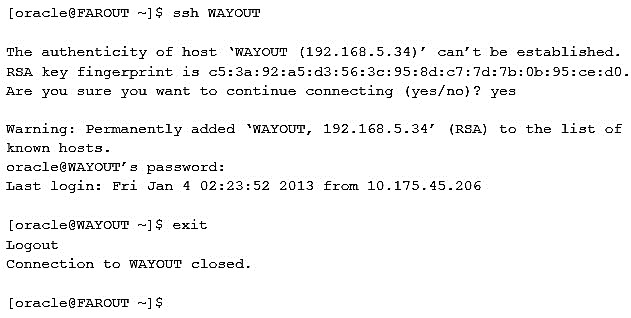
Examine the ssh connection and disconnection shown:

What is checked when the oracle user on the host FAROUT attempts to connect to the oracle user on the host WAYOUT on subsequent occasions? (Choose the best answer.)

  1. A

    Hosts FAROUT and WAYOUT swap public host keys and compare them to the keys that were saved locally in the /oracle/.ssh/known_hosts file

  2. B

    The ssh client on host FAROUT, compares the public host key supplied by host WAYOUT with the public host key that was saved in the /oracle/.ssh/known_hosts file on server FAROUT

  3. C

    The ssh server on host WAYOUT, compares the public host key supplied by host FAROUT with the public host key that was saved in the /oracle/.ssh/authorized_keys file on server WAYOUT

  4. D

    The ssh client on host FAROUT, compares the public host key supplied by host WAYOUT with the public host key that was saved in the /oracle/.ssh/authorized_keys file on server FAROUT

  5. E

    The ssh server on host WAYOUT, compares the public host key supplied by host FAROUT with the public host key that was saved in the /oracle/.ssh/known_hosts file on server WAYOUT

Show answer and explanation

Correct answer: B

Question 10 Single choice

Consider the output shown:

# rpm -i sendmail-cf-8.14.4-8.e16.noarch.rpm
Error: Failed dependencies:
Sendmail = 7.14.4-8.e16 is needed by sendmail-cf-8.e16.noarch
# rpm -i sendmail-8.14.4-8.e16.x86_64.rpm
# rpm -i sendmail-cf-8.14.4-8.e16.noarch.rpm
# rpm -q sendmail sendmail-cf
Sendmail-8.14.4-8.e16.x86_64
Sendmail-cf-8.e16_64
Sendmail-cf-8.14.4-8.e16.noarch
# rpm -e sendmail

Which statement is true about the execution of the rpm -e sendmail command?

  1. A

    It erases the sendmail package without errors.

  2. B

    It fails with an error because the package version is not supplied on the command line.

  3. C

    It fails with an error because the sendmail-cf package depends on the sendmail package.

  4. D

    It erases the sendmail package and raises an error because the sendmail package depends on the sendmail package.

  5. E

    It erases both the sendmail and sendmail-cf packages because the sendmail-cf package depends on the sendmail package.

Show answer and explanation

Correct answer: E