1Z0-083 Exam Details
-
Exam Code
:1Z0-083 -
Exam Name
:Oracle Database Administration II -
Certification
:Oracle Certifications -
Vendor
:Oracle -
Total Questions
:273 Q&As -
Last Updated
:May 31, 2026
Oracle 1Z0-083 Online Questions & Answers
-
Question 211:
Oracle Managed Files (OMF) is enabled in a CDB and this command is successfully executed:

Which three are true? (Choose three.)
A. Application PDBs that are subsequently created in the APP1 application container will be cloned from APP1$SEED.
B. An application seed PDB is created for APP1.
C. An application root PDB is created for APP1.
D. A default service is created for the application root APP1.
E. Application PDBs that are subsequently created in the APP1 application container will be cloned from PDB$SEED.
F. APP1 can never be unplugged. -
Question 212:
Which two are true about the Automatic Database Diagnostic Monitor? (ADDM)? (Choose two.)
A. When ADDM reports multiple findings, summing all their impacts can yield to more than 100% of DB time.
B. It runs automatically after each AWR snapshot.
C. By default it analyzes a period of time corresponding to the last 4 hours of activity.
D. Results are written to the alert log.
E. By default it analyzes a period of time corresponding to the last 24 hours of activity. -
Question 213:
Which three are true in Oracle 19c and later releases? (Choose three).
A. If the password file location changes, then the new location is used automatically by the Oracle Server.
B. Schema Only accounts can be granted administrator privileges.
C. All the Oracle-supplied accounts are Schema Only accounts.
D. Privilege Analysis is included in Oracle Enterprise Edition and no longer requires Database Vault.
E. Unified Auditing can be configured to audit only events that are issued indirectly by an audited user.
F. Unified Auditing can be configured to audit only events that are issued directly by an audited user. -
Question 214:
Which two are true about the character sets used in an Oracle database? (Choose two.)
A. Single-byte character sets provide better performance than multibyte character sets.
B. Unicode enables information from any language to be stored using a single character set.
C. Unicode is the only supported character set for Oracle databases created using Database Configuration Assistant (DBCA).
D. Single-byte character sets always use 7-bit encoding schemes.
E. Multibyte character sets allow more efficient space utilization than single byte character sets.
F. Single-byte character sets always use 8-bit encoding schemes. -
Question 215:
Which two are true about RMAN duplexed backup sets? (Choose two.)
A. They can be written only to disk.
B. They must be written to media.
C. They can be created by using the RMAN CONFIGURE command to specify duplexing before taking a backup.
D. They can be created only by using the COPIES option of a BACKUP command.
E. They can be written to media. -
Question 216:
You take regular backups of one of your production databases by using RMAN with a recovery catalog. You have added two new tablespaces to this database which must be included in future backups. Which process occurs which allows the new backups to contain the new datafiles?
A. The target database control file is synchronized from the recovery catalog with a partial resync at the next backup.
B. The recovery catalog is synchronized from the target database control file with a full resync at the next backup.
C. The target database control file is synchronized from the recovery catalog with a full resync at the next backup.
D. The recovery catalog is synchronized from the target database control file with a partial resync at the next backup. -
Question 217:
How do you configure a CDB for local undo mode?
A. Open the CDB instance in upgrade mode. In CDB$ROOT, execute ALTER DATABASE LOCAL UNDO ON, and then restart the CDB instance.
B. Open the CDB instance in restricted mode. In CDB$ROOT, execute ALTER DATABASE LOCAL UNDO ON, and create an UNDO tablespace in each PDB, then restart the CDB instance.
C. Open the CDB instance in restricted mode. In CDB$ROOT, drop the UNDO tablespace. Execute ALTER DATABASE LOCAL UNDO ONin each PDB, and then restart the CDB instance.
D. Open the CDB instance in read-only mode. In CDB$ROOT, execute ALTER DATABASE LOCAL UNDO ON, and then change the CDB to read/write mode.
E. Open the CDB instance in upgrade mode. In each PDB, execute ALTER DATABASE LOCAL UNDO ON, create an UNDO tablespace, and then restart the CDB instance. -
Question 218:
Which two are true about duplicating pluggable databases (PDBs) with RMAN? (Choose two.)
A. Two or more PDBs can be duplicated with the same RMAN DUPLICATE command.
B. All tablespaces belonging to a PDB must be duplicated when duplicating the PDB.
C. The auxiliary instance is automatically created with ENABLE_PLUGGABLE_DATABASE = TRUE.
D. A user with SYSDBA or SYSBACKUP must be logged in with RMAN to the PDB to duplicate it.
E. CDB$ROOT and PDB$SEED are automatically duplicated. -
Question 219:
Examine this configuration:
1.
CDB1 is an Oracle Database 12c Release 2 database containing pluggable databases PDB$SEED, PDB1, and PDB2.
2.
PDB$SEED is open READ ONLY
3.
PDB1 is open READ WRITE
4.
PDB2 is MOUNTED.
5.
ORACLE_HOME is /u01/app/oracle/product/18.1.0/dbhome_1.
You execute these commands before upgrading the database to the current release:

For which databases will fixup scripts be created?
A. CDB1, PDB$SEED, PDB1, and PDB2
B. PDB$SEED, PDB1, and PDB2 only
C. CDB1 and PDB$SEED only
D. CDB1, PDB1, and PDB2 only
E. CDB1, PDB$SEED, and PDB1 only -
Question 220:
You create a table with the PERIOD FOR clause to enable the use of the Temporal Validity feature of Oracle Database 12c. Examine the table definition:
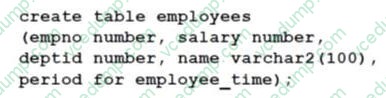
Which three statements are true concerning the use of the Valid Time Temporal feature for the EMPLOYEES table?
A. The valid time columns employee_time_start and employee_time_end are automatically created.
B. The same statement may filter on both transaction time and valid temp or altime by using the AS OF TIMESTAMP and PERIOD FOR clauses.
C. The valid time columns are not populated by the Oracle Server automatically.
D. The valid time columns are visible by default when the table is described.
E. Setting the session valid time using DBMS_FLASHBACK_ARCHIVE.ENABLE_AT_VALID_TIME sets the visibility for data manipulation language (DML), data definition language (DDL), and queries performed by the session.
Related Exams:
-
1Z0-020
Oracle8i: New Features for Administrators -
1Z0-023
Architecture and Administration -
1Z0-024
Performance Tuning -
1Z0-025
Backup and Recovery -
1Z0-026
Network Administration -
1Z0-034
Upgrade Oracle9i/10g OCA to Oracle Database OCP -
1Z0-036
Managing Oracle9i on Linux -
1Z0-041
Oracle Database 10g: DBA Assessment -
1Z0-052
Oracle Database 11g: Administration Workshop I -
1Z0-053
Oracle Database 11g: Administration II
Tips on How to Prepare for the Exams
Nowadays, the certification exams become more and more important and required by more and more enterprises when applying for a job. But how to prepare for the exam effectively? How to prepare for the exam in a short time with less efforts? How to get a ideal result and how to find the most reliable resources? Here on Vcedump.com, you will find all the answers. Vcedump.com provide not only Oracle exam questions, answers and explanations but also complete assistance on your exam preparation and certification application. If you are confused on your 1Z0-083 exam preparations and Oracle certification application, do not hesitate to visit our Vcedump.com to find your solutions here.