1Z0-083 Exam Details
-
Exam Code
:1Z0-083 -
Exam Name
:Oracle Database Administration II -
Certification
:Oracle Certifications -
Vendor
:Oracle -
Total Questions
:273 Q&As -
Last Updated
:May 31, 2026
Oracle 1Z0-083 Online Questions & Answers
-
Question 201:
Which three are true about SGA memory management in a multitenant database? (Choose three.)
A. Setting DB_CACHE_SIZE for a PDB guarantees a minimum amount of Database Buffer Cache memory for that PDB.
B. The SHARED_POOL_SIZE setting for a PDB can be up to 80% of the SHARED_POOL_SIZE setting of the root container.
C. Setting SHARED_POOL_SIZE for a PDB guarantees a minimum amount of Shared Pool memory for that PDB.
D. The SGA_TARGET setting for a PDB cannot exceed 50% of the SGA_TARGET value of the root container.
E. Setting SGA_TARGET for a PDB guarantees a minimum amount of SGA memory for that PDB.
F. SGA_MIN_SIZE cannot be set for a PDB. -
Question 202:
You are working on an Oracle Database 19c database. You enabled the Flashback Database feature.
Which two statements regarding flashback logs are true? (Choose two).)
A. Flashback logs are not archived.
B. Flashback logs are maintained in redo log files.
C. Flashback logs are maintained in the Flash Recovery Area.
D. Flashback logs are used to maintain Flashback Database related errors.
E. Flashback logs need to be cleared manually after you disable Flashback Database. -
Question 203:
A database is configured in ARCHIVELOG mode.
Full RMAN backups are taken and no backup to trace has been taken of the control file.
A media failure has occurred.
In which two scenarios is complete recovery possible? (Choose two.)
A. when any archived log from, before, or after the most recent backup is corrupt.
B. after losing all copies of the control file
C. after losing an archived log from after the most recent backup
D. after losing an archived log from before the most recent backup
E. after losing the SYSTEM tablespace -
Question 204:
Examine this output of an export from the current release of an Oracle multitenant database: $ sqlplus system/oracle . SQL> col name for a10 SQL> select name, open_mode from v$pdbs; NAME OPEN_MODE --------------------------------------PDB$SEED READ ONLY PDB1 READ WRITE PDB2 MOUNTED SQL> exit Next you execute: $ expdp system/oracle full=y
What is the outcome?
A. It fails because Data Pump cannot be container.
B. It creates a full export of the root
C. It creates a full export of the root
D. It creates a full export of only the used while connected to the root container and PDB1. container and all PDBs. container and all open PDBs. root container. -
Question 205:
Which two are true about creating pluggable databases (PDBs) in Oracle 19c and later releases?
A. A PDB snapshot depends on an existing storage snapshot of the source PDB.
B. A PDB snapshot can be a full copy of a source PDB.
C. A PDB snapshot can be a sparse copy of a source PDB
D. A snapshot copy PDB depends on a storage snapshot which can only be stored on specific file systems.
E. A snapshot copy PDB can be created from a stand-alone clone PDB. -
Question 206:
Examine the RMAN commands: RMAN> CONNECT TARGET "sbu@prod AS SYSBACKUP"; RMAN> CONNECT AUXILIARY "sbu@dup_db AS SYSBACKUP"; RMAN> DUPLICATE TARGET DATABASE TO dup_db FROM ACTIVE DATABASE PASSWORD FILE SECTION SIZE 400M;
Which statement is true about the DUPLICATE command?
A. It succeeds and creates multisection backup sets that are used for active database duplication.
B. It fails because there is no connection to a recovery catalog.
C. It succeeds only if the target database is in MOUNT state.
D. It fails because no parallel channels are allocated for the auxiliary database. -
Question 207:
You execute this command successfully:
SQL> ALTER DATABASE BACKUP CONTROLFILE TO TRACE;
What is the outcome?
A. It creates a binary backup of the control file.
B. It updates the alert log with the location and contents of the control file
C. It creates a file that contains SQL statements to re-create the control file.
D. It creates a file that contains RMAN scripts to create a duplicate database.
E. It creates a copy of the control file in the fast recovery area (FRA). -
Question 208:
Which three are true about managing memory components in an Oracle database instance? (Choose three.)
A. With Automatic Shared Memory Management, the database instance can increase the Large Pool size by reducing the Shared Pool size.
B. With Automatic Memory Management, the database instance can increase the System Global Area size by reducing the Program Global Area size.
C. Automatically tuned and resized System Global Area components will always revert to their initial sizes after an instance restart.
D. Automatic Memory Management must be used together with locking the System Global Area into physical memory.
E. With Automatic Shared Memory Management, the database instance can increase the Program Global Area size by reducing the System Global Area size.
F. On Line Transaction Processing systems often use less Program Global Area than Decision Support Systems. -
Question 209:
Examine the command for creating pluggable database PDB2 in container database CDB2.
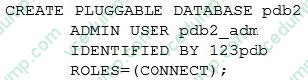
Select three options, any one of which is required for it to execute successfully? (Choose three.)
A. Add the FILE_NAME_CONVERT clause to the statement and set the PDB_FILE_NAME_CONVERT parameter.
B. Add only the CREATE_FILE_DEST clause to the statement.
C. Set only the PDB_FILE_NAME_CONVERT parameter.
D. Set the PDB_FILE_NAME_CONVERT parameter and enable OMF.
E. Enable only OMF.
F. Add the FILE_NAME_CONVERT clause to the statement and enable Oracle Managed Files (OMF) -
Question 210:
Which two are true about the Oracle dataabse methodology? (Choose two.)
A. The Oracle Database time model should be used to find the database and instance areas most in need of tuning.
B. Tuning activities should stop once the user is satisfied with performance.
C. Tuning activities should stop once agreed service levels for performance have been met.
D. The database instance memory should always be tuned before tuning any file systems.
E. SQL statements should always be tuned before tuning any file systems.
F. The alert log should be used to find the database and instance areas most in need of tuning.
Related Exams:
-
1Z0-020
Oracle8i: New Features for Administrators -
1Z0-023
Architecture and Administration -
1Z0-024
Performance Tuning -
1Z0-025
Backup and Recovery -
1Z0-026
Network Administration -
1Z0-034
Upgrade Oracle9i/10g OCA to Oracle Database OCP -
1Z0-036
Managing Oracle9i on Linux -
1Z0-041
Oracle Database 10g: DBA Assessment -
1Z0-052
Oracle Database 11g: Administration Workshop I -
1Z0-053
Oracle Database 11g: Administration II
Tips on How to Prepare for the Exams
Nowadays, the certification exams become more and more important and required by more and more enterprises when applying for a job. But how to prepare for the exam effectively? How to prepare for the exam in a short time with less efforts? How to get a ideal result and how to find the most reliable resources? Here on Vcedump.com, you will find all the answers. Vcedump.com provide not only Oracle exam questions, answers and explanations but also complete assistance on your exam preparation and certification application. If you are confused on your 1Z0-083 exam preparations and Oracle certification application, do not hesitate to visit our Vcedump.com to find your solutions here.