1Z0-082 Exam Details
-
Exam Code
:1Z0-082 -
Exam Name
:Oracle Database Administration I -
Certification
:Oracle Certifications -
Vendor
:Oracle -
Total Questions
:176 Q&As -
Last Updated
:Jul 15, 2026
Oracle 1Z0-082 Online Questions & Answers
-
Question 71:
Which two are true about shrinking a segment online? (Choose two.)
A. It is not possible to shrink either indexes or Index Organized Tables (IOTs)
B. It always eliminates all migrated rows if any exist in the table
C. To shrink a table it must have a PRIMARY KEY constraint
D. To shrink a table it must have a UNIQUE KEY constraint
E. To shrink a table it must have row movement enabled
F. It must be in a tablespace that uses Automatic Segment Space Management (ASSM) -
Question 72:
Which two statements are true about the ORDER BY clause when used with a SQL statement containing a SET operator such as UNION? (Choose two.)
A. Column positions must be used in the ORDER BY clause
B. Only column names from the first SELECT statement in the compound query are recognized
C. The first column in the first SELECT of the compound query with the UNION operator is used by default to sort output in the absence of an ORDER BY clause
D. Each SELECT statement in the compound query must have its own ORDER BY clause
E. Each SELECT statement in the compound query can have its own ORDER BY clause -
Question 73:
Which three functions are performed by dispatchers in a shared server configuration? (Choose three.)
A. writing inbound request to the common request queue from all shared server connections
B. checking for outbound shared server responses on the common outbound response queue
C. receiving inbound requests from processes using shared server connections
D. sending each connection input request to the appropriate shared server input queue
E. broadcasting shared server session responses back to requesters on all connections
F. sending shared server session responses back to requesters on the appropriate connection -
Question 74:
Which two statements are true about the ORDER BY clause? (Choose two.)
A. Only columns that are specified in the SELECT list can be used in the ORDER BY clause.
B. Numeric values are displayed in descending order if they have decimal positions.
C. NULLS are not included in the sort operation.
D. Column aliases can be used in the ORDER BY clause.
E. In a character sort, the values are case-sensitive. -
Question 75:
Examine the description of the PROMOTIONS table:
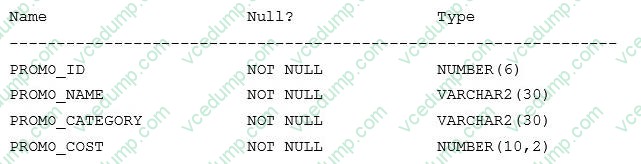
You want to display the unique promotion costs in each promotion category.
Which two queries can be used? (Choose two.)
A. SELECT promo_cost, promo_category FROM promotions ORDER BY by 1;
B. SELECT DISTINCT promo_cost || ' in ` || DISTINCT promo_category FROM promotions ORDER BY 1;
C. SELECT DISTINCT promo_category || ` has ` || promo_cost AS COSTS FROM promotions ORDER BY 1;
D. SELECT promo_category, DISTINCT promo_cost FROM promotions ORDER BY 2;
E. SELECT DISTINCT promo_category, promo_cost FROM promotions ORDER BY 1; -
Question 76:
Which compression method is recommended for Direct-Path Insert operations?
A. COLUMN STORE COMPRESS BASIC
B. COLUMN STORE COMPRESS ADVANCED
C. ROW STORE COMPRESS BASIC
D. ROW STORE COMPRESS ADVANCED -
Question 77:
Examine the description of the CUSTOMERS table: You must determine if any customers' details have been entered more than once using a different CUSTINO, by listing all duplicate names.
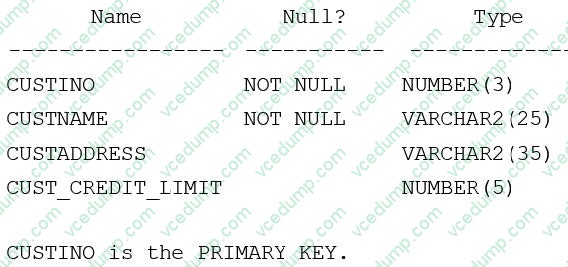
Which two methods can you use to get the required result? (Choose two.)
A. subquery
B. self join
C. LEFT OUTER JOIN with self join
D. RIGHT OUTER JOIN With self join
E. FULL OUTER JOIN with self join -
Question 78:
Your database instance is started with an SPFILE.
A PFILE is also available.
You execute this command:
ALTER SYSTEM SET DB_CACHE_SIZE=100K;
Where is the value changed?
A. in the SPFILE, SPFILE, and memory
B. in the SPFILE and in memory
C. only in the SPFILE
D. in the SPFILE and PFILE
E. only in memory -
Question 79:
Which three are types of segments in an Oracle Database? (Choose three.)
A. undo
B. index
C. stored procedures
D. sequences
E. tables
F. clusters -
Question 80:
Which three statements are true about time zones, date data types, and timestamp data types in an Oracle database? (Choose three.)
A. The CURRENT_TIMESTAMP function returns data without time zone information
B. A TIMESTAMP WITH LOCAL TIMEZONE data type column is stored in the database using the time zone of the session that inserted the row
C. A TIMESTAMP data type column contains information about year, month, and day
D. The DBTIMEZONE function can return an offset from Universal Coordinated Time (UTC)
E. The SESSIONTIMEZONE function can return an offset from Universal Coordinated Time (UTC)
Related Exams:
-
1Z0-020
Oracle8i: New Features for Administrators -
1Z0-023
Architecture and Administration -
1Z0-024
Performance Tuning -
1Z0-025
Backup and Recovery -
1Z0-026
Network Administration -
1Z0-034
Upgrade Oracle9i/10g OCA to Oracle Database OCP -
1Z0-036
Managing Oracle9i on Linux -
1Z0-041
Oracle Database 10g: DBA Assessment -
1Z0-052
Oracle Database 11g: Administration Workshop I -
1Z0-053
Oracle Database 11g: Administration II
Tips on How to Prepare for the Exams
Nowadays, the certification exams become more and more important and required by more and more enterprises when applying for a job. But how to prepare for the exam effectively? How to prepare for the exam in a short time with less efforts? How to get a ideal result and how to find the most reliable resources? Here on Vcedump.com, you will find all the answers. Vcedump.com provide not only Oracle exam questions, answers and explanations but also complete assistance on your exam preparation and certification application. If you are confused on your 1Z0-082 exam preparations and Oracle certification application, do not hesitate to visit our Vcedump.com to find your solutions here.