1Z0-082 Exam Details
-
Exam Code
:1Z0-082 -
Exam Name
:Oracle Database Administration I -
Certification
:Oracle Certifications -
Vendor
:Oracle -
Total Questions
:176 Q&As -
Last Updated
:Jul 15, 2026
Oracle 1Z0-082 Online Questions & Answers
-
Question 81:
Which three statements are true about undo segments and the use of undo by transactions in an Oracle database instance? (Choose three.)
A. An undo segment may be used by multiple transactions simultaneously
B. Undo segments can wrap around to the first extent when a transaction fills the last extend of the undo segment
C. Undo segments have a minimum of three extents
D. Undo segments can extend when a transaction fills the last extent of the undo segment
E. A single transaction may use multiple undo segments simultaneously
F. Undo segments must be stored in a BIGFILE tablespace
G. Undo segments must be stored in a SMALLFILE tablespace -
Question 82:
The orders table has a column ORDER_DATE of data type DATE.
The default display format for a date is DD-MON-RR.
Which two WHERE conditions demonstrate the correct usage of conversion functions? (Choose two.)
A. WHERE order_date > TO_DATE(ADD_MONTHS(SYSDATE, 6), 'MON DD YYYY')
B. WHERE order dare > TO DATE('JUL 10 2018', 'MON DD YYYY')
C. WHERE TO_CHAR(order date, 'MON DD YYYY') = 'JAN 20 2019'
D. WHERE order_date > TO_CHAR(ADD_MONTHS(SYSDATE, 6), 'MON DD YYYY')
E. WHERE order_date IN (TO_DATE('Oct 21 2018', 'Mon DD YYYY'), TO_CHAR('Nov 21 2018', 'Mon DD YYYY')) -
Question 83:
Which two statements are true about the rules of precedence for operators? (Choose two.)
A. The concatenation operator | | is always evaluated before addition and subtraction in an expression
B. NULLS influence the precedence of operators in an expression
C. The + binary operator has the highest precedence in an expression in a SQL statement
D. Arithmetic operators with equal precedence are evaluated from left to right within an expression
E. Multiple parentheses can be used to override the default precedence of operators in an expression -
Question 84:
Which two statements are true regarding a SAVEPOINT? (Choose two.)
A. Rolling back to a SAVEPOINT can undo a CREATE INDEX statement
B. Rolling back to a SAVEPOINT can undo a TRUNCATE statement
C. Only one SAVEPOINT may be issued in a transaction
D. A SAVEPOINT does not issue a COMMIT
E. Rolling back to a SAVEPOINT can undo a DELETE statement -
Question 85:
Examine the structure of the two tables:
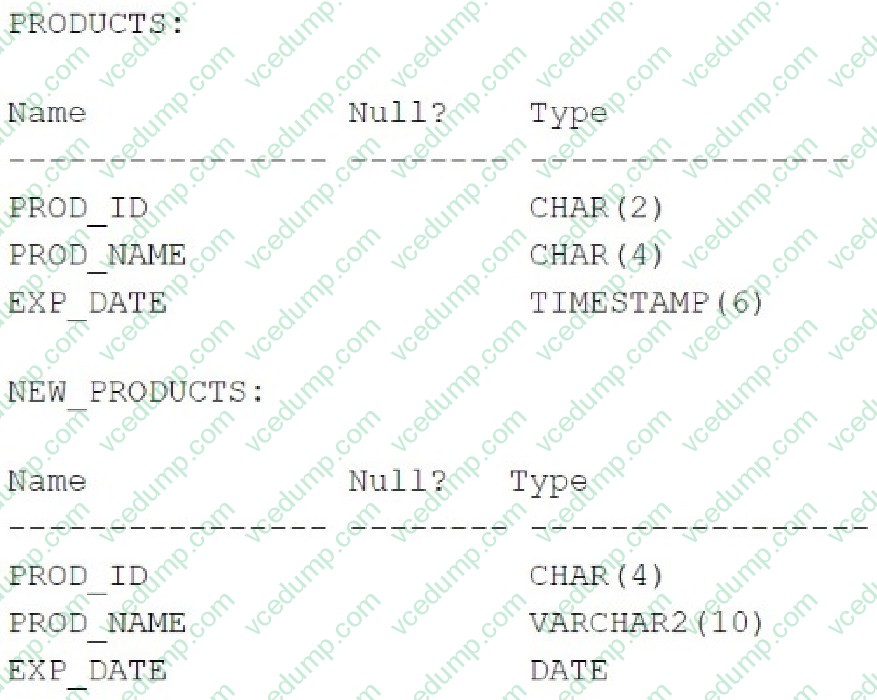
Which two queries execute successfully? (Choose two.)
A. SELECT * FROM products MINUS SELECT prod_id FROM new_products;
B. SELECT prod_id, prod_name FROM products INTERSECT SELECT 100, prod_name FROM new_products;
C. SELECT prod_id, exp_date FROM products UNION ALL SELECT prod_id, NULL FROM new_products;
D. SELECT * FROM products UNION SELECT * FROM new_products;
E. SELECT prod_id FROM products UNION ALL SELECT prod_id, prod_name FROM new_products; -
Question 86:
Which three files are used by conventional path SQL*Loader when the TABLE option is not specified? (Choose three.)
A. dump files
B. control files
C. password files
D. bad files
E. input files -
Question 87:
Which three statements are true about GLOBAL TEMPORARY TABLES? (Choose three.)
A. GLOBAL TEMPORARY TABLE space allocation occurs at session start.
B. GLOBAL TEMPORARY TABLE rows inserted by a session are available to any other session whose user has been granted select on the table.
C. A TRUNCATE command issued in a session causes all news in a GLOBAL TEMPORARY TABLE for the issuing session to be deleted.
D. A GLOBAL TEMPORARY TABLE 's definition is available to multiple sessions.
E. A DELETE command on a GLOBAL TEMPORARY TABLE cannot be rolled back.
F. Any GLOBAL TEMPORARY TABLE rows existing at session termination will be deleted. -
Question 88:
Examine this description of the TRANSACTIONS table:
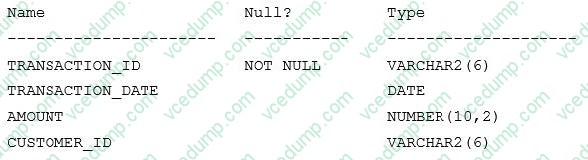
Which two SQL statements execute successfully? (Choose two.)
A. SELECT customer_id AS "CUSTOMER-ID", transaction_date AS DATE, amount + 100 "DUES" FROM transactions;
B. SELECT customer_id AS "CUSTOMER-ID", transaction_date AS "DATE", amount + 100 DUES FROM transactions;
C. SELECT customer_id AS CUSTOMER-ID, transaction_date AS TRANS_DATE, amount + 100 "DUES AMOUNT" FROM transactions;
D. SELECT customer_id CUSTID, transaction_date TRANS_DATE, amount + 100 DUES FROM transactions;
E. SELECT customer_id AS `CUSTOMER-ID', transaction_date AS DATE, amount + 100 `DUES AMOUNT' FROM transactions; -
Question 89:
Examine the description of the PRODUCT_INFORMATION table:
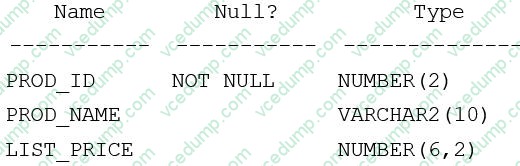
Which query retrieves the number of products with a null list price?
A. SELECT COUNT(list_price) FROM product_information WHERE list_price IS NULL;
B. SELECT COUNT(NVL(list_price, 0)) FROM product_information WHERE list_price IS NULL;
C. SELECT COUNT(DISTINCT list price) FROM product_information WHERE list_price IS NULL;
D. SELECT COUNT(list_price) FROM product_information WHERE list_price = NULL; -
Question 90:
Examine these statements executed in a single Oracle session:
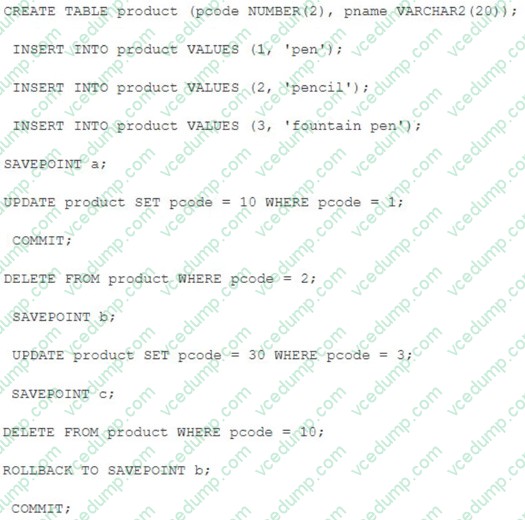
Which three statements are true? (Choose three.)
A. The code for pen is 10.
B. There is no row containing fountain pen.
C. There is no row containing pen.
D. The code for fountain pen is 3.
E. The code for pen is l.
F. There is no row containing pencil.
Related Exams:
-
1Z0-020
Oracle8i: New Features for Administrators -
1Z0-023
Architecture and Administration -
1Z0-024
Performance Tuning -
1Z0-025
Backup and Recovery -
1Z0-026
Network Administration -
1Z0-034
Upgrade Oracle9i/10g OCA to Oracle Database OCP -
1Z0-036
Managing Oracle9i on Linux -
1Z0-041
Oracle Database 10g: DBA Assessment -
1Z0-052
Oracle Database 11g: Administration Workshop I -
1Z0-053
Oracle Database 11g: Administration II
Tips on How to Prepare for the Exams
Nowadays, the certification exams become more and more important and required by more and more enterprises when applying for a job. But how to prepare for the exam effectively? How to prepare for the exam in a short time with less efforts? How to get a ideal result and how to find the most reliable resources? Here on Vcedump.com, you will find all the answers. Vcedump.com provide not only Oracle exam questions, answers and explanations but also complete assistance on your exam preparation and certification application. If you are confused on your 1Z0-082 exam preparations and Oracle certification application, do not hesitate to visit our Vcedump.com to find your solutions here.