1Z0-071 Exam Details
-
Exam Code
:1Z0-071 -
Exam Name
:Oracle Database SQL -
Certification
:Oracle Certifications -
Vendor
:Oracle -
Total Questions
:415 Q&As -
Last Updated
:May 26, 2026
Oracle 1Z0-071 Online Questions & Answers
-
Question 281:
Examine the data in the ENPLOYEES table:
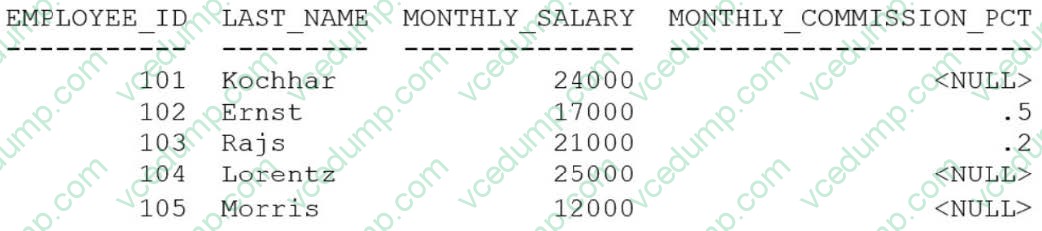
Which statement will compute the total annual compensation tor each employee
A. SELECT last_name, (monthly_salary * 12) + (monthly_salary * 12 * NVL(monthly_commission_pct, 0)) AS annual_comp FROM employees;
B. SELECT last_name, (monthly_salary * 12) + (monthly_salary * 12 * monthly_commission_pct) AS annual_comp FROM employees;
C. SELECT last_name, (monthly_salary + monthly_commission_pct) * 12 AS annual_comp FROM employees;
D. SELECT last_name, (monthly_salary * 12) + (monthly_commission_pct * 12) AS annual_comp FROM employees; -
Question 282:
Which two statements are true regarding non-equijoins? (Choose two.)
A. Table aliases must be used.
B. The SQL:1999 compliant ANSI join syntax must be used.
C. The USING clause can be used.
D. The Oracle join syntax can be used.
E. The ON clause can be used. -
Question 283:
Which three statements are true about time zones, date data types, and timestamp data types in an Oracle database? (Choose three.)
A. A TIMESTAMP WITH LOCAL TIMEZONE data type column is stored in the database using the time zone of the session that inserted the row.
B. The SESSIONTIMEZONE function can return an offset from Universal Coordinated Time (UTC).
C. The DBTIMEZONE function can return an offset from Universal Coordinated Time (UTC).
D. The CURRENT_TIMESTAMP function returns data without time zone information.
E. A TIMESTAMP data type column contains information about year, month, and day. -
Question 284:
Examine the description of the EMPLOYEES table:
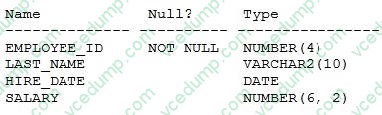
Examine these requirements:
1.
Display the last name, date of hire and the number of years of service for each employee.
2.
If the employee has been employed 5 or more years but less than 10, display "5+ years of service".
3.
If the employee has been employed 10 or more years but less than 15, display "10+ years of service".
4.
If the employee has been employed 15 or more years, display "15+ years of service".
5.
If none of these conditions matches, display "<5 years of service".
6.
Sort the results by the HIRE_DATE column.
Which statement satisfies all the requirements?
A. Option A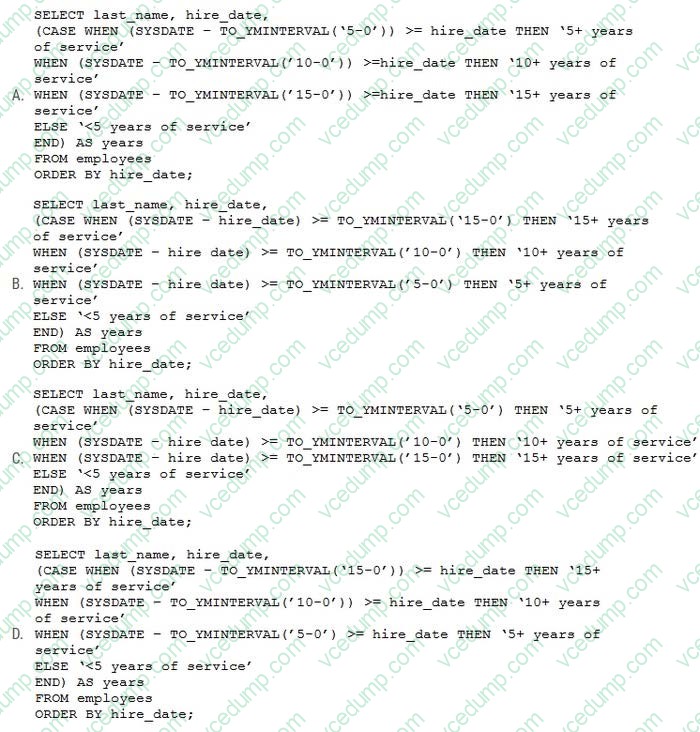
B. Option B
C. Option C
D. Option D -
Question 285:
You execute these commands successfully:
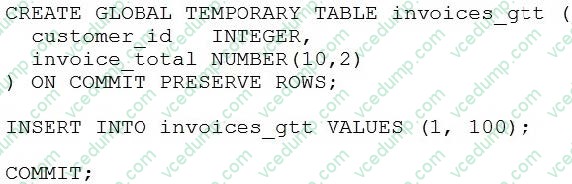
Which two are true?
A. You can add a foreign key to the table.
B. When you terminate your session, the row will be deleted.
C. To drop the table in this session, you must first truncate it.
D. You can add a column to the table in this session.
E. Other sessions can view the committed row. -
Question 286:
View the exhibit and examine the structure in ORDERS and ORDER_ITEMS tables.
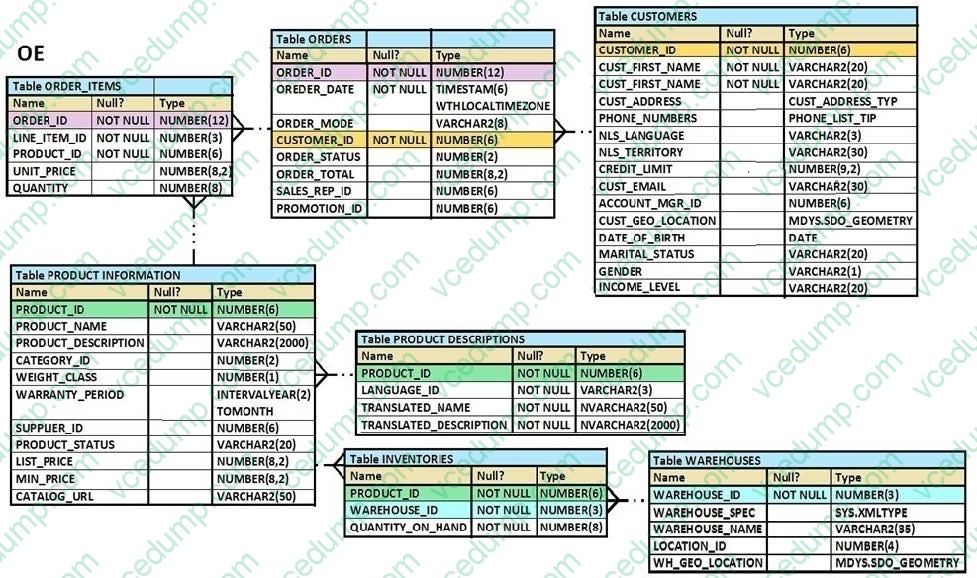
You need to create a view that displays the ORDER_ID, ORDER_DATE, and the total number of items in each order.
Which CREATE VIEW statement would create the view successfully?
A. CREATE OR REPLACE VIEW ord_vu AS SELECT o.order_id, o.order_date, COUNT (i.line_item_id) FROM orders o JOIN order_items i ON (o.order_id = i.order_id) GROUP BY o.order_id, o.order_date;
B. CREATE OR REPLACE VIEW ord_vu (order_id, order_date) AS SELECT o.order_id, o.order_date, COUNT (i.line_item_id) "NO OF ITEMS" FROM orders o JOIN order_items i ON (o.order_id = i.order_id) GROUP BY o.order_id, o.order_date;
C. CREATE OR REPLACE VIEW ord_vu AS SELECT o.order_id, o.order_date, COUNT (i.line_item_id) "NO OF ITEMS" FROM orders o JOIN order_items i ON (o.order_id = i.order_id) GROUP BY o.order_id, o.order_date;
D. CREATE OR REPLACE VIEW ord_vu AS SELECT o.order_id, o.order_date, COUNT (i.line_item_id) || "NO OF ITEMS" FROM orders o JOIN order_items i ON (o.order_id = i.order_id) GROUP BY o.order_id, o.order_date WHITH CHECK OPTION; -
Question 287:
Which three statements are true about GLOBAL TEMPORARY TABLES?
A. GLOBAL TEMPORARY TABLE rows inserted by a session are available to any other session whose user has been granted select on the table.
B. A TRUNCATE command issued in a session causes all rows In a GLOBAL TEMPORARY TABLE for the issuing session to be deleted.
C. A DELETE command on a GLOBAL TEMPORARY TABLE cannot be rolled back.
D. A GLOBAL TEMPORARY TABLE's definition is available to multiple sessions.
E. Any GLOBAL TEMPORARY TABLE rows existing at session termination will be deleted.
F. GLOBAL TEMPORARY TABLE space allocation occurs at session start. -
Question 288:
Examine this query:
SELECT TRUNC (ROUND(156.00,-2),-1) FROM DUAL;
What is the result?
A. 16
B. 160
C. 150
D. 200
E. 100 -
Question 289:
Which three are true about system and object privileges? (Choose three.)
A. WITH GRANT OPTTON cannot be used when granting an object privilege to PUBLIC.
B. WITH GRANT OPTION can be used when granting an object privilege to both users and roles.
C. Revoking an object privilege that was granted with the WITH GRANT OPTION clause has a cascading effect.
D. Adding a primary key constraint to an existing table in another schema requires a system privilege.
E. Adding a foreign key constraint pointing to a table in another schema requires the REFERENCES object privilege.
F. Revoking a system privilege that was granted with WITH ADMIN OPTION has a cascading effect. -
Question 290:
You create a table named 123. Which statement runs successfully?
A. SELECT * FROM TABLE (123) ;
B. SELECT * FROM andapos;123andapos;;
C. SELECT * FROM "123";
D. SELECT * FROM Vandapos;123Vandapos;;
Related Exams:
-
1Z0-020
Oracle8i: New Features for Administrators -
1Z0-023
Architecture and Administration -
1Z0-024
Performance Tuning -
1Z0-025
Backup and Recovery -
1Z0-026
Network Administration -
1Z0-034
Upgrade Oracle9i/10g OCA to Oracle Database OCP -
1Z0-036
Managing Oracle9i on Linux -
1Z0-041
Oracle Database 10g: DBA Assessment -
1Z0-052
Oracle Database 11g: Administration Workshop I -
1Z0-053
Oracle Database 11g: Administration II
Tips on How to Prepare for the Exams
Nowadays, the certification exams become more and more important and required by more and more enterprises when applying for a job. But how to prepare for the exam effectively? How to prepare for the exam in a short time with less efforts? How to get a ideal result and how to find the most reliable resources? Here on Vcedump.com, you will find all the answers. Vcedump.com provide not only Oracle exam questions, answers and explanations but also complete assistance on your exam preparation and certification application. If you are confused on your 1Z0-071 exam preparations and Oracle certification application, do not hesitate to visit our Vcedump.com to find your solutions here.