1Z0-071 Exam Details
-
Exam Code
:1Z0-071 -
Exam Name
:Oracle Database SQL -
Certification
:Oracle Certifications -
Vendor
:Oracle -
Total Questions
:415 Q&As -
Last Updated
:Jul 14, 2026
Oracle 1Z0-071 Online Questions & Answers
-
Question 1:
Examine the following query: SQL> SELECT prod_id, amount_sold FROM sales ORDER BY amount_sold FETCH FIRST 5 PERCENT ROWS ONLY;
What is the output of this query?
A. It displays 5 percent of the products with the highest amount sold.
B. It displays the first 5 percent of the rows from the SALES table.
C. It displays 5 percent of the products with the lowest amount sold.
D. It results in an error because the ORDER BY clause should be the last clause. -
Question 2:
In your session, the NLS._DAE_FORMAT is DD- MM- YYYY.There are 86400 seconds in a day.Examine this result:
1.
DATE
2.
02-JAN-2020
Which statement returns this?
A. SELECT TO_ CHAR(TO_ DATE(`29-10-2019') +INTERVAL `2'; MONTH + INTERVAL `5'; DAY INTERVAL `86410' SECOND, ` DD-MON-YYYY') AS "date" FROM DUAL;
B. SELECT TO_ CHAR(TO_ DATE(`29-10-2019') + INTERVAL `3' MONTH + INTERVAL `7' DAY INTERVAL `360' SECOND, ` DD-MON-YYYY') AS "date" FROM DUAL;
C. SELECT To CHAR(TO _DATE(`29-10-2019') + INTERVAL `2' NONTH + INTERVAL `5' DAY INEERVAL `120' SECOND, ` DD-MON-YYY) AS "date" FROM DUAL;
D. SELECT-TO_CHAR(TO _DATE(`29-10-2019'+ INTERVAL `2' MONTH+INTERVAL `6' DAYINTERVAL `120' SECOND, `DD-MON-YY') AS "daTe" FROM DUAL;
E. SELECT-TO_CHAR(TO _DATE(`29-10-2019'+ INTERVAL `2' MONTH+INTERVAL `4' DAYINTERVAL `120' SECOND, `DD-MON-YY') AS "daTe" FROM DUAL; -
Question 3:
Examine this partial statement: SELECT ename, sal,comm FROM emp Now examine this output:
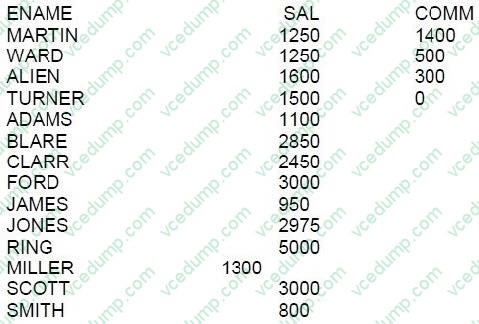
WHICH ORDER BY clause will generate the displayed output?
A. ORDER BY NVL(enam,0) DESC, ename
B. ORDER BY NVL(comm,0) ASC NULLS FIRST, ename
C. ORDER BY NVL(comm,0) ASC NULLS LAST, ename
D. ORDER BY comm DESC NULLS LAST, ename -
Question 4:
Which statement is true regarding the INTERSECT operator?
A. The names of columns in all SELECT statements must be identical.
B. It ignores NULL values.
C. Reversing the order of the intersected tables alters the result.
D. The number of columns and data types must be identical for all SELECT statements in the query. -
Question 5:
Which three actions can you perform by using the ORACLE_DATAPUMP access driver? (Choose three.)
A. Create a directory object for a flat file.
B. Create a directory object for an external table.
C. Read data from an external table and load it into a table in the database.
D. Execute DML statements on an external table.
E. Read data from a table in the database and insert it into an external table.
F. Query data from an external table. -
Question 6:
Examine this list of requirements for a sequence:
1.
Name:EMP_SEQ
2.
First value returned:1
3.
Duplicates are never permitted.
4.
Provide values to be inserted into the EMPLOYEES.EMPLOYEE_ID COLUMN.
5.
Reduce the chances of gaps in the values.
Which two statements will satisfy these requirements?
A. CREATE SEQUENCE emp_seq START WITH 1 INCRENENT BY 1 NOCACHE;
B. CREATE SEQUENCE emp_seq START WITH 1 INCREMENT BY 1 CYCLE;
C. CREATE SEQUENCE emp_seq NOCACHE;
D. CREATE SEQUENCE emp_seq START WITH 1 CACHE;
E. CREATE SEQUENCE emp_seq START WITH 1 INCREMENT BY 1 CACHE;
F. CREATE SEQUENCE emp_seq; -
Question 7:
Which three statements are true about external tables? (Choose three.)
A. They can be temporary tables.
B. DML statements can modify them.
C. They can be used in queries containing joins.
D. They can be used in queries containing sorts.
E. They can be indexed.
F. Their metadata is stored in the database. -
Question 8:
Examine the description of the CUSTOMERS table:
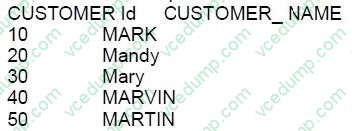
Which two SELECT statements will return these results: (Choose two.)
CUSTOMER_ NAME
Mandy Mary
A. SELECT customer_name FROM customers WHERE UPPER(customer_name) LIKE `MA*';
B. SELECT customer_name FROM customers WHERE customer_name = `*Ma*';
C. SELECT customer_name FROM customers WHERE customer_name LIKE `Ma*';
D. SELECT customer_name FROM customers WHERE UPPER(customer_name) LIKE `MA%';
E. SELECT customer_name FROM customers WHERE customer_name LIKE `%a%';
F. SELECT customer_name FROM customers WHERE customer_name LIKE `Ma%';
G. SELECT customer_name FROM customers WHERE customer_name LIKE `*Ma*'; -
Question 9:
Which three statements are true regarding the data types? (Choose three.)
A. The minimum column width that can be specified for a VARCHAR2 data type column is one.
B. Only one LONG column can be used per table.
C. A TIMESTAMP data type column stores only time values with fractional seconds.
D. The BLOB data type column is used to store binary data in an operating system file.
E. The value for a CHAR data type column is blank-padded to the maximum defined column width. -
Question 10:
Which two join conditions in a FROM clause are non-equijoins? (Choose two.)
A. table1 JOIN table2 USING (column1, column2)
B. table1 JOIN table2 ON (table1.column BETWEEN table2.column1 AND table2.column2)
C. table1 NATURAL JOIN table2
D. table1 JOIN table2 ON (table1.column >= table2.column)
E. table1 JOIN table2 ON (table1.column = table2.column) WHERE table2.column LIKE `A%'
Related Exams:
-
1Z0-020
Oracle8i: New Features for Administrators -
1Z0-023
Architecture and Administration -
1Z0-024
Performance Tuning -
1Z0-025
Backup and Recovery -
1Z0-026
Network Administration -
1Z0-034
Upgrade Oracle9i/10g OCA to Oracle Database OCP -
1Z0-036
Managing Oracle9i on Linux -
1Z0-041
Oracle Database 10g: DBA Assessment -
1Z0-052
Oracle Database 11g: Administration Workshop I -
1Z0-053
Oracle Database 11g: Administration II
Tips on How to Prepare for the Exams
Nowadays, the certification exams become more and more important and required by more and more enterprises when applying for a job. But how to prepare for the exam effectively? How to prepare for the exam in a short time with less efforts? How to get a ideal result and how to find the most reliable resources? Here on Vcedump.com, you will find all the answers. Vcedump.com provide not only Oracle exam questions, answers and explanations but also complete assistance on your exam preparation and certification application. If you are confused on your 1Z0-071 exam preparations and Oracle certification application, do not hesitate to visit our Vcedump.com to find your solutions here.