1Z0-071 Exam Details
-
Exam Code
:1Z0-071 -
Exam Name
:Oracle Database SQL -
Certification
:Oracle Certifications -
Vendor
:Oracle -
Total Questions
:415 Q&As -
Last Updated
:May 26, 2026
Oracle 1Z0-071 Online Questions & Answers
-
Question 111:
Which three arithmetic operations can be performed on a column by using a SQL function that is built into Oracle database? (Choose three.)
A. Finding the lowest value
B. Finding the quotient
C. Raising to a power
D. Subtraction
E. Addition -
Question 112:
Which statement is true about an inner join specified in a query's WHERE clause?
A. It only applies for equijoin conditions.
B. It applies for equijoin and nonequijoin conditions.
C. It requires column names to be the same in all tables being joined.
D. It must have primary-key and foreign-key constraints defined on the join columns. -
Question 113:
Which three statements are true? (Choose three.)
A. The data dictionary is created and maintained by the database administrator.
B. The data dictionary views consist of joins of dictionary base tables and user-defined tables.
C. The usernames of all the users including database administrators are stored in the data dictionary.
D. The USER_CONS_COLUMNS view should be queried to find the names of columns to Which constraints apply.
E. Both USER_OBJECTS and CAT views provide the same information about all objects that are owned by the user.
F. Views with the same name but different prefixes, such as DBA, ALL and USER, reference the same base tables from the data dictionary. -
Question 114:
Which task can be performed by using a single Data Manipulation Language (DML) statement?
A. adding a column constraint while inserting a row into a table
B. adding a column with a default value while inserting a row into a table
C. removing all data only from a single column on Which a unique constraint is defined
D. removing all data only from a single column on Which a primary key constraint is defined -
Question 115:
Which two are true about the NVL, NVL2, and COALESCE functions?
A. The first expression in NVL2 is never returned.
B. NVL2 can have any number of expressions in the list.
C. COALESCE stops evaluating the list of expressions when it finds the first null value.
D. COALESCE stops evaluating the list of expressions when it finds the first non-null value.
E. NVL must have expressions of the same data type.
F. NVL can have any number of expressions in the list. -
Question 116:
You execute these commands:
CREATE TABLE customers (customer id INTEGER, customer name VARCHAR2 (20));
INSERT INTO customers VALUES (1`Custmoer1 `);
SAVEPOINT post insert;
INSERT INTO customers VALUES (2, 'Customer2 `);
SELECTCOUNT (*) FROM customers;
Which two, used independently, can replace
A. ROLLBACK;so the query retums 1?
B. COMMIT;
C. ROLIBACK TO SAVEPOINT post_ insert;
D. CONOIT TO SAVEPOINT post_ insert;
E. ROLLEBACK TO post_ insert; -
Question 117:
Examine these statements:

Which is true ahout modifyIng the columns in AITER_TEST?
A. c1 can be changed to NUMBER(10) and c2 can be changed to VARCHAN2 (10).
B. c2 can be changed to NUMBER(5) but c1 cannot be changed to VARCHAN2 (5).
C. c2 can be changed to VARCHAR2(10) but c1 cannot be changed to NUMBER (10).
D. c1 can be changed to NUMBER(10) but c2 cannot be changed to VARCHAN2 (10).
E. c1 can be changed to VARCHAR2(5) and c2 can be changed to NUMBER (12,2). -
Question 118:
Which statement is true about TRUNCATE and DELETE?
A. For tables with multiple indexes and triggers DELETE is faster than TRUNCATE.
B. For large tables TRUNCATE is faster than DELETE.
C. You can never TRUNCATE a table if foreign key constraints will be violated.
D. You can never DELETE rows from a table if foreign key constraints will be violated. -
Question 119:
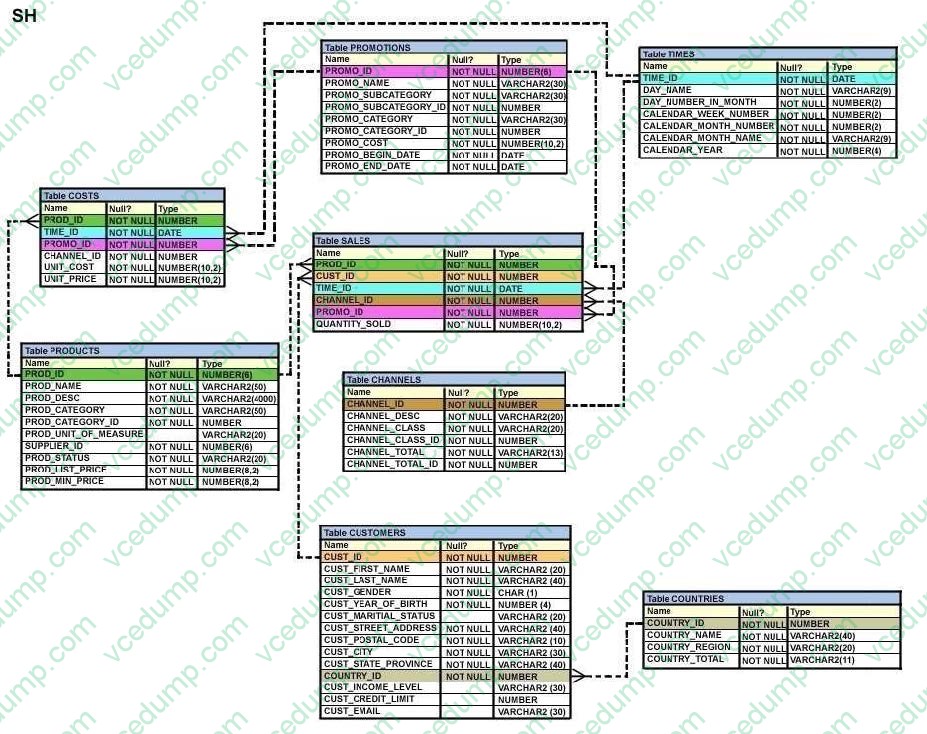
View the Exhibit and examine the description for the SALES and CHANNELS tables. (Choose the best answer.)
You issued this SQL statement:
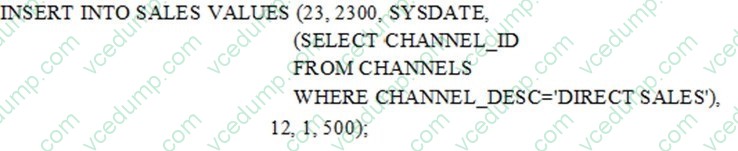
Which statement is true regarding the result?
A. The statement will fail because the subquery in the VALUES clause is not enclosed within single quotation marks.
B. The statement will fail because a subquery cannot be used in a VALUES clause.
C. The statement will execute and a new row will be inserted in the SALES table.
D. The statement will fail because the VALUES clause is not required with the subquery. -
Question 120:
Which two are true about granting object privileges on tables, views, and sequences? (Choose two.)
A. INSERT can be granted only on tables and sequences.
B. DELETE can be granted on tables, views, and sequences.
C. SELECT can be granted on tables, views, and sequences.
D. ALTER can be granted only on tables and sequences.
E. REFERENCES can be granted only on tables.
Related Exams:
-
1Z0-020
Oracle8i: New Features for Administrators -
1Z0-023
Architecture and Administration -
1Z0-024
Performance Tuning -
1Z0-025
Backup and Recovery -
1Z0-026
Network Administration -
1Z0-034
Upgrade Oracle9i/10g OCA to Oracle Database OCP -
1Z0-036
Managing Oracle9i on Linux -
1Z0-041
Oracle Database 10g: DBA Assessment -
1Z0-052
Oracle Database 11g: Administration Workshop I -
1Z0-053
Oracle Database 11g: Administration II
Tips on How to Prepare for the Exams
Nowadays, the certification exams become more and more important and required by more and more enterprises when applying for a job. But how to prepare for the exam effectively? How to prepare for the exam in a short time with less efforts? How to get a ideal result and how to find the most reliable resources? Here on Vcedump.com, you will find all the answers. Vcedump.com provide not only Oracle exam questions, answers and explanations but also complete assistance on your exam preparation and certification application. If you are confused on your 1Z0-071 exam preparations and Oracle certification application, do not hesitate to visit our Vcedump.com to find your solutions here.