1Z0-070 Real Exam Questions

Oracle Exadata X5 Administration

103 questions available · Page 1 of 11

Updated Exam DumpsVerified AnswersPass Guarantee

Get Complete Exam Dumps
Question 1 Multiple choice

You are planning the migration of a large data warehouse to a Little Endian X6 Database Machine using which is running database version 12.2.0.1.

The current database version is Oracle Database 11.2.0.4.0 hosted on a Big Endian platform.

The current database characterset is WE8ISO8859P15.

Which two migration methods are supported?

  1. A

    Data Pump

  2. B

    cross-platform Transportable Database

  3. C

    Physical Standby database

  4. D

    Logical Standby database

Show answer and explanation

Correct answers: A, D

Explanation

References:
https://www.oracle.com/technetwork/database/upgrade/overview/upgrading-oracle-database-wp-122-3403093.pdf

Question 2 Single choice

Which statement is true about operating systems in an X5 Database Machine multirack configuration consisting of two full racks and one Exadata storage expansion rack?

  1. A

    All Exadata storage servers used by the same virtual cluster nodes must run the same O/S but Exadata Storage Servers in different clusters may run different operating systems.

  2. B

    All Exadata storage servers must run the Oracle Solaris O/S and all database servers within the same cluster must run Oracle Linux.

  3. C

    All Exadata storage servers may run Oracle Virtual Machine (OVM).

  4. D

    All Exadata storage servers must run Oracle Linux.

  5. E

    All Exadata storage servers must run the Oracle Linux O/S and all database servers within the same cluster must run the same version of Oracle Virtual Machine (OVM).

Show answer and explanation

Correct answer: D

Explanation

Explanation:
On both physical and virtual deployments, Exadata systems use minimal Linux distributions to ensure that just the RPMs needed to run Oracle database, are installed and enabled.

References:
http://www.oracle.com/technetwork/database/exadata/exadata-x5-2-ds-2406241.pdf

Question 3 Multiple choice

You are checking the status of the ports on one of the InfiniBand switches on your X5 Database Machine.

You run the getportstatus command as shown:

[root@exampsw-ib2 bin]# getportstatus 17b
Port status for connector 17B Switch Port 2
Adminstate:......................Enabled
LinkWidthEnabled: ...............1X or 4X
LinkWidthSupported:..............1X or 4X
LinkWidthActive..................4X

LinkSpeedSupported: .
....2.5 Gbps or 5.0 Gbps or 10.0 Gbps LinkState: ....................Active PhysLinkState: ................LinkUp LinkSpeedActive: ...........10.0 Gbps LinkSpeedEnabled: .

...2.5 Gbps or 5.0 Gbps or 10.0 Gbps

You have 36 ports to check.

Which two methods would you use to check the status of all 36 ports?

  1. A

    Use the ibqueryerrors.pl script after logging in to the InfiniBand switch as root.

  2. B

    Use Enterprise Manager.Cloud Control.

  3. C

    Use Enterprise Manager Express.

  4. D

    Create user-defined metrics for the InfiniBand switch.

Show answer and explanation

Correct answers: A, B

Explanation

Explanation:
There are two approaches for monitoring Oracle Exadata Storage Servers: using a command-line interface (CLI) or using the graphical interface provided by the Oracle Enterprise Manager Cloud Control 12c console.

You can manually monitor the InfiniBand Switch Ports with the ibqueryerrors.pl command.
Run the ibqueryerrors.pl command to report on switch port error counters and port configuration information using the command:
# ibqueryerrors.pl -rR -s RcvSwRelayErrors,XmtDiscards,XmtWait,VL15Dropped

References:
http://www.oracle.com/technetwork/articles/servers-storage-admin/monitor-exadata-em12-
2291964. html

Question 4 Multiple choice

Which two statements are true about Auto Service Request (ASR) with an X5 Database Machine?

  1. A

    ASR Manager must be installed and configured on a dedicated server external to the Database

    Machine.

  2. B

    Configuring ASR is mandatory for all Database Machine assets.

  3. C

    ASR Manager opens a service request (SR) automatically after sensors detect hardware faults.

  4. D

    ASR Manager must be installed and configured on one of the database servers.

  5. E

    ASR can upload configuration metadata to support problem resolution.

  6. F

    ASR communicates with Oracle support services using HTTPS.

Show answer and explanation

Correct answers: A, C

Explanation

Explanation:
A: Oracle recommends that you install Oracle ASR Manager on an external, standalone server.

C: Oracle ASR is designed to generate Oracle service requests automatically when certain types of faults are detected on Oracle products that are qualified for Oracle ASR.

Oracle ASR works only for specific component faults. Most of the common components, such as disks, fans, and power supplies, are covered. However, some components are not covered. For example, Oracle ASR does not cover InfiniBand events; there are specific images and specific InfiniBand switch firmware
that you must use. You cannot upgrade these components independently.

Incorrect Answers:
D: Oracle recommends that you install Oracle ASR Manager on an external, standalone server.

References:
http://docs.oracle.com/cd/E80920_01/ASXQI/toc.htm#GUID-490B2837-C608-4626-B4FF-59F679C36302

Question 5 Multiple choice

Which three statements are true about Automatic Hard Disk Scrubbing and repair on high-capacity storage servers in an X5 Database Machine?

  1. A

    Disk repair is made immediately from Smart Flash Cache for corruption on disk when the

    corresponding data is clean in the Smart Flash Cache.

  2. B

    Hard disks are scanned every two weeks by default but only when disks are idle.

  3. C

    Hard disks are scanned every two weeks by default in all situations.

  4. D

    Disk repair is made immediately from Smart Flash Cache for corruption on disk when the

    corresponding data is dirty in the Smart Flash Cache.

  5. E

    Disk repair may be made from another mirror copy if the corrupt area is part of a Normal or High

    Redundancy Disk Group.

Show answer and explanation

Correct answers: A, C, E

Explanation

Explanation:
The default schedule of scrubbing is every two weeks.

References:
http://docs.oracle.com/cd/E80920_01/DBMMN/maintaining-exadata-storage-servers.htm

Question 6 Multiple choice

Which two are true about sparse griddisks and their use in disk groups on an X5 Exadata Database Machine?

  1. A

    Sparse diskgroups must be created using sparse griddisks.

  2. B

    Sparse diskgroups may be created using a combination of sparse and non-sparse griddisks.

  3. C

    Sparse diskgroups may not be used for database snapshots.

  4. D

    Additional space for a sparse griddisk is allocated as soon as newly written data is stored in the flashcache on a cell.

  5. E

    The virtual size of a sparse griddisk may exceed the physical size of the space occupied by the griddisk.

Show answer and explanation

Correct answers: A, E

Explanation

Explanation:
A: A sparse ASM disk group is composed of sparse grid disks.

E: Sparse grid disks allocate space as new data is written to the disk, and therefore have a virtual size that can be much larger than the actual physical size. Sparse grid disks can be used to create a sparse disk group to store database files that will use a small portion of their allocated space. Sparse disk groups are especially useful for quickly and efficiently creating database snapshots on Oracle Exadata. Traditional databases can also be created using a sparse disk group.

References:
http://docs.oracle.com/cd/E80920_01/SAGUG/exadata-storage-server-snapshots.htm#SAGUG-GUID-42945059-13FD-4F6A-B7FA-A1201D16238F
http://docs.oracle.com/cd/E80920_01/DBMSO/exadata-whatsnew.htm#DBMSO22120

Question 7 Multiple choice

Which four statements are true concerning the configuration or use of Enterprise Manager Cloud Control to monitor and manage Exadata Database Machine components?

  1. A

    Computer nodes forward their SNMP traps to the Management Server process on the same computer

    node.

  2. B

    Storage nodes forward their SNMP traps to the Management Server process on the same storage

    node.

  3. C

    Cloud control can monitor and manage a Database Machine compute node expansion rack.

  4. D

    Oracle management agents must only be installed on one storage node in a Database Machine to

    enable monitoring and management of all storage nodes.

  5. E

    Cloud Control cannot monitor partitioned Exadata Database Machine systems.

  6. F

    Cloud Control can monitor and manage a Database Machine storage Expansion rack.

  7. G

    Oracle management agents must only be installed on one compute node in a Database Machine to

    enable monitoring and management of all compute nodes and storage nodes.

Show answer and explanation

Correct answers: B, C, F, G

Explanation

Explanation:
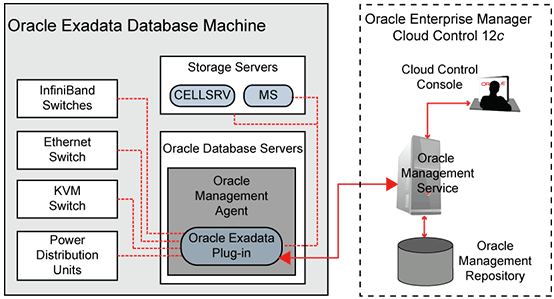
B (not A): Oracle Exadata components-including database and storage servers, switches, and power distribution units (PDUs)-use SNMP to raise alerts and report monitoring information.
Oracle's CellCLI interface is a Java-based framework delivered by the storage cell's management server process (MS) that provides administrative capabilities to your storage server entities.

C: Cloud control can monitor the Exadata Database Machine.

Figure: Oracle Enterprise Manager Cloud Control 12c monitoring architecture. Note the Management Server process (MS) on the Storage servers.

G (not D): Before using Oracle Enterprise Manager Cloud Control 12c with Oracle Exadata, an Oracle Management Agent and Oracle Exadata plug-in must be installed on every Oracle Exadata database server (compute node). This agent monitors software targets, such as the database instances and Oracle Clusterware resources, on the database servers. The plug-in enables monitoring of other hardware components in Oracle Exadata, including the storage servers, switches, and power distribution units.

References:
http://www.oracle.com/technetwork/articles/servers-storage-admin/monitor-exadata-em12-
2291964. html

Question 8 Multiple choice

Which three must be true for a Smart Scan to occur for a table?

  1. A

    cell_offload_processing must be true in sessions issuing SQL statements that access the table.

  2. B

    The query must be executed serially.

  3. C

    The query must be executed in parallel.

  4. D

    Direct path reads must be used at run time.

  5. E

    The ASM diskgroup containing the table's tablespace must have a 4 Mbyte AU size.

  6. F

    The ASM diskgroup containing the table's tablespace must have cell.smart_scan_capable set to true.

Show answer and explanation

Correct answers: A, D, F

Explanation

Explanation:
A: pt_param( 'cell_offload_processing' 'TRUE') hint is used to enable the exadata smart scan feature in sql execution process.

D: Direct reads bypass the buffer cache and go directly into the process PGA. Cell offload operations occur for direct reads only.

F: The cell.smart_scan_capable attribute must be set to TRUE.

Incorrect Answers:
B, C: The query can run either serially or in parallel.

References:
http://blog.tanelpoder.com/2013/05/29/forcing-smart-scans-on-exadata-is-_serial_direct_read-parameter-safe-to-use-in-production/

Question 9 Multiple choice

Which two statements are true about the Enterprise Manager plug-in configuration for the X5 Database Machine?

  1. A

    There is one plug-in for Cloud Control.

  2. B

    There are several separate plug-ins for Cloud Control.

  3. C

    Some components of the Database Machine require SNMP trap forwarders.

  4. D

    All components of the Database Machine require SNMP trap forwarders.

Show answer and explanation

Correct answers: A, C

Question 10 Multiple choice

Which three are true concerning Hybrid Columnar Compression (HCC) deployed on Exadata storage?

  1. A

    HCC can be used only when the Exadata Smart Flash Cache is configured in Write-Through mode.

  2. B

    HCC data is never cached in the Exadata Smart Flash Cache.

  3. C

    By default, decompression is performed by Exadata Storage Servers.

  4. D

    Rows residing in HCC compressed segments, are always self-contained in a single database block.

  5. E

    Rows residing in HCC compressed segments, are always self-contained in a single compression unit.

  6. F

    Row-level locks are supported on HCC compressed data.

Show answer and explanation

Correct answers: C, E, F

Explanation

Explanation:
C: The decompression process typically takes place on the Oracle Exadata Storage Server in order to maximize performance and offload processing from the database server.

E: A logical construct called the compression unit is used to store a set of hybrid columnar compressed rows. When data is loaded, column values for a set of rows are grouped together and compressed. After the column data for a set of rows has been compressed, it is stored in a compression unit.

F: What happens when I update a row on compressed tables? What about locks?
BASIC and OLTP:

the updated row stays in the compressed block 'usual' Oracle's row-level locks Hybrid columnar:

Updated row is moved, as in a delete + insert
How to see that? With dbms_rowid package
New row is OLTP compressed if possible Lock affects the entire CU that contains the row

Note: Oracle's Hybrid Columnar Compression technology is a new method for organizing data within a database block. As the name implies, this technology utilizes a combination of both row and columnar methods for storing data. This hybrid approach achieves the compression benefits of columnar storage, while avoiding the performance shortfalls of a pure columnar format.

Incorrect Answers:
B: Data remains compressed not only on disk, but also remains compressed in the Exadata Smart Flash Cache, on Infiniband, in the database server buffer cache, as well as when doing back-ups or log shipping to Data Guard.

References:
http://www.oracle.com/technetwork/database/exadata/ehcc-twp-131254.pdf