1Z0-062 Exam Details
-
Exam Code
:1Z0-062 -
Exam Name
:Oracle Database 12c: Installation and Administration -
Certification
:Oracle Certifications -
Vendor
:Oracle -
Total Questions
:411 Q&As -
Last Updated
:Dec 24, 2024
Oracle 1Z0-062 Online Questions & Answers
-
Question 71:
Which three statements are true about using flashback database in a multitenant container database (CDB)? (Choose three.) (Choose three.)
A. The root container can be flashed back without flashing back the pluggable databases (PDBs).
B. To enable flashback database, the CDB must be mounted.
C. Individual PDBs can be flashed back without flashing back the entire CDB.
D. The DB_FLASHBACK RETENTION_TARGET parameter must be set to enable flashback of the CDB.
E. A CDB can be flashed back specifying the desired target point in time or an SCN, but not a restore point. -
Question 72:
Examine these parameter settings:

Now examine this statement:
ALTER TABLESPACE undotbs1 RETENTION GUARANTEE;
Tablespace altered.
Which two are true about undo retention in this configuration? (Choose two.)
A. Unexpired undo is retained for at least 900 seconds before being deleted to free up space even if other transactions fail due to lack of space in the UNDO TABLESPACE.
B. Active undo is retained for at least 900 seconds before being deleted to free up space even if other transactions fail due to lack of space in the UNDO TABLESPACE.
C. Undo data is written to flashback logs after 900 seconds.
D. Expired undo is retained for at least 900 seconds before being deleted to free up space even if other transactions fail due to lack of space in the UNDO TABLESPACE.
E. Undo data expires after 900 minutes.
F. Unexpired undo is retained for 900 seconds, only if free undo space is available. -
Question 73:
Which three statements are true about the Pre-Upgrade Information Tool? (Choose three.)
A. It generates a script to recompile invalid objects post-upgrade.
B. The preupgrade_fixups.sql script is created to list and describe issues in the source database.
C. A log file, preupgrade.log, is created that contains the output of the Pre-Upgrade Information tool.
D. It checks for required tablespaces and if they are not available, creates them automatically.
E. The preupgrade_fixups.sql script is executed automatically to fix issues in the source database.
F. The postupgrade_fixups.sql script is created to address issues that can be fixed after a database has been upgraded. -
Question 74:
The performance of your database degrades between 11:00 AM and 3:00 PM. Automatic Workload Repository (AWR) snapshots are collected on an hourly basis.
What is the most efficient way of diagnosing this problem?
A. Create a custom ADDM task for the period defined by the snapshots taken between 11:00 AM and 3:00 PM.
B. Analyze the latest Automatic Database Diagnostic Monitor (ADDM) report.
C. Analyze the hourly ADDM reports generated between 11:00 AM and 3:00 PM.
D. Create a SQL Tuning Set (STS) for the currently cached SQL statements in the shared pool and run SQL Performance Analyzer (SPA) to generate recommendations. -
Question 75:
SMD is a smallfile locally managed tablespace with manual segment space management.
The SH user receives the following error while inserting data into the sales table:

Which three actions can be taken to enable the user to insert data? (Choose three.)
A. altering the data file associated with the SMD tablespace to grow automatically
B. adding a data file to the SMD tablespace, provided the tablespace has not reached its maximum number of files
C. changing segment space management for the SMD tablespace to automatic
D. resizing the data file associated with the SMD tablespace to make it larger, provided all data files have not yet reached their maximum size
E. increasing the space quota on the SMD tablespace for the SH user, provided the files have not yet reached their maximum size -
Question 76:
For which three requirements would you use the Database Resource Manager? (Choose three.)
A. specifying an idle time limit that applies to sessions that are idle and blocking other sessions
B. limiting the degree of parallelism of operations performed by user sessions in a consumer group
C. specifying the maximum number of concurrent sessions allowed for a user
D. limiting the CPU used per database call
E. specifying the amount of private space a session can allocate in the shared pool of the SGA. -
Question 77:
One of your databases has archive logging enabled and RMAN backups are taken at regular intervals.
The data file for the USERS tablespace is corrupt.
Which command must you execute before starting the recovery of this tablespace?
A. STARTUP FORCE
B. ALTER TABLESPACE users OFFLINE IMMEDIATE;
C. SWITCH DATAFILE ALL;
D. ALTER TABLESPACE users OFFLINE NORMAL;
E. ALTER TABLESPACE users OFFLINE TEMPORARY; -
Question 78:
What action must you take to ensure complete database recovery till the point of failure?
A. Multiplex the control files
B. Duplex the RMAN backup sets.
C. Multiplex the online redo log files.
D. Configure the database to run in ARCHIVELOG mode. -
Question 79:
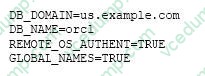
Examine the parameter settings in your local ORCL database:
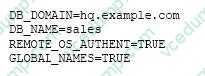
Examine the parameter settings for the remote SALES database:
As the SYS user, you issue the following command on ORCL:
CREATE PUBLIC DATABASE LINK sales.us.example.com USING `sales1';
The sales1 tnsnames entry points to the sales database instance.
Which two are requirements to ensure that you can successfully connect by using this database link? (Choose two.)
A. The GLOBAL_NAMES initialization parameter should be set to FALSE in the ORCL database.
B. The SALES1 net service name should be known to both the local and remote databases.
C. Local database users who use this database link should have accounts and the required privileges in the remote database.
D. The REMOTE_OS_AUTHENT initialization parameter should be set to FALSE in the remote database.
E. Only the user creating the database link must have an account and the required privileges in the remote database. -
Question 80:
Identify three valid methods of opening, pluggable databases (PDBs).
A. ALTER PLUGGABLE DATABASE OPEN ALL ISSUED from the root
B. ALTER PLUGGABLE DATABASE OPEN ALL ISSUED from a PDB
C. ALTER PLUGGABLE DATABASE PDB OPEN issued from the seed
D. ALTER DATABASE PDB OPEN issued from the root
E. ALTER DATABASE OPEN issued from that PDB
F. ALTER PLUGGABLE DATABASE PDB OPEN issued from another PDB
G. ALTER PLUGGABLE DATABASE OPEN issued from that PDB
Related Exams:
-
1Z0-020
Oracle8i: New Features for Administrators -
1Z0-023
Architecture and Administration -
1Z0-024
Performance Tuning -
1Z0-025
Backup and Recovery -
1Z0-026
Network Administration -
1Z0-034
Upgrade Oracle9i/10g OCA to Oracle Database OCP -
1Z0-036
Managing Oracle9i on Linux -
1Z0-041
Oracle Database 10g: DBA Assessment -
1Z0-052
Oracle Database 11g: Administration Workshop I -
1Z0-053
Oracle Database 11g: Administration II
Tips on How to Prepare for the Exams
Nowadays, the certification exams become more and more important and required by more and more enterprises when applying for a job. But how to prepare for the exam effectively? How to prepare for the exam in a short time with less efforts? How to get a ideal result and how to find the most reliable resources? Here on Vcedump.com, you will find all the answers. Vcedump.com provide not only Oracle exam questions, answers and explanations but also complete assistance on your exam preparation and certification application. If you are confused on your 1Z0-062 exam preparations and Oracle certification application, do not hesitate to visit our Vcedump.com to find your solutions here.