1Z0-062 Exam Details
-
Exam Code
:1Z0-062 -
Exam Name
:Oracle Database 12c: Installation and Administration -
Certification
:Oracle Certifications -
Vendor
:Oracle -
Total Questions
:411 Q&As -
Last Updated
:Dec 24, 2024
Oracle 1Z0-062 Online Questions & Answers
-
Question 291:
Examine the contents of SQL loader control file:
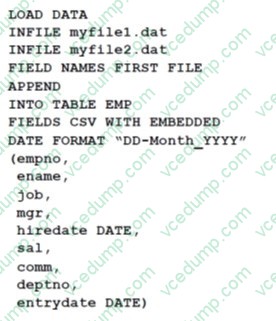
Which three statements are true regarding the SQL* Loader operation performed using the control file? (Choose three.)
A. An EMP table is created if a table does not exist. Otherwise, if the EMP table is appended with the loaded data.
B. The SQL* Loader data file myfile1.dat has the column names for the EMP table.
C. The SQL* Loader operation fails because no record terminators are specified.
D. Field names should be the first line in the both the SQL* Loader data files.
E. The SQL* Loader operation assumes that the file must be a stream record format file with the normal carriage return string as the record terminator. -
Question 292:
What is the outcome of the SHUTDOWN ABORT command?
A. Pending transactions are committed and the database is closed.
B. Dirty buffers in the buffer cache and unwritten redo are not written to the data files and redo log files respectively.
C. Uncommitted transactions are rolled back
D. Instance recovery must be requested by the DBA at the next startup -
Question 293:
Which two actions does an incremental checkpoint perform? (Choose two.)
A. It signals CKPT to write the checkpoint position to the data file headers.
B. It writes the checkpoint position to the data file headers.
C. It advances the checkpoint position in the checkpoint queue.
D. It writes the checkpoint position to the control file. -
Question 294:
You must upgrade your Oracle 11g to Database to Oracle 12c R2. Which method can you use?
A. Perform a rolling upgrade.
B. Perform a direct upgrade by running the Database Upgrade Assistant (DBUA).
C. Use Enterprise Manager Express.
D. Use SQL*Developer
E. Use the Database Creation Assistant (DBCA) to upgrade -
Question 295:
You want to create a database with a block size other than the default 8 kilobytes (KB) by using the Database Configuration Assistant (DBCA).
Which option should you use?
A. Automatic Storage Management (ASM) for storage of data files
B. a file system for storage of data files
C. a Data Warehouse database template
D. a custom database template -
Question 296:
Which three resources might be prioritized between competing pluggable databases when creating a multitenant container database plan (CDB plan) using Oracle Database Resource Manager? (Choose three.)
A. Maximum Undo per consumer group
B. Maximum Idle time
C. Parallel server limit
D. CPU
E. Exadata I/O
F. Local file system I/O -
Question 297:
Which two statements are true about the Oracle Direct Network File system (DNFS)? (Choose two.)
A. It utilizes the OS file system cache.
B. A traditional NFS mount is not required when using Direct NFS.
C. Oracle Disk Manager can manage NFS on its own, without using the operating kernel NFS driver.
D. Direct NFS is available only in UNIX platforms.
E. Direct NFS can load-balance I/O traffic across multiple network adapters. -
Question 298:
Which three statements are true about naming methods? (Choose three.)
A. Local naming supports multiple protocols, but for any one connection, the client and server must use the same protocol.
B. In the Easy Connect method, clients can connect to a database server by using the host name of the database with an optional port and service name.
C. In the Easy Connect method, the listener port and IP address must be provided for the connection to be successful.
D. The local naming method does not support connect-time failover and load-balancing options.
E. The directory naming method supports connect-time failover and load-balancing options. -
Question 299:
A database is stored in an Automatic Storage Management (ASM) disk group, disk group, DGROUP1 with SQL:

There is enough free space in the disk group for mirroring to be done.
What happens if the CONTROLLER1 failure group becomes unavailable due to error of for maintenance?
A. Transactions and queries accessing database objects contained in any tablespace stored in DGROUP1 will fall.
B. Mirroring of allocation units will be done to ASM disks in the CONTROLLER2 failure group until the CONTROLLER1 for failure group is brought back online.
C. The data in the CONTROLLER1 failure group is copied to the controller2 failure group and rebalancing is initiated.
D. ASM does not mirror any data until the controller failure group is brought back online, and newly allocated primary allocation units (AU) are stored in the controller2 failure group, without mirroring.
E. Transactions accessing database objects contained in any tablespace stored in DGROUP1 will fail but queries will succeed. -
Question 300:
Which naming method enables clients to connect to a database instance without any client side configuration in sqlnet.ora or tnsnames.ora?
A. the external naming method
B. the easy connect method
C. the local naming method
D. the directory naming method
Related Exams:
-
1Z0-020
Oracle8i: New Features for Administrators -
1Z0-023
Architecture and Administration -
1Z0-024
Performance Tuning -
1Z0-025
Backup and Recovery -
1Z0-026
Network Administration -
1Z0-034
Upgrade Oracle9i/10g OCA to Oracle Database OCP -
1Z0-036
Managing Oracle9i on Linux -
1Z0-041
Oracle Database 10g: DBA Assessment -
1Z0-052
Oracle Database 11g: Administration Workshop I -
1Z0-053
Oracle Database 11g: Administration II
Tips on How to Prepare for the Exams
Nowadays, the certification exams become more and more important and required by more and more enterprises when applying for a job. But how to prepare for the exam effectively? How to prepare for the exam in a short time with less efforts? How to get a ideal result and how to find the most reliable resources? Here on Vcedump.com, you will find all the answers. Vcedump.com provide not only Oracle exam questions, answers and explanations but also complete assistance on your exam preparation and certification application. If you are confused on your 1Z0-062 exam preparations and Oracle certification application, do not hesitate to visit our Vcedump.com to find your solutions here.