1Z0-062 Exam Details
-
Exam Code
:1Z0-062 -
Exam Name
:Oracle Database 12c: Installation and Administration -
Certification
:Oracle Certifications -
Vendor
:Oracle -
Total Questions
:411 Q&As -
Last Updated
:Dec 24, 2024
Oracle 1Z0-062 Online Questions & Answers
-
Question 21:
What is a requirement for creating a remote database scheduler job?
A. The remote database job must run as a user that is valid on the target remote database.
B. A private database link must be created from the originating database to the target remote database.
C. The target remote database on which the job is scheduled must be Oracle Database 11g Release 2 or later.
D. The target remote database must be on a different host form the originating scheduler database host. -
Question 22:
Automatic Shared Memory Management (ASMM) is enabled for your database instance. You execute the following command:
SQL> ALTER SYSTEM SET DB_CACHE_SIZE = 100M;
Which statement is true?
A. It succeeds and the minimum size for the DEFAULT buffer pool is set to 100M.
B. It fails because DB_CACHE_SIZE is a static initialization parameter.
C. It fails because ASMM is enabled and individual SGA components cannot be sized.
D. It succeeds and the value is changed in the SPFILE immediately, but the change takes effect only at the next instance startup. -
Question 23:
Which two statements are true about initialization parameter files? (Choose two.)
A. A lost or damaged SPFILE can be re-created by using the parameter values listed in the alert log.
B. A PFILE must exist for an SPFILE to be created.
C. The ALTER SYSTEM command cannot be used to change the value of any parameter if a database instance has started using a PFILE.
D. Both the SPFILE and PFILE must always reside on a file system accessible from the database host server.
E. On startup, by default a database instance always first searches for an SPFILE, and if it does not find any, searches for a PFILE. -
Question 24:
What can be automatically implemented after the SQL Tuning Advisor is run as part of the Automated Maintenance Task?
A. statistics recommendations
B. SQL profile recommendations
C. SQL statement restructure recommendations
D. creation of materialized views to improve query performance -
Question 25:
Which three statements are true about Flashback Database? (Choose three.)
A. Flashback logs are written sequentially, and are archived.
B. Flashback Database uses a restored control file to recover a database.
C. The Oracle database automatically creates, deletes, and resides flashback logs in the Fast Recovery Area.
D. Flashback Database can recover a database to the state that it was in before a reset logs operation.
E. Flashback Database can recover a data file that was dropped during the span of time of the flashback.
F. Flashback logs are used to restore to the blocks before images, and then the redo data may be used to roll forward to the desired flashback time. -
Question 26:
Examine the details of the Top 5 Timed Events in the following Automatic Workloads Repository (AWR) report:
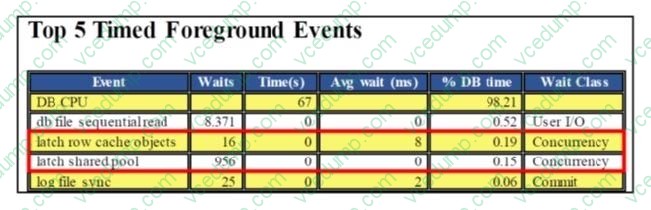
What are three possible causes for the latch-related wait events?
A. The size of the shared pool is too small.
B. Cursors are not being shared.
C. A large number COMMITS are being performed.
D. There are frequent logons and logoffs.
E. The buffers are being read into the buffer cache, but some other session is changing the buffers. -
Question 27:
Which three statements are true about Automatic Workload Repository (AWR)? (Choose three.)
A. An AWR snapshot shows the SQL statements that are producing the highest load on the system, based on criteria such as elapsed time and CPU time.
B. AWR data is stored in memory and in a database.
C. All AWR tables belong to the SYSTEM schema.
D. The manageability monitor (MMON) process gathers statistics and creates an AWR snapshot that is used by the self-tuning components in a database.
E. An AWR snapshot contains system-wide tracing and logging information. -
Question 28:
Backup requirements for a database:
*
Level 0 backup on Sunday
*
Cumulative incremental level 1 backup on Monday, Wednesday, and Saturday
*
Differential incremental level 1 backup on Tuesday, Thursday, and Friday
Which three statements are true about the strategy? (Choose three.)
A. Level 0 backup on Sunday contains all the blocks that have been formatted.
B. Level 0 backup on Sunday contains all the blocks that have been changed since the last level 1 backup.
C. Level 1 backup on Tuesday, Thursday, and Friday contains all the blocks that have been changed since the last level 1 backup.
D. Level 1 backup on Monday, Wednesday, and Saturday contains all the blocks that have been changed since the last level 0 backup.
E. Level 1 backup on Tuesday, Thursday, and Friday contains all the blocks that have been changed since the last level 0 backup. -
Question 29:
One of your databases supports an OLTP workload. The default UNDO tablespace is fixed size with:
1.
RETENTION NOGUARANTEE
2.
UNDO_RETENTION is 12 minutes
User SCOTT gets this error after a query on the SALES table has run for more than 15 minutes:
ORA-01555: snapshot too old
Which three factors taken separately or in some combination might be the cause? (Choose three.)
A. An update was made to the SALES table after the query began
B. An update to the SALES table was committed after the query began
C. A committed delete to the SALES table was made more than 12 minutes before the query began
D. An uncommitted update to the SALES table was made more than 12 minutes before the query began
E. A committed update to the SALES table was made more than 12 minutes before the query began
F. An uncommitted delete to the SALES table was made more than 12 minutes before the query began
G. An update was made to the SALES table before the query began -
Question 30:
Examine the resources consumed by a database instance whose current Resource Manager plan is displayed.
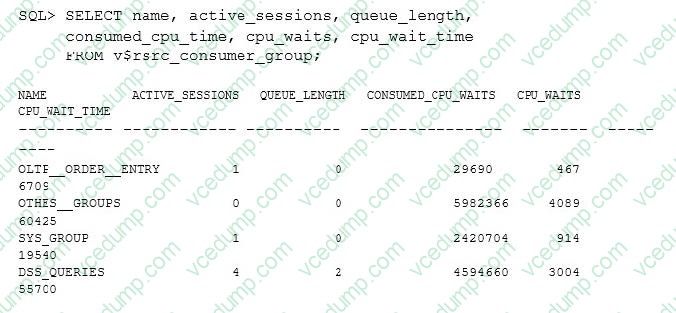
Which two statements are true? (Choose two.)
A. An attempt to start a new session by a user belonging to DSS_QUERIES fails with an error.
B. An attempt to start a new session by a user belonging to OTHER_GROUPS fails with an error.
C. The CPU_WAIT_TIME column indicates the total time that sessions in the consumer group waited for the CPU due to resource management.
D. The CPU_WAIT_TIME column indicates the total time that sessions in the consumer group waited for the CPU due to I/O waits and latch or enqueue contention.
E. A user belonging to the DSS__QUERIES resource consumer group can create a new session but the session will be queued.
Related Exams:
-
1Z0-020
Oracle8i: New Features for Administrators -
1Z0-023
Architecture and Administration -
1Z0-024
Performance Tuning -
1Z0-025
Backup and Recovery -
1Z0-026
Network Administration -
1Z0-034
Upgrade Oracle9i/10g OCA to Oracle Database OCP -
1Z0-036
Managing Oracle9i on Linux -
1Z0-041
Oracle Database 10g: DBA Assessment -
1Z0-052
Oracle Database 11g: Administration Workshop I -
1Z0-053
Oracle Database 11g: Administration II
Tips on How to Prepare for the Exams
Nowadays, the certification exams become more and more important and required by more and more enterprises when applying for a job. But how to prepare for the exam effectively? How to prepare for the exam in a short time with less efforts? How to get a ideal result and how to find the most reliable resources? Here on Vcedump.com, you will find all the answers. Vcedump.com provide not only Oracle exam questions, answers and explanations but also complete assistance on your exam preparation and certification application. If you are confused on your 1Z0-062 exam preparations and Oracle certification application, do not hesitate to visit our Vcedump.com to find your solutions here.