1Z0-062 Exam Details
-
Exam Code
:1Z0-062 -
Exam Name
:Oracle Database 12c: Installation and Administration -
Certification
:Oracle Certifications -
Vendor
:Oracle -
Total Questions
:411 Q&As -
Last Updated
:Dec 24, 2024
Oracle 1Z0-062 Online Questions & Answers
-
Question 251:
Examine these parameter settings:

You execute this:
CREATE UNDO TABLESPACE UNDOTBS2 SEGMENT SPACE MANAGEMENT AUTO;
Which is true?
A. It fails because there is already an active UNDO TABLESPACE for the database instance.
B. It executes successfully and space in the UNDOTBS2 tablespace will be bitmap managed.
C. It fails because Automatic Segment Space Management (ASSM) is not supported for an UNDO TABLESPACE.
D. It fails because size and data file clause are missing.
E. It executes successfully and space in the UNDOTBS2 tablespace will be freelist managed. -
Question 252:
A PFILE exists for your database. You want to increase the value of the PROCESSES parameter from 300 to 400 and make it persistent for your database instance.
You plan to use the ALTER SYSTEM command.
Which two methods can be used? (Choose two.)
A. Edit PFILE manually, re-create the SPFILE from the edited PFILE, and restart the database instance by using the SPFILE.
B. Create an SPFILE, start the database instance by using the SPFILE, and then execute the ALTER SYSTEM SET PROCESSES=400 SCOPE=SPFILE command.
C. Create an SPFILE, start the database instance by using the SPFILE, and then execute the ALTER SYSTEM SET PROCESSES=400 SCOPE=DEFERRED command.
D. Create an SPFILE, STARTUP MOUNT the database instance by using the SPFILE, and then execute the ALTER SYSTEM SET PROCESSES=400 command.
E. Start the database instance by using the PFILE, and then execute the ALTER SYSTEM SET PROCESSES=400 SCOPE=BOTH command.
F. Use the PFILE to STARTUP MOUNT the database instance, and then execute the ALTER SYSTEM SET PROCESSES=400 command. -
Question 253:
You are administering a database stored in Automatic Storage Management (ASM). You use RMAN to back up the database and the MD_BACKUP command to back up the ASM metadata regularly. You lost an ASM disk group DG1 due to hardware failure.
In which three ways can you re-create the lost disk group and restore the data? (Choose three.)
A. Use the MD_RESTORE command to restore metadata for an existing disk group by passing the existing disk group name as an input parameter and use RMAN to restore the data.
B. Use the MKDG command to restore the disk group with the same configuration as the backed-up disk group and data on the disk group.
C. Use the MD_RESTORE command to restore the disk group with the changed disk group specification, failure group specification, name, and other attributes and use RMAN to restore the data.
D. Use the MKDG command to restore the disk group with the same configuration as the backed-up disk group name and same set of disks and failure group configuration, and use RMAN to restore the data.
E. Use the MD_RESTORE command to restore both the metadata and data for the failed disk group.
F. Use the MKDG command to add a new disk group DG1 with the same or different specifications for failure group and other attributes and use RMAN to restore the data. -
Question 254:
Examine these steps:
CONNECT / AS SYSDBA
CREATE DIRECTORY dumpdir AS '/u01/app/';
Directory created.
GRANT READ, WRITE ON DIRECTORY dumpdir TO PUBLIC;
Grant succeeded.
CREATE USER TEST IDENTIFIED BY test;
User created.
GRANT CREATE SESSION, RESOURCE, UNLIMITED TABLESPACE TO test;
Grant succeeded.
CONN test/test
Connected.
CREATE TABLE test_employees (id NUMBER(3), name VARCHAR2(20), salary NUMBER(7)); Table
created.
SQL> CREATE SYNONYM emp FOR test_employees;
Synonym created.
Now examine this command:
$ expdp test/test DIRECTORY=dumpdir DUMPFILE=test_emp.dmp LOGFILE=test.log TABLES=emp
CONTENT=data_only query='EMP:"WHERE salary=12000"'
What is true about the execution of this command?
A. It throws an error as the QUERY parameter is not supported on an empty table.
B. It throws an error as the table test_employees is empty and CONTENT=data_only is specified.
C. It performs the export successfully.
D. It throws an error as Data Pump cannot find a table called TEST.EMP. -
Question 255:
You want to create a database and you have the following:
-Oracle Grid Infrastructure is installed and configured.
-
Oracle Database Vault is installed in ORACLE_HOME to be used for this database.
-
Oracle Enterprise Manager Cloud Control is available and an agent is deployed on the database server.
Examine the requirements:
1.
configuring the database instance to support shared server mode
2.
using Automatic Storage Management (ASM) for storing database files.
3.
configuring a naming method to help a remote user connect to a database instance
4.
configuring the Fast Recovery Area
5.
configuring Database Vault
6.
configuring Enterprise Manager (EM) Database Express
7.
registering with EM Cloud Control
8.
configuring remote log archive destinations
9.
enabling daily incremental backups
10.
configuring a nondefault block size for nondefault block size tablespaces
Which of these requirements can be met while creating a database by using the Database Configuration Assistant (DBCA)?
A. 1, 2, 4, 5, 7, 8, 9 and 10
B. 1, 2, 4, 5, 6 and 7
C. 1, 2, 3, 8, 9 and 10
D. 1, 2, 3, 4, 6, 8, 9 and 10
E. 1, 2, 4, 5, 6, 7 and 8 -
Question 256:
Examine the memory-related parameters set in the SPFILE of an Oracle database:
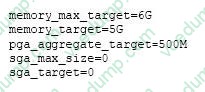
Which statement is true?
A. Only SGA components are sized automatically.
B. Memory is dynamically re-allocated between the SGA and PGA as needed.
C. The size of the PGA cannot grow automatically beyond 500 MB.
D. The value of the MEMORY_TARGET parameter cannot be changed dynamically. -
Question 257:
Which two statements are true about the Database Configuration Assistant (DBCA)? (Choose two.)
A. It can be used to create a database template from an existing database.
B. It can be used to add a new tablespace.
C. It can generate SQL database creation scripts.
D. It can be used to copy an existing Oracle database to a new host and apply any patches necessary in the new host.
E. It can configure Automatic Storage Management (ASM) diskgroups. -
Question 258:
Which two statements are true about availability audit features after migration to unified auditing? (Choose two.)
A. The ability of users to audit their own schema objects is not available in the post-migrated database.
B. Operating system audit trail is available in the post-migrated database.
C. Network auditing is available in the post-migrated database.
D. Mandatory auditing of audit administrative actions is available in the post-migrated database. -
Question 259:
You upgraded your database from pre-12c to a multitenant container database (CDB) containing pluggable databases (PDBs).
Examine the query and its output:

Which two tasks must you perform to add users with SYSBACKUP, SYSDG, and SYSKM privilege to the password file? (Choose two.)
A. Assign the appropriate operating system groups to SYSBACKUP, SYSDG, SYSKM.
B. Grant SYSBACKUP, SYSDG, and SYSKM privileges to the intended users.
C. Re-create the password file with SYSBACKUP, SYSDG, and SYSKM privilege and the FORCE argument set to No.
D. Re-create the password file with SYSBACKUP, SYSDG, and SYSKM privilege, and FORCE arguments set to Yes.
E. Re-create the password file in the Oracle Database 12c format. -
Question 260:
Your database is configured in ARCHIVELOG mode.
Examine the RMAN configuration parameters:

Examine the command:
RMAN> BACKUP DATABASE PLUS ARCHIVELOG DELETE INPUT;
What is the outcome?
A. It fails because the DELETE INPUT option can be used only with the BACKUP AS BACKUPSET command.
B. It executes successfully and creates a backup set of the database along with archived log files and then deletes the original archived log files.
C. It executes successfully and creates an image copy of the database along with archive log files and then deletes the original archived log files.
D. It fails because the DELETE INPUT option can be used only with the BACKUP AS COPY command.
Related Exams:
-
1Z0-020
Oracle8i: New Features for Administrators -
1Z0-023
Architecture and Administration -
1Z0-024
Performance Tuning -
1Z0-025
Backup and Recovery -
1Z0-026
Network Administration -
1Z0-034
Upgrade Oracle9i/10g OCA to Oracle Database OCP -
1Z0-036
Managing Oracle9i on Linux -
1Z0-041
Oracle Database 10g: DBA Assessment -
1Z0-052
Oracle Database 11g: Administration Workshop I -
1Z0-053
Oracle Database 11g: Administration II
Tips on How to Prepare for the Exams
Nowadays, the certification exams become more and more important and required by more and more enterprises when applying for a job. But how to prepare for the exam effectively? How to prepare for the exam in a short time with less efforts? How to get a ideal result and how to find the most reliable resources? Here on Vcedump.com, you will find all the answers. Vcedump.com provide not only Oracle exam questions, answers and explanations but also complete assistance on your exam preparation and certification application. If you are confused on your 1Z0-062 exam preparations and Oracle certification application, do not hesitate to visit our Vcedump.com to find your solutions here.