1Z0-062 Exam Details
-
Exam Code
:1Z0-062 -
Exam Name
:Oracle Database 12c: Installation and Administration -
Certification
:Oracle Certifications -
Vendor
:Oracle -
Total Questions
:411 Q&As -
Last Updated
:Dec 24, 2024
Oracle 1Z0-062 Online Questions & Answers
-
Question 121:
Examine this command which executes successfully:
SQL> ALTER TABLE cities SHRINK SPACE;
Which two are true? (Choose two.)
A. The CITIES table has no CLOB columns.
B. The CITIES table has no LONG columns.
C. CITIES may be an Index Organized table (IOT).
D. Row movement must have been enabled for CITIES.
E. Row movement must have been enabled for CITIES. -
Question 122:
You plan to install the Oracle Database 12c software on a new server. The database will use Automatic Storage Management (ASM) and Oracle Restart. Oracle Grid Infrastructure for a standalone server is already installed on the server.
You want to configure job role separation. You create the following operating system users and groups:
- The user oracle as the owner of the Oracle database installation
-
The user grid as the owner of Oracle Grid Infrastructure
-
The group oinstall as an Oracle Inventory group
-
The group dba as the OSDBA group for Oracle database
-
The group asmdba as the OSDBA group for Oracle ASM
- The group asmadmin as the administration privileges group for Oracle ASM
-The group asmoper as the group for Oracle ASM
Which two additional tasks should you perform with regard to the OS-level owners and groups? (Choose two.)
A. creating a separate central inventory group for the Oracle Database 12c installation
B. assigning oinstall as the primary group for the oracle user
C. assigning asmadmin and asmoper as primary groups for the oracle user
D. creating OS groups associated with the OSBACKUPDBA, OSDGDBA, and OSKMDBA system privileges
E. assigning asmdba as the secondary group for the oracle user -
Question 123:
Your database supports a Decision Support System (DSS) workload that involves the execution of complex queries. Currently, the database is running with peak workload. You want to analyze some of the most resource-intensive statements cached in the library cache.
What must you run to receive recommendations on the efficient use of indexes and materialized views to improve query performance?
A. Automatic Database Diagnostic Monitor (ADDM)
B. SQL Tuning Advisor
C. SQL Access Advisor
D. SQL Performance Analyzer
E. Automatic Workload Repository (AWR) report -
Question 124:
You want execution of large database operations to suspend, and then resume, in the event of space allocation failures.
You set the value of the initialization parameter RESUMABLE_TIMEOUT to 3600.
Which two statements are true? (Choose two.)
A. Before a statement executes in resumable mode, the ALTER SESSION ENABLE RESUMABLE statement must be issued in its session.
B. Data Manipulation Language (DML) operations are resumable, provided that they are not embedded in a PL/SQL block.
C. A resumable statement can be suspended and resumed only once during execution.
D. A suspended statement will report an error if no corrective action has taken place during a timeout period.
E. Suspending a statement automatically results in suspending a transaction and releasing all the resources held by the transaction. -
Question 125:
Examine the parameters:
Your database instance is started with a PFILE.
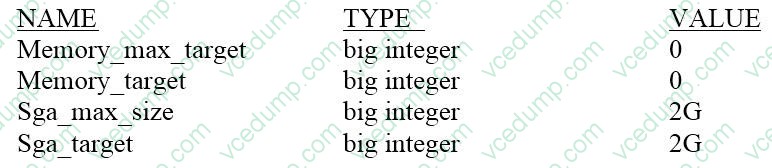
You want to increase the size of the buffer cache. Free memory is available to increase the size of the buffer cache.
You execute the command:
SQL> ALTER SYSTEM SET DB_CACHE_SIZE=1024M;
Which is the outcome?
A. Change is applied to the current instance, but does not persist after instance restart.
B. The value is changed only in the PFILE and takes effect at the next instance startup.
C. The value is changed for the current instance and in the PFILE.
D. It fails because the SCOPE clause is missing. -
Question 126:
In your multitenant container database (CDB) containing pluggable database (PDBs), you granted the CREATE TABLE privilege to the common user C # # A_ADMIN in root and all PDBs. You execute the following command from the root container:
SQL > REVOKE create table FROM C # # A_ADMIN;
What is the result?
A. It executes successfully and the CREATE TABLE privilege is revoked from C # # A_ADMIN in root only.
B. It fails and reports an error because the CONTAINER=ALL clause is not used.
C. It excludes successfully and the CREATE TABLE privilege is revoked from C # # A_ADMIN in root and all PDBs.
D. It fails and reports an error because the CONTAINER=CURRENT clause is not used.
E. It executes successfully and the CREATE TABLE privilege is revoked from C # # A_ADMIN in all PDBs. -
Question 127:
You executed a DROP USER CASCADE on an Oracle 11g release 1 database and immediately realized that you forgot to copy the OCA.EXAM_RESULTS table to the OCP schema.
The RECYCLE_BIN enabled before the DROP USER was executed and the OCP user has been granted the FLASHBACK ANY TABLE system privilege.
What is the quickest way to recover the contents of the OCA.EXAM_RESULTS table to the OCP schema?
A. Execute FLASHBACK TABLE OCA.EXAM_RESULTS TO BEFORE DROP RENAME TO OCP.EXAM_RESULTS; connected as SYSTEM.
B. Recover the table using traditional Tablespace Point In Time Recovery.
C. Recover the table using Automated Tablespace Point In Time Recovery.
D. Recovery the table using Database Point In Time Recovery.
E. Execute FLASHBACK TABLE OCA.EXAM_RESULTS TO BEFORE DROP RENAME TO EXAM_RESULTS; connected as the OCP user. -
Question 128:
You use a recovery catalog for maintaining your database backups.
You execute the following command:
$rman TARGET / CATALOG rman / cat@catdb
RMAN > BACKUP VALIDATE DATABASE ARCHIVELOG ALL;
Which two statements are true? (Choose two.)
A. Corrupted blocks, if any, are repaired.
B. Checks are performed for physical corruptions.
C. Checks are performed for logical corruptions.
D. Checks are performed to confirm whether all database files exist in correct locations
E. Backup sets containing both data files and archive logs are created. -
Question 129:
Which set of statements is true about data dictionary views?
1.
They are stored in the SYSTEM tablespace.
2.
They are based on virtual tables.
3.
They are owned by the SYS user.
4.
They can be queried by a normal user only if the 07_DICTIONARY_ACCESSIBILITY parameter is set to TRUE.
5.
The V$FIXED_TABLE view can be queried to list the names of these views.
6.
They are owned by the SYSTEM user.
A. 2, 5, and 6
B. 1, 2, and 3
C. 1 and 3
D. 2, 3, 4, and 5 -
Question 130:
Your database is in ARCHIVELOG mode and you want to automate the backup scheduling for your database.
Which two tools or utilities would you use to achieve this? (Choose two.)
A. Oracle Enterprise Manager Database Express (EM Express)
B. Oracle Enterprise Manager Cloud Control
C. Database Configuration Assistant (DBCA)
D. Recovery Manager (RMAN) script invoked by using scheduler
Related Exams:
-
1Z0-020
Oracle8i: New Features for Administrators -
1Z0-023
Architecture and Administration -
1Z0-024
Performance Tuning -
1Z0-025
Backup and Recovery -
1Z0-026
Network Administration -
1Z0-034
Upgrade Oracle9i/10g OCA to Oracle Database OCP -
1Z0-036
Managing Oracle9i on Linux -
1Z0-041
Oracle Database 10g: DBA Assessment -
1Z0-052
Oracle Database 11g: Administration Workshop I -
1Z0-053
Oracle Database 11g: Administration II
Tips on How to Prepare for the Exams
Nowadays, the certification exams become more and more important and required by more and more enterprises when applying for a job. But how to prepare for the exam effectively? How to prepare for the exam in a short time with less efforts? How to get a ideal result and how to find the most reliable resources? Here on Vcedump.com, you will find all the answers. Vcedump.com provide not only Oracle exam questions, answers and explanations but also complete assistance on your exam preparation and certification application. If you are confused on your 1Z0-062 exam preparations and Oracle certification application, do not hesitate to visit our Vcedump.com to find your solutions here.