1Z0-061 Exam Details
-
Exam Code
:1Z0-061 -
Exam Name
:Oracle Database 12c: SQL Fundamentals -
Certification
:Oracle Certifications -
Vendor
:Oracle -
Total Questions
:339 Q&As -
Last Updated
:Oct 10, 2022
Oracle 1Z0-061 Online Questions & Answers
-
Question 31:
You need to calculate the number of days from 1st January 2007 till date . Dates are stored in the default format of dd-mon-rr. Which two SQL statements would give the required output? (Choose two.)
A. SELECT SYSDATE - '01-JAN-2007' FROM DUAL:
B. SELECT SYSDATE - TOJDATE(X)1/JANUARY/2007") FROM DUAL:
C. SELECT SYSDATE - TOJDATE('01-JANUARY-2007') FROM DUAL:
D. SELECT TO_CHAR(SYSDATE. 'DD-MON-YYYY') - '01-JAN-2007' FROM DUAL:
E. SELECT TO_DATE(SYSDATE. *DD/MONTH/YYYY') - '01/JANUARY/2007' FROM DUAL: -
Question 32:
Examine the structure of the EMPLOYEES table:
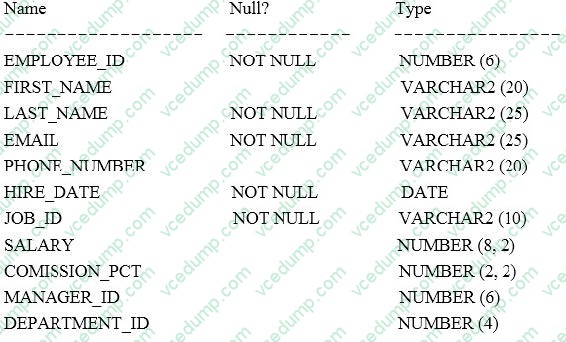
You want to generate a report that contains the department IDs and last names of employees ordered by hire date in their respective departments. Employees from one department must appear in a single row. Which query will provide the required output?
A. SELECT department_id "Dept.",LISTAGG (last_name, `;') WITHIN GROUP (ORDER BY hire_date)" Employees"FROM employeesGROUP BY department_idORDER BY department_id;
B. SELECT department_id "Dept.",LISTAGG (last_name, `;') WITHIN GROUP (ORDER BY hire_date)" Employees"FROM employeesGROUP BY department_idORDER BY hire_date;
C. SELECT department_id "Dept.",LISTAGG (last_name, `;') WITHIN GROUP (ORDER BY hire_date)" Employees")FROM employeesGROUP BY department_idORDER BY hire_date;
D. SELECT department_id "Dept.",LISTAGG (last_name, `;') WITHIN GROUP ORDER BY (hire_date)" Employees")FROM employeesGROUP BY department_idORDER BY department_id; -
Question 33:
Which two statements are true regarding single row functions?
A. MOD: returns the quotient of a division
B. TRUNC: can be used with number and date values
C. CONCAT: can be used to combine any number of values
D. SYSDATE: returns the database server current date and time
E. INSTR: can be used to find only the first occurrence of a character in a string
F. TRIM: can be used to remove all the occurrences of a character from a string -
Question 34:
Which two statements are true about constraints? (Choose two.)
A. The UNIQUE constraint does not permit a null value for the column.
B. A UNIQUE index gets created for columns with PRIMARY KEY and UNIQUE constraints.
C. The PRIMARY KEY and FOREIGN KEY constraints create a UNIQUE index.
D. The NOT NULL constraint ensures that null values are not permitted for the column. -
Question 35:
See the structure of the PROGRAMS table:
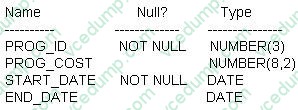
Which two SQL statements would execute successfully? (Choose two.)
A. SELECT NVL(ADD_MONTHS(END_DATE, 1), SYSDATE)FROM programs;
B. SELECT TO_DATE(NVL(SYSDATE-END_DATE, SYSDATE))FROM programs;
C. SELECT NVL(MONTHS_BETWEEN(start_date, end_date), 'Ongoing')FROM programs;
D. SELECT NVL(TO_CHAR(MONTHS_BETWEEN(start_date, end_date)), 'Ongoing') FROM programs; -
Question 36:
Which three are true? (Choose three.)
A. A MERGE statement is used to merge the data of one table with data from another.
B. A MERGE statement replaces the data of one table with that of another.
C. A MERGE statement can be used to insert new rows into a table.
D. A MERGE statement can be used to update existing rows in a table. -
Question 37:
Evaluate the following SQL statements:
Exhibit:
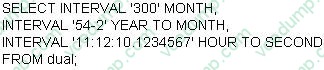
Which is the correct output of the above query?
A. +00-300, +54-02, +00 11:12:10.123457
B. +00-300, +00-650, +00 11:12:10.123457
C. +25-00, +54-02, +00 11:12:10.123457
D. +25-00, +00-650, +00 11:12:10.123457 -
Question 38:
Which statements are correct regarding indexes? (Choose all that apply.)
A. For each data manipulation language (DML) operation performed, the corresponding indexes are automatically updated.
B. A nondeferrable PRIMARY KEY or UNIQUE KEY constraint in a table automatically creates a unique index.
C. A FOREIGN KEY constraint on a column in a table automatically creates a non unique key
D. When a table is dropped, the corresponding indexes are automatically dropped -
Question 39:
Which statement is true regarding sub queries?
A. The LIKE operator cannot be used with single- row subqueries.
B. The NOT IN operator is equivalent to IS NULL with single- row subqueries.
C. =ANY and =ALL operators have the same functionality in multiple- row subqueries.
D. The NOT operator can be used with IN, ANY, and ALL operators in multiple- row subqueries. -
Question 40:
Which view should a user query to display the columns associated with the constraints on a table owned by the user?
A. USER_CONSTRAINTS
B. USER_OBJECTS
C. ALL_CONSTRAINTS
D. USER_CONS_COLUMNS
E. USER_COLUMNS
Related Exams:
-
1Z0-020
Oracle8i: New Features for Administrators -
1Z0-023
Architecture and Administration -
1Z0-024
Performance Tuning -
1Z0-025
Backup and Recovery -
1Z0-026
Network Administration -
1Z0-034
Upgrade Oracle9i/10g OCA to Oracle Database OCP -
1Z0-036
Managing Oracle9i on Linux -
1Z0-041
Oracle Database 10g: DBA Assessment -
1Z0-052
Oracle Database 11g: Administration Workshop I -
1Z0-053
Oracle Database 11g: Administration II
Tips on How to Prepare for the Exams
Nowadays, the certification exams become more and more important and required by more and more enterprises when applying for a job. But how to prepare for the exam effectively? How to prepare for the exam in a short time with less efforts? How to get a ideal result and how to find the most reliable resources? Here on Vcedump.com, you will find all the answers. Vcedump.com provide not only Oracle exam questions, answers and explanations but also complete assistance on your exam preparation and certification application. If you are confused on your 1Z0-061 exam preparations and Oracle certification application, do not hesitate to visit our Vcedump.com to find your solutions here.