1Z0-061 Exam Details
-
Exam Code
:1Z0-061 -
Exam Name
:Oracle Database 12c: SQL Fundamentals -
Certification
:Oracle Certifications -
Vendor
:Oracle -
Total Questions
:339 Q&As -
Last Updated
:Oct 10, 2022
Oracle 1Z0-061 Online Questions & Answers
-
Question 21:
The EMPLOYEES table contains these columns: EMPLOYEE_ID NUMBER(4)
LAST_NAME VARCHAR2 (25)
JOB_ID VARCHAR2(10)
You want to search for strings that contain 'SA_' in the JOB_ID column. Which SQL statement do you use?
A. SELECT employee_id, last_name, job_id FROM employees WHERE job_id LIKE '%SA\_' ESCAPE '\';
B. SELECT employee_id, last_name, job_id FROM employees WHERE job_id LIKE '%SA_';
C. SELECT employee_id, last_name, job_id FROM employees WHERE job_id LIKE '%SA_' ESCAPE "\";
D. SELECT employee_id, last_name, job_id FROM employees WHERE job_id = '%SA_'; -
Question 22:
Which two statements are true regarding constraints?
A. A foreign key cannot contain null values.
B. A column with the unique constraint can contain null values.
C. A constraint is enforced only for the insert operation on a table.
D. A constraint can be disabled even if the constraint column contains data.
E. All constraints can be defined at the column level as well as the table level. -
Question 23:
The COMMISSION column shows the monthly commission earned by the employee.
Exhibit
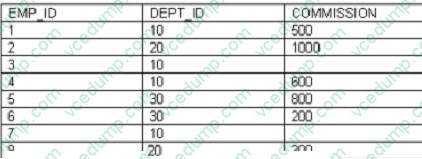
Which two tasks would require sub queries or joins in order to be performed in a single step? (Choose two.)
A. listing the employees who earn the same amount of commission as employee 3
B. finding the total commission earned by the employees in department 10
C. finding the number of employees who earn a commission that is higher than the average commission of the company
D. listing the departments whose average commission is more that 600
E. listing the employees who do not earn commission and who are working for department 20 in descending order of the employee ID
F. listing the employees whose annual commission is more than 6000 -
Question 24:
You need to calculate the number of days from 1st Jan 2007 till date.
Dates are stored in the default format of dd-mon-rr.
Which two SQL statements would give the required output? (Choose two.)
A. SELECT SYSDATE - TO_DATE ('01/JANUARY/2007') FROM DUAL;
B. SELECT TO_DATE (SYSDATE, 'DD/MONTH/YYYY')-'01/JANUARY/2007' FROM DUAL;
C. SELECT SYSDATE - TO_DATE ('01-JANUARY-2007') FROM DUAL;
D. SELECT SYSDATE - '01-JAN-2007' FROM DUAL;
E. SELECT TO_CHAR (SYSDATE, 'DD-MON-YYYY')-'01-JAN-2007' FROM DUAL; -
Question 25:
Which two statements are true regarding tables? (Choose two.)
A. A table name can be of any length.
B. A table can have any number of columns.
C. A column that has a DEFAULT value cannot store null values.
D. A table and a view can have the same name in the same schema.
E. A table and a synonym can have the same name in the same schema.
F. The same table name can be used in different schemas in the same database. -
Question 26:
Which statements are true regarding the WHERE and HAVING clauses in a SELECT statement? (Choose two.)
A. The HAVING clause can be used with aggregate functions in subqueries.
B. The WHERE clause can be used to exclude rows after dividing them into groups.
C. The WHERE clause can be used to exclude rows before dividing them into groups.
D. The aggregate functions and columns used in the HAVING clause must be specified in the SELECT list of the query.
E. The WHERE and HAVING clauses can be used in the same statement only if they are applied to different columns in the table. -
Question 27:
Examine the create table statements for the stores and sales tables.
SQL> CREATE TABLE stores (store_id NUMBER(4)CONSTRAINT store_id_pk PRIMARY KEY, store_name VARCHAR2(12, store_address VARCHAR2(20, start_date DATE);
SQL> CREATE TABLE sales (sales_id NUMBER(4)CONSTRAINT sales_id_pk PRIMARY KEY, item_id NUMBER(4,quantity NUMBER(10), sales_date DATE, store_id NUMBER(4, CONSTRAINT store_id_fk FOREIGN KEY(store_id)
REFERENCES stores(store_id));
You executed the following statement:
SQL> DELETE from stores
WHERE store_id=900;
The statement fails due to the integrity constraint error:
ORA-02292: integrity constraint (HR.STORE_ID_FK) violated
Which three options ensure that the statement will execute successfully? (Choose three.)
A. Disable the primary key in the STORES table.
B. Use CASCADE keyword with DELETE statement.
C. DELETE the rows with STORE_ID = 900 from the SALES table and then delete rows from STORES table.
D. Disable the FOREIGN KEY in SALES table and then delete the rows.
E. Create the foreign key in the SALES table on SALES_ID column with on DELETE CASCADE option. -
Question 28:
Evaluate the following SQL statement:
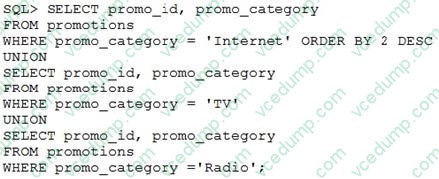
Which statement is true regarding the outcome of the above query?
A. It executes successfully and displays rows in the descending order of PROMO_CATEGORY.
B. It produces an error because positional notation cannot be used in the order by clause with set operators.
C. It executes successfully but ignores the order by clause because it is not located at the end of the compound statement.
D. It produces an error because the order by clause should appear only at the end of a compound query-that is, with the last select statement. -
Question 29:
View the Exhibit and examine the structure of the product, component, and PDT_COMP tables.
In product table, PDTNO is the primary key.
In component table, COMPNO is the primary key.
In PDT_COMP table,
You want to generate a report listing the product names and their corresponding component names, if the component names and product names exist.
Evaluate the following query:
SQL>SELECT pdtno, pdtname, compno, compname
FROM product _____________ pdt_comp
USING (pdtno) ____________ component USING (compno)
WHERE compname IS NOT NULL;
Which combination of joins used in the blanks in the above query gives the correct output?
A. JOIN; JOIN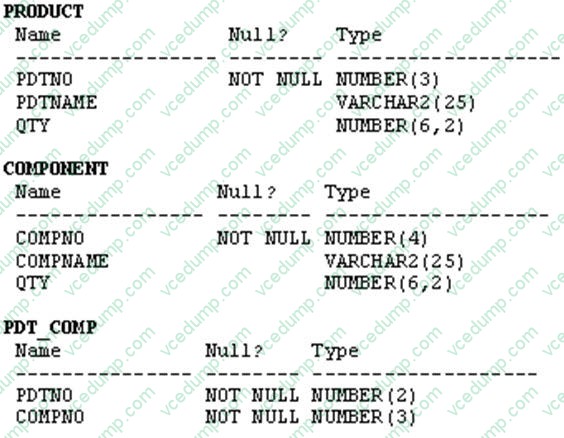
B. FULL OUTER JOIN; FULL OUTER JOIN
C. RIGHT OUTER JOIN; LEFT OUTER JOIN
D. LEFT OUTER JOIN; RIGHT OUTER JOIN -
Question 30:
The DBA issues this SQL command:
CREATE USER Scott
IDENTIFIED by tiger;
What privileges does the user Scott have at this point?
A. No privileges.
B. Only the SELECT privilege.
C. Only the CONNECT privilege.
D. All the privileges of a default user.
Related Exams:
-
1Z0-020
Oracle8i: New Features for Administrators -
1Z0-023
Architecture and Administration -
1Z0-024
Performance Tuning -
1Z0-025
Backup and Recovery -
1Z0-026
Network Administration -
1Z0-034
Upgrade Oracle9i/10g OCA to Oracle Database OCP -
1Z0-036
Managing Oracle9i on Linux -
1Z0-041
Oracle Database 10g: DBA Assessment -
1Z0-052
Oracle Database 11g: Administration Workshop I -
1Z0-053
Oracle Database 11g: Administration II
Tips on How to Prepare for the Exams
Nowadays, the certification exams become more and more important and required by more and more enterprises when applying for a job. But how to prepare for the exam effectively? How to prepare for the exam in a short time with less efforts? How to get a ideal result and how to find the most reliable resources? Here on Vcedump.com, you will find all the answers. Vcedump.com provide not only Oracle exam questions, answers and explanations but also complete assistance on your exam preparation and certification application. If you are confused on your 1Z0-061 exam preparations and Oracle certification application, do not hesitate to visit our Vcedump.com to find your solutions here.