1Z0-061 Exam Details
-
Exam Code
:1Z0-061 -
Exam Name
:Oracle Database 12c: SQL Fundamentals -
Certification
:Oracle Certifications -
Vendor
:Oracle -
Total Questions
:339 Q&As -
Last Updated
:Oct 10, 2022
Oracle 1Z0-061 Online Questions & Answers
-
Question 101:
Which three arithmetic operations can be performed on a column by using a SQL function that is built into Oracle database? (Choose three.)
A. addition
B. subtraction
C. raising to a power
D. finding the quotient
E. finding the lowest value -
Question 102:
View the Exhibit and examine the structure of ORD and ORD_ITEMS tables.
The ORD_NO column is PRIMARY KEY in the ORD table and the ORD_NO and ITEM_NO columns are composite PRIMARY KEY in the ORD_ITEMS table.
Which two CREATE INDEX statements are valid? (Choose two.)
A. CREATE INDEX ord_idx1ON ord(ord_no);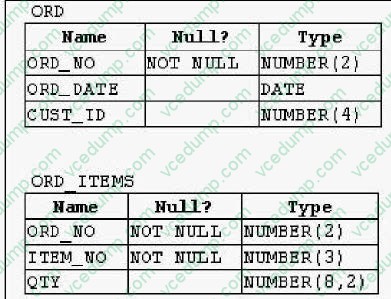
B. CREATE INDEX ord_idx2ON ord_items(ord_no);
C. CREATE INDEX ord_idx3ON ord_items(item_no);
D. CREATE INDEX ord_idx4ON ord, ord_items(ord_no, ord_date, qty); -
Question 103:
Which four are types of functions available in SQL? (Choose 4)
A. string
B. character
C. integer
D. calendar
E. numeric
F. translation
G. date
H. conversion -
Question 104:
You want to display the date for the first Monday of the next month and issue the following command:

What is the outcome?
A. It executes successfully and returns the correct result.
B. It executes successfully but does not return the correct result.
C. It generates an error because TO_CHAR should be replaced with TO_DATE.
D. It generates an error because rrrr should be replaced by rr in the format string.
E. It generates an error because fm and double quotation marks should not be used in the format string. -
Question 105:
The PRODUCTS table has the following structure:
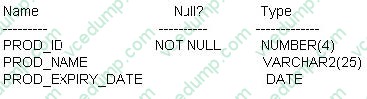
Evaluate the following two SQL statements:

Which statement is true regarding the outcome?
A. Both the statements execute and give the same results.
B. Both the statements execute and give different results.
C. Only the second SQL statement executes successfully.
D. Only the first SQL statement executes successfully. -
Question 106:
You need to create a table with the following column specifications:
1.
Employee ID (numeric data type) for each employee
2.
Employee Name (character data type) that stores the employee name
3.
Hire date, which stores the date of joining the organization for each employee
4.
Status (character data type), that contains the value 'active1 if no data is entered
5.
Resume (character large object [CLOB] data type), which contains the resume submitted by the employee Which is the correct syntax to create this table?
A. Option A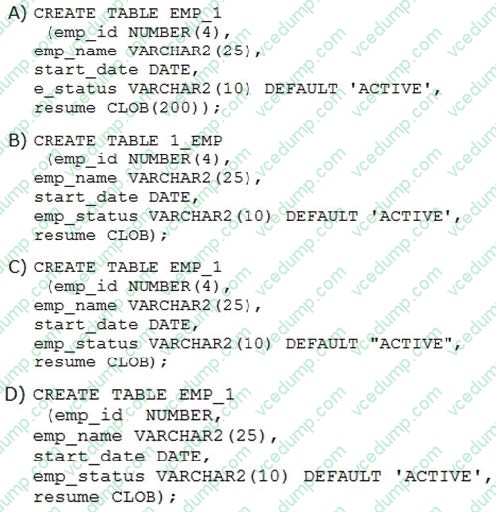
B. Option B
C. Option C
D. Option D -
Question 107:
Which statement is true regarding the COALESCE function?
A. It can have a maximum of five expressions in a list.
B. It returns the highest NOT NULL value in the list for all rows.
C. It requires that all expressions in the list must be of the same data type.
D. It requires that at least one of the expressions in the list must have a NOT NULL value. -
Question 108:
View the Exhibit and examine the structure of the customers table.
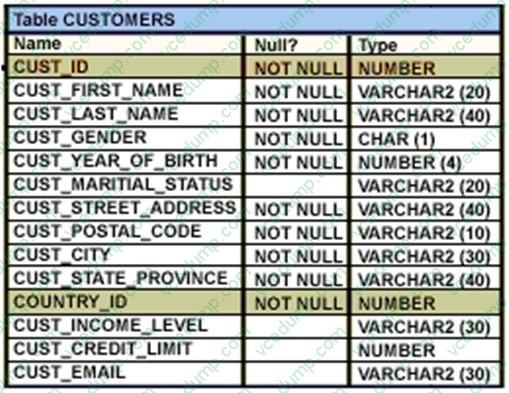
Using the customers table, you need to generate a report that shows the average credit limit for customers in Washington and NEW YORK. Which SQL statement would produce the required result?
A. Option A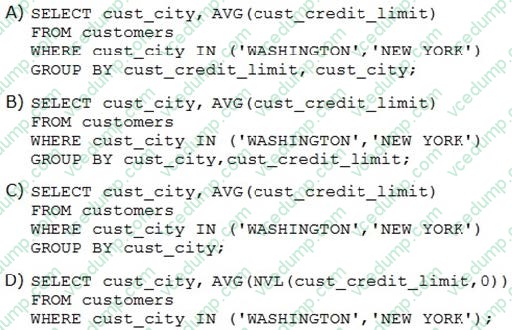
B. Option B
C. Option C
D. Option D -
Question 109:
Examine the data in the CUST_NAME column of the CUSTOMERS table. CUST_NAME
Lex De Haan Renske Ladwig Jose Manuel Urman Jason Mallin You want to extract only those customer names that have three names and display the * symbol in place of the first name as follows: CUST NAME
*** De Haan **** Manuel Urman Which two queries give the required output? (Choose two.)
A. SELECT LPAD(SUBSTR(cust_name, INSTR(cust_name, ' ')), LENGTH(cust_name), '*') "CUST NAME" FROM customersWHERE INSTR(cust_name, ' ', 1, 2)0;
B. SELECT LPAD(SUBSTR(cust_name, INSTR(cust_name, ' ')), LENGTH(cust_name), '*') "CUST NAME" FROM customersWHERE INSTR(cust_name, ' ', -1, 2)0;
C. SELECT LPAD(SUBSTR(cust_name, INSTR(cust_name, ' ')), LENGTH(cust_name)- INSTR(cust_name, ''), '*') "CUST NAME"FROM customersWHERE INSTR(cust_name, ' ', - 1, -2)0;
D. SELECT LPAD(SUBSTR(cust_name, INSTR(cust_name, ' ')), LENGTH(cust_name)- INSTR(cust_name, ' '), '*') "CUST NAME"FROM customersWHERE INSTR(cust_name, ' ', 1, 2)0 ; -
Question 110:
View the Exhibit and examine the structure of CUSTOMERS and SALES tables.
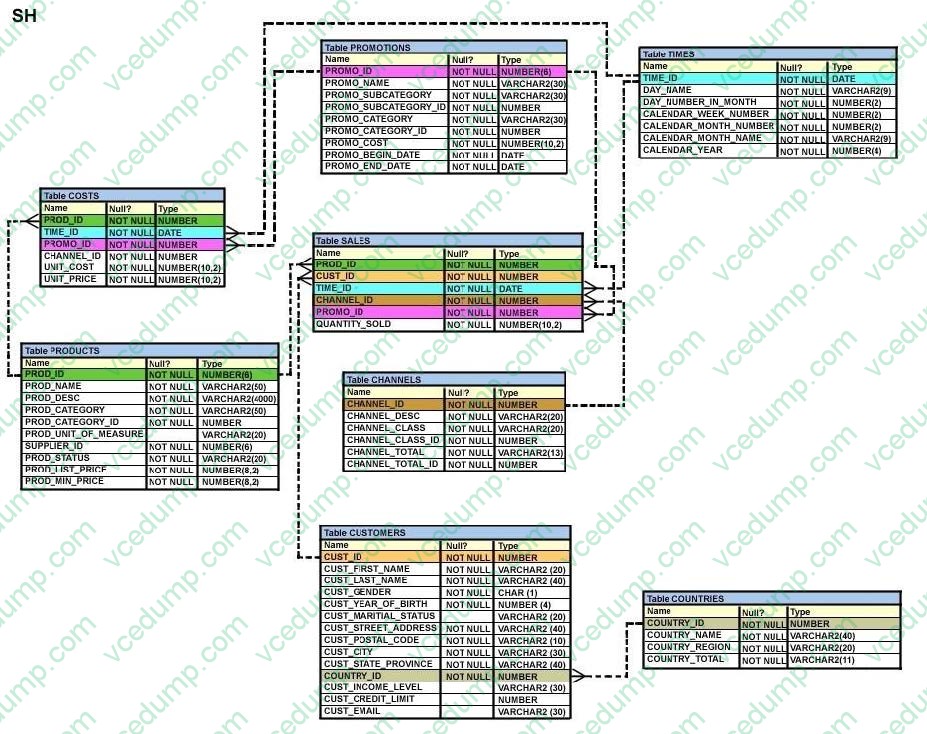
Evaluate the following SQL statement:
UPDATE (SELECT prod_id, cust_id, quantity_sold, time_id
FROM sales)
SET time_id = '22-MAR-2007'
WHERE cust_id = (SELECT cust_id
FROM customers
WHERE cust_last_name = 'Roberts' AND
credit_limit = 600);
Which statement is true regarding the execution of the above UPDATE statement?
A. It would not execute because two tables cannot be used in a single UPDATE statement.
B. It would not execute because the SELECT statement cannot be used in place of the table name.
C. It would execute and restrict modifications to only the columns specified in the SELECT statement.
D. It would not execute because a subquery cannot be used in the WHERE clause of an UPDATE statement.
Related Exams:
-
1Z0-020
Oracle8i: New Features for Administrators -
1Z0-023
Architecture and Administration -
1Z0-024
Performance Tuning -
1Z0-025
Backup and Recovery -
1Z0-026
Network Administration -
1Z0-034
Upgrade Oracle9i/10g OCA to Oracle Database OCP -
1Z0-036
Managing Oracle9i on Linux -
1Z0-041
Oracle Database 10g: DBA Assessment -
1Z0-052
Oracle Database 11g: Administration Workshop I -
1Z0-053
Oracle Database 11g: Administration II
Tips on How to Prepare for the Exams
Nowadays, the certification exams become more and more important and required by more and more enterprises when applying for a job. But how to prepare for the exam effectively? How to prepare for the exam in a short time with less efforts? How to get a ideal result and how to find the most reliable resources? Here on Vcedump.com, you will find all the answers. Vcedump.com provide not only Oracle exam questions, answers and explanations but also complete assistance on your exam preparation and certification application. If you are confused on your 1Z0-061 exam preparations and Oracle certification application, do not hesitate to visit our Vcedump.com to find your solutions here.