1Z0-053 Exam Details
-
Exam Code
:1Z0-053 -
Exam Name
:Oracle Database 11g: Administration II -
Certification
:Oracle Certifications -
Vendor
:Oracle -
Total Questions
:698 Q&As -
Last Updated
:Jul 11, 2026
Oracle 1Z0-053 Online Questions & Answers
-
Question 331:
Examine the following PL/SQL block:
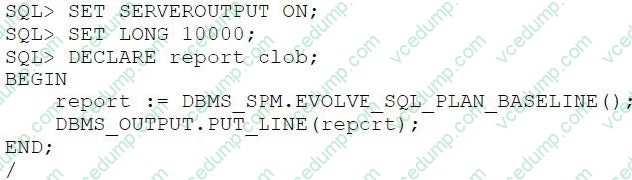
Which statement describes the effect of the execution of the above PL/SQL block?
A. The plan baselines are verified with the SQL profiles.
B. All fixed plan baselines are converted into nonfixed plan baselines.
C. All the nonaccepted SQL profiles are accepted into the plan baseline.
D. The nonaccepted plans in the SQL Management Base are verified with the existing plan baselines. -
Question 332:
View the Exhibit and examine the resource consumption details for the current plan in use by the database instance. Which two statements are true based on the output? (Choose two.) Exhibit:
A. An attempt to start a new session by the user belonging to DSS_QUERIES fails with an error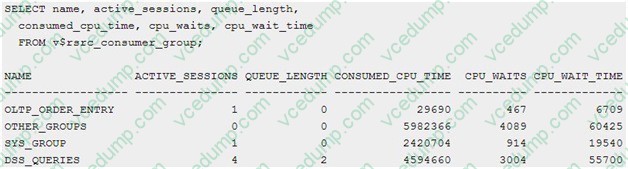
B. A user belonging to DSS_QUERIES can log in to a new session but the session will be queued
C. The CPU_WAIT_TIME column indicates the total time that sessions in the consumer group waited for the CPU due to resource management
D. The CPU_WAIT_TIME column indicates the total time that sessions in the consumer group waited for the CPU due to resource management, I/O waits, and latch or enqueue contention -
Question 333:
For which two situations would you use functionality provided by the Resource Manager? (Choose two.)
A. setting idle timeout limits on resource plans
B. saving storage space by using compressed backup sets
C. creating jobs that will run automatically at a scheduled time
D. assigning priorities to jobs to manage access to system resources
E. creating alerts to perform notification when tablespaces are low on available space resources -
Question 334:
In your database, the LDAP_DIRECTORY_SYSAUTH initialization parameter has been set to YES and the users who need to access the database as DBAs have been granted SYSDBA enterprise role in Oracle Internet Directory (OID). SSL and the password file have been configured. A user SCOTT with the SYSDBA privilege tries to connect to the database instance from a remote machine using the command:
$ SQLPLUS scott/tiger@DB01 AS SYSDBA Which DB01 is the net service name.
Which authentication method would be used first?
A. authentication by password file
B. authentication by using certificates over SSL
C. authentication by using the Oracle Internet Directory
D. authentication by using the local OS of the database server -
Question 335:
Examine the following commands and their output:
SQL> SELECT ename, sal FROM emp WHERE ename='JAMES';
ENAME SAL
JAMES 1050
SQL> UPDATE emp SET sal=sal+sal*1.2 WHERE ename='JAMES'; 1 row updated.
SQL> SELECT ename, sal FROM emp WHERE ename='JAMES';
ENAME SAL
JAMES 2310
View the exhibit and examine the Flashback Version Query that was executed after the preceding commands.
What could be the possible cause for the query not displaying any row?
Exhibit:
A. Flashback logging is not enabled for the database.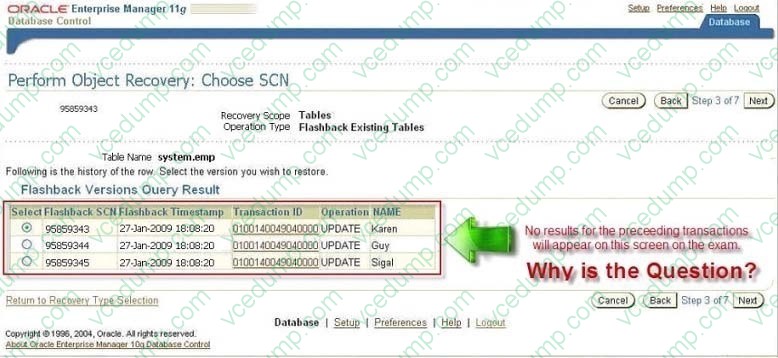
B. The changes made to the table are not committed.
C. Supplemental logging is not enabled for the database.
D. The database is not configured in ARCHIVELOG mode. -
Question 336:
A database instance is using an Automatic Storage Management (ASM) instance, which has a disk group, DGROUP1, created as follows:
SQL> CREATE DISKGROUP dgroup1 NORMAL REDUNDANCY
FAILGROUP controller1 DISK '/devices/diska1', '/devices/diska2' FAILGROUP controller2 DISK '/devices/diskb1', '/devices/diskb2';
What happens when the whole CONTROLLER1 Failure group is damaged?
A. The transactions that use the disk group will halt.
B. The mirroring of allocation units occurs within the CONTROLLER2 failure group.
C. The data in the CONTROLLER1 failure group is shifted to the CONTROLLER2 failure group and implicit rebalancing is triggered.
D. The ASM does not mirror any data and newly allocated primary allocation units (AU) are stored in the CONTROLLER2 failure group. -
Question 337:
What is the correct order of the following commands if you wanted to restore datafile 4, which was accidentally removed from the file system?
a: sql 'alter database datafile 4 online';
b: restore datafile 4;
c: recover datafile 4;
d: sql 'alter database datafile 4 offline';
e: startup
f:
shutdown
A. a, c, b, d
B. d, b, c, a
C. f, d, b, c, a, e
D. c, a, b, d, f
E. a, b, d, e -
Question 338:
In which two aspects does hot patching differ from conventional patching? (Choose two.)
A. It consumes more memory compared with conventional patching.
B. It can be installed and uninstalled via OPatch unlike conventional patching.
C. It takes more time to install or uninstall compared with conventional patching.
D. It does not require down time to apply or remove unlike conventional patching.
E. It is not persistent across instance startup and shutdown unlike conventional patching. -
Question 339:
View the Exhibit for the object interdependency diagram.
The PRODUCTS table is used to create the PRODCAT_VW view.
PRODCAT_VW is used in the GET_DATA procedure.
GET_DATA is called in the CHECK_DATA function.
A new column PROD_QTY is added to the PRODUCTS table.
How does this impact the status of the dependent objects? Exhibit:
A. All dependent objects remain valid.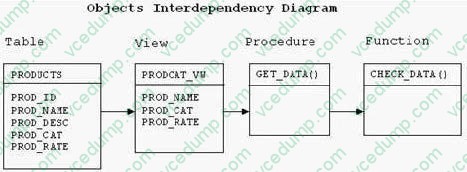
B. Only the procedure and function become invalid and must be recompiled.
C. Only the view becomes invalid and gets automatically revalidated the next time it is used.
D. Only the procedure and function become invalid and get automatically revalidated the next time they are called. -
Question 340:
Examine the following RMAN script:
RMAN> run {
debug on;
allocate channel c1 type disk;
backup datafile 5;
}
Which statement describes the purpose of the script?
A. The data file is checked for physical corruption and backed up if found clean.
B. The backup of data file 5 is performed and the interactive messages during the backup are suppressed.
C. The existing backup for the data file is checked and the backup is performed if there are changes in the data file after the last backup.
D. The backup of data file 5 is performed and all SQL statements that are executed during RMAN compilation and their results are displayed
Related Exams:
-
1Z0-020
Oracle8i: New Features for Administrators -
1Z0-023
Architecture and Administration -
1Z0-024
Performance Tuning -
1Z0-025
Backup and Recovery -
1Z0-026
Network Administration -
1Z0-034
Upgrade Oracle9i/10g OCA to Oracle Database OCP -
1Z0-036
Managing Oracle9i on Linux -
1Z0-041
Oracle Database 10g: DBA Assessment -
1Z0-052
Oracle Database 11g: Administration Workshop I -
1Z0-053
Oracle Database 11g: Administration II
Tips on How to Prepare for the Exams
Nowadays, the certification exams become more and more important and required by more and more enterprises when applying for a job. But how to prepare for the exam effectively? How to prepare for the exam in a short time with less efforts? How to get a ideal result and how to find the most reliable resources? Here on Vcedump.com, you will find all the answers. Vcedump.com provide not only Oracle exam questions, answers and explanations but also complete assistance on your exam preparation and certification application. If you are confused on your 1Z0-053 exam preparations and Oracle certification application, do not hesitate to visit our Vcedump.com to find your solutions here.