1Z0-053 Exam Details
-
Exam Code
:1Z0-053 -
Exam Name
:Oracle Database 11g: Administration II -
Certification
:Oracle Certifications -
Vendor
:Oracle -
Total Questions
:698 Q&As -
Last Updated
:Jul 11, 2026
Oracle 1Z0-053 Online Questions & Answers
-
Question 11:
You are managing the APPPROD database as a DBA which is not using the Oracle-managed files. You plan to duplicate this database in the same system with the name DUPDB.You want to create the same directory structure for duplicate database files as of the target database.
You executed the following RMAN commands:
RMAN> CONNECT TARGET sys/sys@APPPROD RMAN> CONNECT AUXILIARY sys/sys@DUPDB RMAN> DUPLICATE TARGET DATABASE TO dupdb FROM ACTIVE DATABASE PASSWORD FILE SPILE NOFILENAMECHECK;
What are the implications of this command?
A. It creates database files for the duplicate database under the Oracle base with a different directory for the duplicate database.
B. It overwrites data files of the target database because a different location for data files is not mentioned for the duplicate database.
C. It creates database files for the duplicate database under the same Oracle home as that of the target database with the same directory structure.
D. It creates database files for the duplicate database under the same Oracle home as that of the target but with a different directory for the duplicate database. -
Question 12:
View the Exhibit to examine the parameters set for your database instance. You execute the following command to perform I/O calibration after the declaration of bind variables in the session that are used in the command:
SQL> EXECUTE dbms_resource_manager.calibrate_io(
num_physical_disks=>1,
max_latency=>50,
max_iops=>:max_iops,
max_mbps=>:max_mbps,
actual_latency=>:actual_latency);
Which statement describes the consequence?
Exhibit:
A. The command produces an error.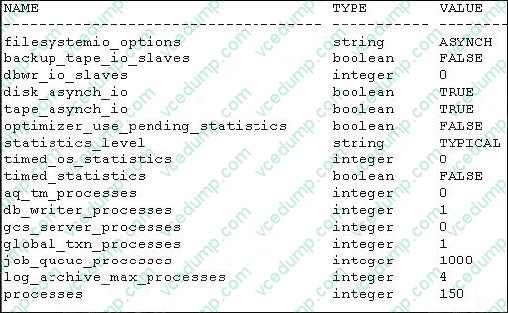
B. The calibration process runs successfully and populates all the bind variables.
C. The calibration process runs successfully but the latency time is not computed.
D. The calibration process runs successfully but only the latency time is computed. -
Question 13:
View the Exhibit and examine the output. You execute the following RMAN command to perform the backup operation:
RMAN> RUN { ALLOCATE CHANNEL c1 DEVICE TYPE disk MAXOPENFILES 8; BACKUP DATABASE FILESPERSET 4; }
What is the multiplexing level in the preceding backup process?
A. 4
B. 8
C. 7 -
Question 14:
You have discovered that one of three control files has been lost. What steps would you follow to recover that control file?
a.
Shut down the database.
b.
Restore a control-file copy from backup media.
c.
Use the create control file command to create a new control file.
d.
Copy the backup control file into place.
e.
Create a new copy of the control file from one of the surviving control files.
f.
Recover the database using the recover database using BACKUP CONTROLFILE command.
g.
Start up the database.
A. a, b, f, g
B. c, f, g
C. a, d, f, g
D. a, f, g
E. a, e, g -
Question 15:
Examine the following scenario:
Database is running in ARCHIVELOG mode.
Complete consistent backup is taken every Sunday.
On Tuesday the instance terminates abnormally because the disk on which control files are located gets corrupted
The disk having active online redo log files is also corrupted. The hardware is repaired and the paths for online redo log files and control files are still valid.
Which option would you use to perform the recovery of database till the point of failure?
A. Restore the latest whole backup, perform complete recovery, and open the database normally
B. Restore the latest whole backup, perform incomplete recovery, and open the database with the RESETLOGS option.
C. Restore the latest backups control file, perform complete recovery, and open the database with the RESETLOGS option.
D. Restore the latest backup control file, perform incomplete recovery using backup control file, and open the database with the RESETLOG option. -
Question 16:
View the exhibit and examine the output. Which statement can be an inference from the output? Exhibit:
A. The FRA disk group has an asynchronous I/O bottleneck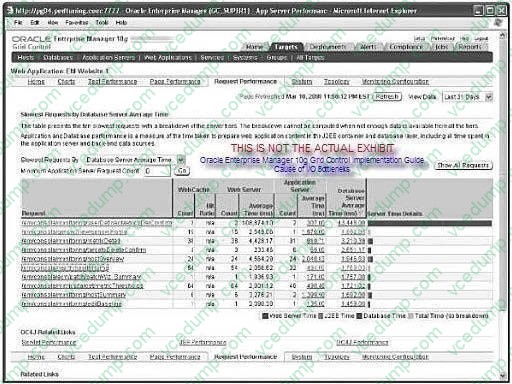
B. The least number of I/Os are performed on the last data file in the list
C. The number of times that the backup or restore process directed the OS to wait until an I/O was complete is the highest for the last data file in the list
D. The number of times that the backup or restore process made an OS call to poll for I/O completion in Nonblocking mode is the least for the FRA disk group -
Question 17:
Your archive-log destination directory runs out of space. What is the impact of this on the database?
A. None. The database will switch over to the stand-by archive-log destination directory.
B. A warning message will be written to the alert log of the database, but no adverse impacts to the database will be experienced.
C. The database will shut down, and will not restart until you correct the out-of-space situation.
D. The database will continue to try to write to the archive-log destination directory for one hour. After one hour, the database will shut down normally.
E. Once Oracle has cycled through all online redo logs, it will stop processing any DML or DDL until the out-ofspace condition is corrected. -
Question 18:
If you back up a database without connecting to the recovery catalog, which operations will cause the recovery catalog to be updated? (Choose all that apply.)
A. The next time you back up the database when you are also connected to the recovery catalog and the target database
B. The next time you are connected to the target database and the recovery catalog database and issue the resync command
C. The next time you connect RMAN to just the recovery catalog
D. The next time you connect to the recovery catalog and the target database with RMAN
E. Connecting to the recovery catalog and issuing the resync all databases command -
Question 19:
What is the purpose of the catalog command?
A. To review RMAN control file and recovery catalog metadata and ensure that its correct
B. To delete RMAN backup-related metadata from the recovery catalog
C. To create metadata in the control file and the recovery catalog related to backup set pieces
D. To create a report that lists database backups
E. To rebuild the recovery catalog -
Question 20:
View the Exhibit to examine the output produced by the following query at three different times since the database instance started and has undergone workloads of different capacities:
SQL> SELECT substr(component, 0, 10) COMP, current_size CS, user_specified_size US FROM v$memory_dynamic_components WHERE current_size!=0;
What do you infer from this?
Exhibit:
A. All sessions are connected to the database instance in dedicated mode, and no RMAN or parallel query operations have been performed.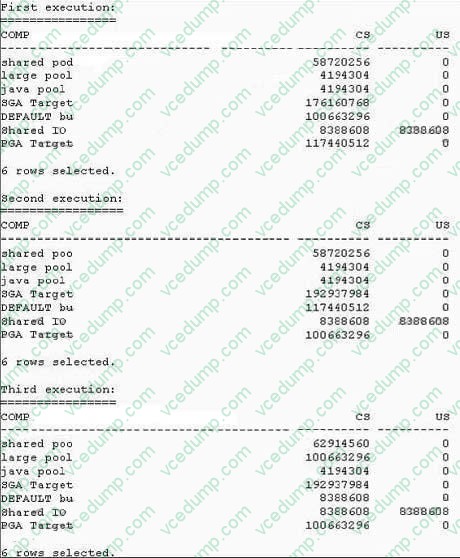
B. The database instance is running with manual shared memory management.
C. The database instance is running with manual PGA management.
D. The database instance has the MEMORY_TARGET value set to a nonzero value.
Related Exams:
-
1Z0-020
Oracle8i: New Features for Administrators -
1Z0-023
Architecture and Administration -
1Z0-024
Performance Tuning -
1Z0-025
Backup and Recovery -
1Z0-026
Network Administration -
1Z0-034
Upgrade Oracle9i/10g OCA to Oracle Database OCP -
1Z0-036
Managing Oracle9i on Linux -
1Z0-041
Oracle Database 10g: DBA Assessment -
1Z0-052
Oracle Database 11g: Administration Workshop I -
1Z0-053
Oracle Database 11g: Administration II
Tips on How to Prepare for the Exams
Nowadays, the certification exams become more and more important and required by more and more enterprises when applying for a job. But how to prepare for the exam effectively? How to prepare for the exam in a short time with less efforts? How to get a ideal result and how to find the most reliable resources? Here on Vcedump.com, you will find all the answers. Vcedump.com provide not only Oracle exam questions, answers and explanations but also complete assistance on your exam preparation and certification application. If you are confused on your 1Z0-053 exam preparations and Oracle certification application, do not hesitate to visit our Vcedump.com to find your solutions here.