1Y0-402 Exam Details
-
Exam Code
:1Y0-402 -
Exam Name
:Citrix XenApp and XenDesktop 7.15 Assessment, Design and Advanced Configurations -
Certification
:Citrix Certifications -
Vendor
:Citrix -
Total Questions
:140 Q&As -
Last Updated
:May 25, 2026
Citrix 1Y0-402 Online Questions & Answers
-
Question 81:
Scenario: A Citrix Architect needs to design a new XenApp and XenDesktop environment.
Click the Exhibit button to view information collected by the architect during the Resource Layer discussions.
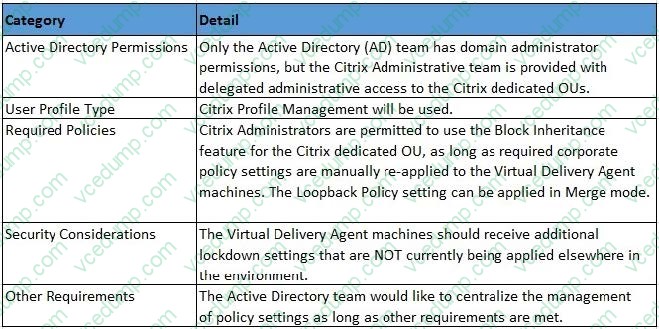
Based on the requirements, the Citrix Administrative team should use _______to manage Citrix policies and __________ to manage Microsoft settings. (Choose the correct option to complete the sentence.)
A. Citrix Studio; Workspace Environment Manager
B. Active Directory Group Policy Objects; Active Directory Group Policy Objects
C. Citrix Studio; Local Policies
D. Active Directory Group Policy Objects; Workspace Environment Manager
E. Citrix Studio; Active Directory Group Policy Objects -
Question 82:
Scenario: IT management has decided which server hardware model to use for new XenApp and XenDesktop Sites and needs guidance on sizing the Hardware Layer.
Click the Exhibit button to view the host details.
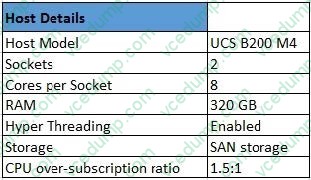
A Citrix Architect is planning to install XenServer 7.x on this host which will be used to host only XenApp servers.
How many vCPUs should be consumed to deploy XenApp servers with high performance, considering the over-subscription ratio?
A. 32
B. 24
C. 16
D. 48 -
Question 83:
Scenario: A Citrix Architect is assessing a Provisioning Services farm. The farm has access to one Store; the vDisks in the Store are shown in the Exhibit. Click the Exhibit button to view the vDisks.
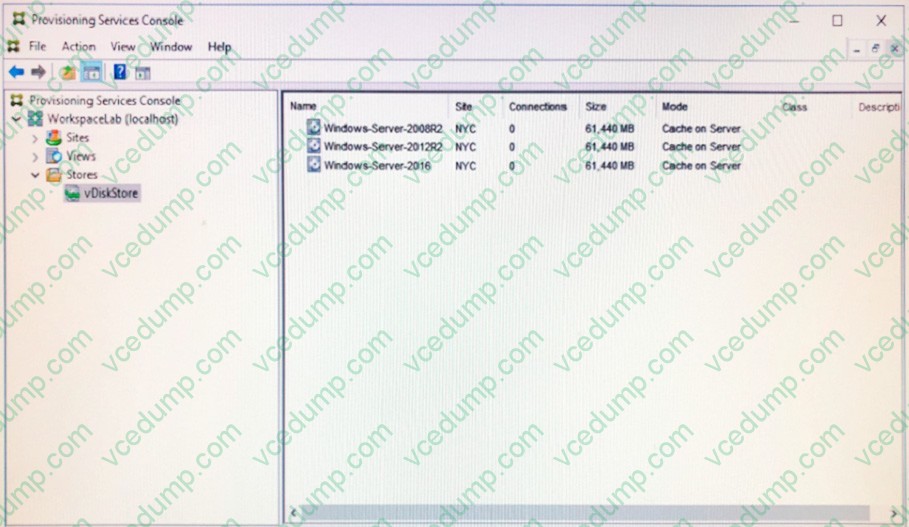
How much RAM should the architect allocate to each of the Provisioning Services servers to optimally cache existing vDisk data while NOT over-provisioning resources?
A. 14 GB
B. 17 GB
C. 12 GB
D. 9 GB -
Question 84:
Scenario: A Citrix Architect needs to design a new XenApp and XenDesktop environment. The customer previously installed all applications locally on managed laptops and desktops but is willing to evaluate other application delivery methods
as part of the new deployment. The environment will be standardized on Windows 10 and Windows Server 2016 for the Virtual Delivery Agent (VDA) machines.
As part of an application analysis performed earlier in the project, the information in the Exhibit was collected regarding one of the required applications.
Click the Exhibit button to view the information.
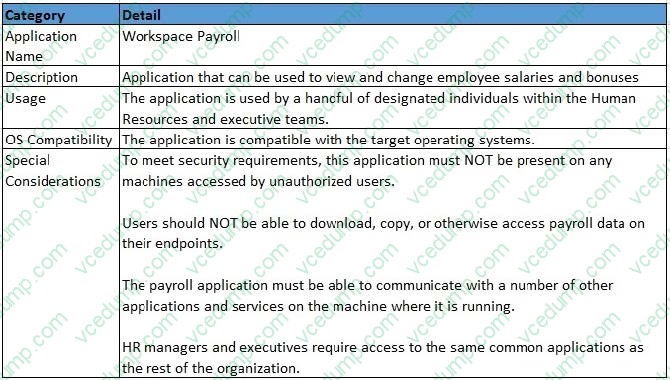
The customer has an additional objective to minimize the number of images that must be managed. How should the architect install the application?
A. Directly on endpoint devices and included in a virtual desktop session using the Local App Access feature
B. On an Application Layer using Citrix App Layering, be included in a layered image, and accessed through a virtual desktop session
C. Directly on a Server OS VDA machine and accessed from the endpoint as a published application
D. Stream it to a VDA machine using Microsoft App-V and accessed through a virtual desktop session
E. On an Application Layer using Citrix App Layering then be presented to assigned users as an Elastic Layer during a virtual desktop session -
Question 85:
Scenario: A Citrix Architect needs to design a new XenApp and XenDesktop environment The architect has identified the requirements, based on the assessment and early stages of the design Click the Exhibit button to view the requirements.
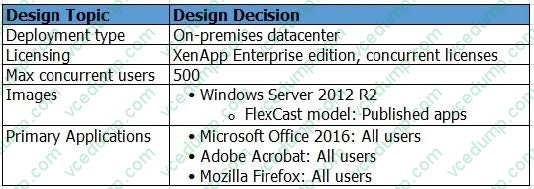
Additionally, the IT team has identified the following general requirements:
The provisioning strategy should be compatible with the planned design decisions.
The provisioning strategy should minimize the steps required to perform image and application updates.
Which three follow-up questions should the architect ask about this environment, based on the planned design decisions? (Choose three.)
A. How much storage is available for the Virtual Delivery Agent (VDA) machines?
B. What is the VM uplink speed in the current deployment?
C. Is PXE currently being used in the subnets where the Virtual Delivery Agent (VDA) machines will be placed?
D. Will the machines using the images be physical or virtual?
E. Are there any applications which must only be accessed by a subset of users? -
Question 86:
Scenario: A Citrix Architect needs to design a multi-datacenter XenApp and XenDesktop environment that will use Provisioning Services (PVS) to manage Virtual Delivery Agent (VDA) machine images. Each datacenter will have a separate Provisioning Services farm. During the design discussions, the architect creates a diagram to depict the way vDisk files will be replicated between PVS farms, based on the available storage for the vDisk Stores.
Click the Exhibit button to view the diagram.
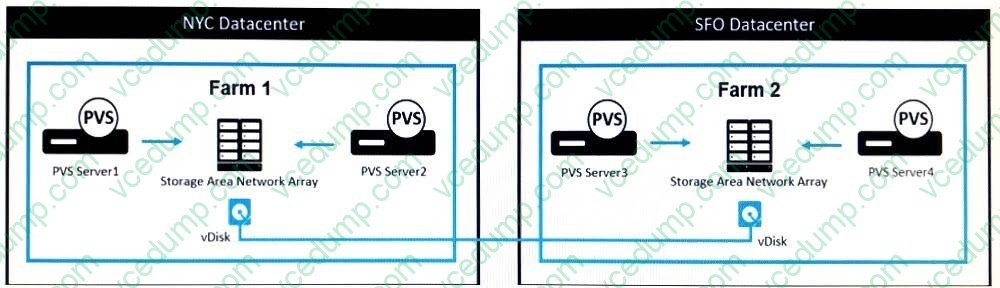
Overall, the customer has identified the following objectives for the image replication process:
Minimize the administrative time required to replicate images between farms Must be usable by storage administrators without PVS farm administrative permissions Utilize pre-existing infrastructure and processes where possible
Which method should the architect use to replicate the vDisk files between datacenters?
A. Scheduled robocopy commands
B. vDisk Replicator Tool
C. Microsoft DFS-R
D. Manual copy
E. SAN replication -
Question 87:
Scenario: While assessing User Layer, a Citrix Architect finds that most of the internal users connect using corporate-owned laptops, desktop devices, and thin clients. Many of these laptops and desktop devices are running Windows 10,
while the remainder of the machines are running Windows 7 and are in the process of being migrated to Windows 10. Some users also connect using personal devices.
Currently, Citrix Receiver is manually installed on any endpoint device added to the company. All these devices use Citrix Receiver version 4.8 and above. The IT team is planning to automate a process to update all the devices with the latest
version of Citrix Receiver and to automate another process for automatic installation of Citrix Receiver without incurring extra costs and maintenance.
The architect needs to identify which type of Citrix Receiver to recommend for 25 task workers in a remote location where installation of Citrix Receiver is NOT possible. The workers do NOT require any device mappings. Which type of Citrix Receiver should the architect recommend?
A. Native receiver
B. Receiver for Web
C. Receiver for Chrome
D. HTML 5 -
Question 88:
Scenario: A Citrix Architect needs to design a new XenApp and XenDesktop environment. The customer previously installed all applications locally on managed laptops and desktops but is willing to evaluate other application delivery methods
as part of the new deployment. The environment will be standardized on Windows 10 and Windows Server 2016 for the Virtual Delivery Agent (VDA) machines.
As part of an application analysis performed earlier in the project, the information shown in the Exhibit was collected regarding one of the required applications.
Click the Exhibit button to view the information.
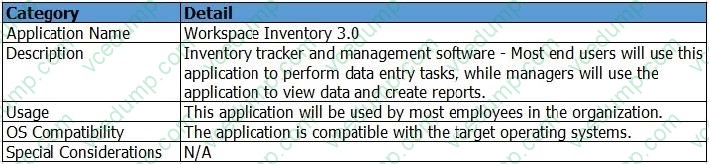
Additionally, the customer has the following objectives:
Minimize the amount of additional infrastructure components.
Utilize thin clients as endpoints in order to reduce costs.
Users should NOT have direct access to the thin client operating system.
How should the architect install the application?
A. Directly on a VDA machine image and accessed through a virtual desktop session
B. On an Application Layer using Citrix App Layering and included in a layered image and accessed through a virtual desktop session
C. Directly on endpoint devices and included in a virtual desktop session using the Local App Access feature
D. Stream it to a VDA machine using Microsoft App-V and accessed through a virtual desktop session
E. On an Application Layer using Citrix App Layering then presented to assigned users as an Elastic Layer during a virtual desktop session -
Question 89:
Scenario: A Citrix Architect has designed an active/passive XenApp and XenDesktop environment for a customer, where the passive datacenter serves as the disaster recovery (DR) datacenter for all users.
The following has been configured:
NetScaler Gateways in both datacenters, each with a unique URL
NetScaler load balancing of StoreFront and Delivery Controller XML services
A separate XenApp and XenDesktop Site at each datacenter
Two StoreFront servers deployed in each datacenter aggregating resources from the Delivery Controllers in the respective datacenter
During a disaster recovery strategy review, the IT infrastructure director recommends exploring cloud-based disaster recovery options for the XenApp and XenDesktop environment. The director reminds the team that the new solution would
also have to support the following objectives:
The DR environment needs to be fully functional in the event that the primary datacenter goes completely offline.
The DR environment should require minimal operating costs until it is needed to host active user sessions.
In a DR event, active user sessions should connect directly to the resource location without going through additional hops.
The architect develops four different conceptual diagrams to display the current architecture as well as the potential cloud-based DR locations.
Click the Exhibit button to view the conceptual diagrams.
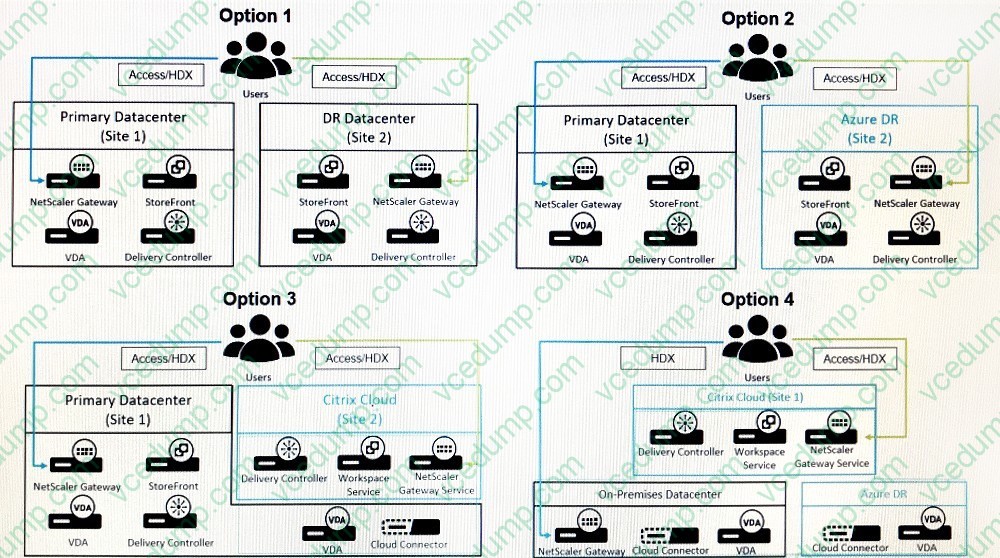
Based on the diagrams and above requirements, which Site architecture should the architect use?
A. Option 4
B. Option 2
C. Option 3
D. Option 1 -
Question 90:
Scenario: A Citrix Architect needs to implement XenDesktop in an environment. The Customer Service team processes credit card information in Web applications. A Payment Card Industry (PCI) audit determines that processes that can run on a Virtual Delivery Agent (VDA) machine are controlled through the use of whitelisting.
Which method would be an appropriate fit for the environment, based on the requirements?
A. Citrix Secure Browser
B. NTFS Permissions
C. Microsoft App-V
D. Citrix Workspace Environment Management
Related Exams:
-
1Y0-118
Citrix WinFrame 1.8 Administration -
1Y0-201
Managing Citrix XenDesktop 7.6 Solutions -
1Y0-202
Citrix XenApp and XenDesktop Administration 7.6 LTSR -
1Y0-203
Citrix XenApp and XenDesktop 7.15 Administration -
1Y0-204
Citrix Virtual Apps and Desktops 7 Administration -
1Y0-220
Citrix Metaframe XP 1.0 for Windows -
1Y0-222
CCIA MetaFrame Presentation Server with Feature Release 3 -
1Y0-223
MetaFrame Presentation Server 3.0: Enterprise Edition Administration -
1Y0-230
Citrix NetScaler 12 Essentials and Unified Gateway -
1Y0-231
Deploy and Manage Citrix ADC 13 with Citrix Gateway
Tips on How to Prepare for the Exams
Nowadays, the certification exams become more and more important and required by more and more enterprises when applying for a job. But how to prepare for the exam effectively? How to prepare for the exam in a short time with less efforts? How to get a ideal result and how to find the most reliable resources? Here on Vcedump.com, you will find all the answers. Vcedump.com provide not only Citrix exam questions, answers and explanations but also complete assistance on your exam preparation and certification application. If you are confused on your 1Y0-402 exam preparations and Citrix certification application, do not hesitate to visit our Vcedump.com to find your solutions here.