1D0-541 Real Exam Questions

CIW v5 Database Design Specialist

128 questions available · Page 1 of 13

Updated Exam DumpsVerified AnswersPass Guarantee

Get Complete Exam Dumps
Question 1 Single choice

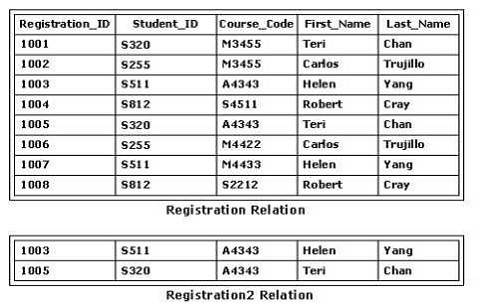
Consider the Registration relation shown in the exhibit.

Which of the following SQL statements would return the Registration2 relation from the Registration relation?
  1. A

    SELECT Course_Code
    FROM Registration;

  2. B

    SELECT *
    FROM Registration
    WHERE Registration_ID = 1003
    AND Registration_ID = 1005;

  3. C

    SELECT *
    FROM Registration
    WHERE Course_Code = 'A4343';

  4. D

    SELECT Registration_ID, Student_ID, First_Name, Last_Name
    FROM Registration
    WHERE Course_Code = 'A4343';

Show answer and explanation

Correct answer: C

Question 2 Single choice

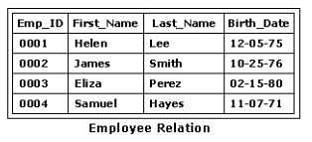
For the Employee relation shown in the exhibit, which set of column values holds the complete tuple for the employee named James Smith?
  1. A

    0002, James, Smith

  2. B

    0002, James, Smith, 10-25-76

  3. C

    First_Name, James, Last_Name, Smith

  4. D

    Emp_ID, 0002, First_Name, James, Last_Name, Smith

Show answer and explanation

Correct answer: B

Question 3 Single choice

Which term describes the rejoining of relations that have been decomposed?

  1. A

    Normalization

  2. B

    Denormalization

  3. C

    Referential integrity

  4. D

    Domain constraints

Show answer and explanation

Correct answer: B

Question 4 Single choice

Which subset of Structured Query Language (SQL) is used to create and name database entities?

  1. A

    Data Control Language

  2. B

    Database Entity Language

  3. C

    Data Definition Language

  4. D

    Data Manipulation Language

Show answer and explanation

Correct answer: C

Question 5 Single choice

Which type of relational integrity is violated if a primary key in a database has a null value?

  1. A

    Entity integrity

  2. B

    Domain integrity

  3. C

    Domain constraints

  4. D

    Referential integrity

Show answer and explanation

Correct answer: A

Question 6 Single choice

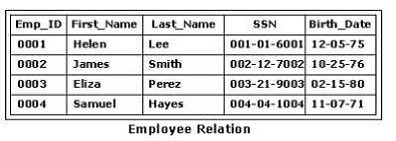
Consider the table for an employee database shown in the exhibit.

What is the cardinality of the table?
  1. A

    5

  2. B

    20

  3. C

    4

  4. D

    25

Show answer and explanation

Correct answer: C

Question 7 Single choice

Which of the following best describes a composite key?

  1. A

    A composite key is a primary key and foreign key that consists of the first two attributes of a relation.

  2. B

    A composite key is a primary or foreign key defined by its parent key attributes.

  3. C

    A composite key is a foreign key that consists of the same attributes as the primary key from a related table.

  4. D

    A composite key is a primary or foreign key that consists of two or more attributes of a relation.

Show answer and explanation

Correct answer: D

Question 8 Single choice

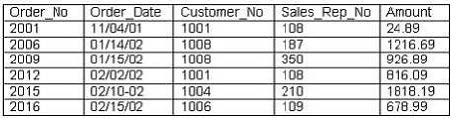
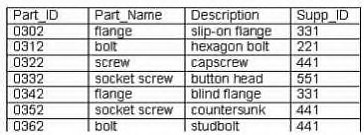
Consider the following table as well as the Dept1_Parts and Dept2_Parts relations shown in the exhibit:
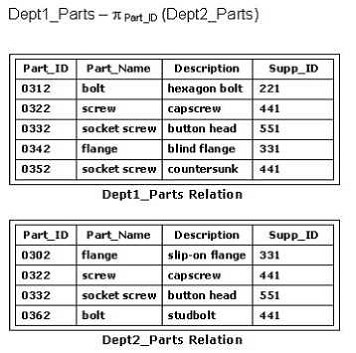
Which of the following relational algebraic expressions would result in the given table?

  1. A
  2. B
  3. C
  4. D
Show answer and explanation

Correct answer: A

Question 9 Single choice

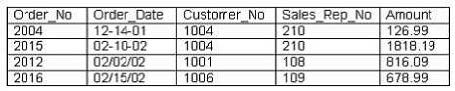
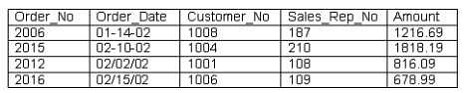
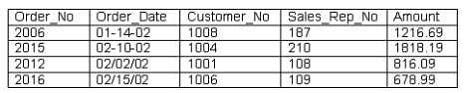
Consider the following SQL statement and the Orders relation shown in the exhibit:
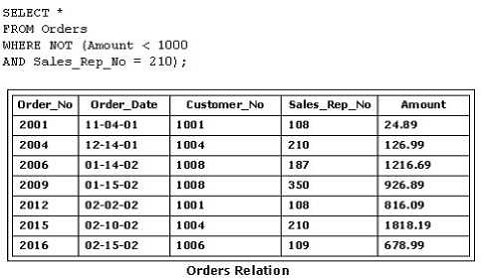
What is the output of this SQL statement?
  1. A
  2. B
  3. C
  4. D
Show answer and explanation

Correct answer: D

Question 10 Single choice

Consider the following relation definitions: STUDENT( Student_Number: integer NOT NULL Name: variable length character string length 20 )
Primary Key Student_Number
HOUSING(
Housing_ID: integer NOT NULL
Student_Number: integer NOT NULL
Building: variable length character string length 25 )
Primary Key Housing_ID
Foreign Key Student_Number References STUDENT(Student_Number)
ON DELETE NO ACTION
ON UPDATE CASCADE

What are the referential constraints for the relations defined in these relation definitions?

  1. A

    There is no relationship between changes in STUDENT(Student_Number) and HOUSING (Student_Number).

  2. B

    When STUDENT(Student_Number) is changed or deleted, this modification or deletion will automatically be reflected in HOUSING(Student_Number).

  3. C

    Modifications to HOUSING(Student_Number) are automatically reflected in changes to STUDENT (Student_Number), but deletions are not permitted.

  4. D

    Modifications to STUDENT(Student_Number) are automatically reflected in changes to HOUSING (Student_Number). For a deletion to occur from STUDENT(Student_Number), it must first occur in HOUSING(Student_Number).

Show answer and explanation

Correct answer: D