Background
Coho Vineyard & Winery is a parent company with two subsidiaries: Coho Vineyard and Coho Winery.
Coho Vineyard is based in Medford, Oregon. The vineyard grows grapes and produces and bottles wine.
Coho Winery, based in Grants Pass, Oregon, distributes packaged wine to businesses and consumers. In addition to wine, the winery sells imported cheese and olive oil.
Current Environment
1. Coho Vineyard & Winery requires financial reporting from both Coho Vineyard and Coho Winery. The parent company consolidates financials using a third-party tool.
2. Coho Winery currently manages inventory and financials using spreadsheets, separate from the parent company.
Inventory and Warehousing
1. The entire warehouse is temperature controlled. A refrigerated section of the warehouse is used for items that require colder storage.
2. Items do not have fixed locations in the warehouse.
3. Coho currently uses smart numbering for cheese items. Items start with F for France and U for the United States, such as the following:
F11234 = French cheese
U14567 = U.S. cheese
4. Wine does not currently use smart numbering.
5. Inventory is valued using First In, First Out (FIFO).
6. Olive oil has a 12-month shelf life.
7. WineA is expensive and is not regularly stocked in the warehouse.
8. WineB must be stored in the refrigerated section of the warehouse.
9. WineC is non-refrigerated wine and represents the majority of warehouse inventory.
Vendors and Procurement
1. Cheese is purchased from vendors in two countries: France and the United States.
2. Non-cheese items can be purchased from vendors in other countries or regions.
3. Olive oil is purchased and sold in full cases of six bottles.
4. When Coho Vineyard produces more wine than expected in a season, rebate programs are offered to
any company whose monthly purchases exceed $5,000.
General
The Coho Vineyard & Winery parent company, as well as Coho Vineyard, will not be included in the implementation of Dynamics 365 Finance and Dynamics 365 Supply Chain Management for Coho Winery.
They plan to implement these systems as separate legal entities within the next five years.
Inventory and Warehousing (Future Requirements)
1.
Items must be renumbered in the new system.
2. Separate item numbers must be used for each imported item to support simplified reporting by source country or region.
3. Advanced Warehouse Management capabilities must be enabled in the new system.
4. Each bottle of wine must have a single item number.
5. The vintage of each bottle changes annually and may affect the cost of the bottle. This cost must be tracked by year.
6. Some bottles of wine require refrigeration. The system must automatically determine appropriate warehouse storage locations for these items.
7. Wine must be grouped in a product hierarchy, such as the following:
Red
Cabernet
Merlot
White
Chardonnay
Pinot
8. Inventory value must be recorded at the end of each month.
9. Each month, olive oil on-hand inventory is evaluated. Any inventory with less than six months of remaining shelf life is sold to a discount retail store. If less than 90 days of shelf life remains, the olive oil is donated or destroyed.
10. A minimum of 20 cases and a maximum of 50 cases of olive oil must be on hand and not reserved for upcoming customer orders.
11. WineB must be refrigerated.
Vendors and Procurement (Future Requirements)
1. The cheese smart numbering system will not be used in the future. Instead, standard system configurations must be used to ensure the correct cheese items are ordered based on the country or region of origin.
2. Olive oil must be managed in full cases only; however, inventory cost must be calculated at the each level.
3. If any bottle of olive oil is broken within a case, the remaining eaches must be sold at a discounted price.
4. Vendor rebates must be calculated and submitted as claims.
5. Rebate programs are passed on to retailers selling Coho Winery wines. These rebates must be claimed from Coho Vineyard.
6. Purchase orders (POs) must be maintained online with tracked changes between vendors and buyers.
7. The controller has decided that WineA must not be included in financial inventory on the Coho Winery books. The winery has an agreement with the vendor that ownership of WineA remains with the vendor until a later date.
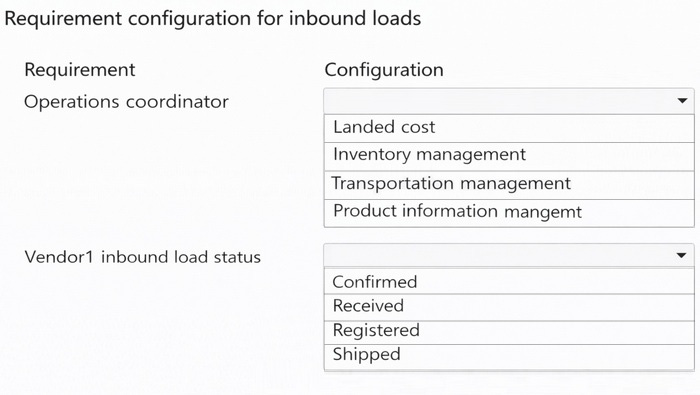
8. Vendor1 sends bulk shipments. Coho Winery does not always have sufficient warehouse staff available to receive inventory. The company requires Vendor1 to send advanced shipping notices (ASNs).
9. The operations coordinator must schedule inbound loads. The company requires automation of inbound load creation where possible.
Issues
1. The warehouse is at maximum capacity, and empty bin locations are not always available. The warehouse manager wants to establish fast-moving pick locations for WineB on the warehouse floor, with replenishment from higher rack storage.
2. Coho Winery recently conducted an internal audit risk assessment. The assessment found that inventory value reports were stored in spreadsheets, which can be easily edited and lack adequate controls.
3. After olive oil is counted, multiple cases are destroyed due to shelf life expiration. The inventory planner
must determine whether a new purchase order should be placed for olive oil.
4. Vendor rebate claims are frequently rejected because they were miscalculated by failing to include discounts.
5. The purchasing manager receives multiple complaints regarding purchase orders:
Issue 1: PO changes are not accepted and confirmed, resulting in out-of-stock situations.
Issue 2: Vendors do not have control over PO responses and instead rely on email communication.