business requirements, the existing environment, and problem statements.
If the case study includes an All Information tab, note that the information shown there is identical to the information presented on the individual tabs. When you are ready to answer a question, click the Question button to return to the question.
Background
Munson's Pickles and Preserves Farm is a distribution company that supplies pickles, preserves, pickling supplies, and accessory products to local farmers' markets and grocery stores. Munson's Pickles and Preserves Farm does not manufacture products and does not provide canning services.
Current Environment
Munson's Pickles and Preserves Farm uses an accounting system that is disconnected from its warehousing system. This separation has caused challenges in controlling and valuing inventory. Based on these issues, Munson's Pickles and Preserves Farm has decided to implement Dynamics 365 Finance and Dynamics 365 Supply Chain Management.
Warehousing
1. Munson's Pickles and Preserves Farm operates a single warehouse that serves as the distribution center for all products.
2. The warehouse contains bulk storage locations and racking; however, location names and location numbering are not currently defined.
3. Bulk locations are used to store excess inventory that does not fit in picking locations.
4. The warehouse is temperature controlled, with locations grouped into two zones: refrigerated and non-perishable.
5. Inventory adjustments are performed frequently due to insufficient inventory controls.
Inventory Data
1. Item numbers are inconsistent and currently use a smart-numbering format, such as 1-23-PKL and 44-
24-PICK.
2. Cucumbers are not grown by Munson's Pickles and Preserves Farm and are sourced from local farmers.
3. Pickles are sold in bottle sizes of 8 oz, 16 oz, and 32 oz, and bottles are packed in cases.
4. Pickles may be spears, chips, or whole within the bottles. Shape does not affect cost when the flavor is the same.
5. Pickle flavors include sweet, spicy, and dill, and each flavor has a different price.
6. Preserves are offered in multiple flavors, such as mango, strawberry, and grape, and are seasonal items. Due to fluctuating flavors and quantities, preserves remain vendor-owned until sold. Mango preserves require refrigeration, while other preserve flavors do not.
7. Many items are sold as pickling accessories or supplies.
8. Some inventory items, such as vinegar, have expiration dates.
9. Fast-moving items are identified based on inventory turns per quarter. Sweet and spicy pickles are the highest-volume items.
Purchasing and Sales
1. Munson's Pickles and Preserves Farm operates an online store at munsonspicklesandpreservesfarm.com.
2. The online store sells only a subset of products, limited to accessories such as bottles and jars.
3. A new product line of kosher pickles will be distributed by Munson's Pickles and Preserves Farm.
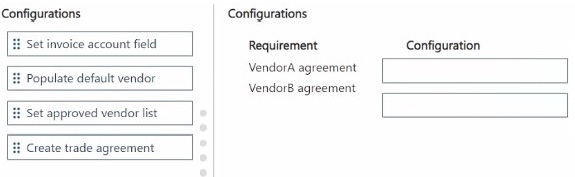
4. VendorA is the primary supplier for Munson's Pickles and Preserves Farm. VendorB is the second-largest supplier.
Requirements
Warehousing
1. The warehouse manager requires that fast-moving items be easily accessible to order pickers in AisleA, with no more than one item per bin location in AisleA. Sweet and spicy pickles exceed available capacity in AisleA and must also be stored in bulk locations.
Spicy pickles must have no less than half a pallet available in AisleA at all times.
Sweet pickles must have sufficient inventory in AisleA before warehouse work waves are created.
2. Strawberry preserves are selling slowly during the current season and are stored in higher bin locations because they are not considered fast-moving items.
Inventory and Data
1. Item numbers must be restructured to support a streamlined numbering system. The legacy item number must be stored in Dynamics 365 for cross-reference purposes. Munson's Pickles and Preserves Farm has selected 0000001 as the new item number format for pickles. The value PKL will be stored as an attribute.
2. Pickle item numbers must be consolidated into a single item number where possible, regardless of bottle size.
3. Cucumbers must be sold at actual cost because they are special-order items.
4. Kosher pickles must be created in the item master. Kosher pickles use the same jar sizes and flavors as standard pickles but include a kosher designation and have a higher cost.
5. Vinegar and other perishable items must have batch number and expiration date tracking enabled.
6. A batch of mango preserves was discarded because warehouse workers stored the product in the non-perishable zone instead of the refrigerated zone.
Purchasing and Sales
1. Cucumbers must be sourced from local vendors and purchased only for special orders.
2. Munson's Pickles and Preserves Farm has signed an exclusivity agreement with VendorA. Buyers must purchase products only from VendorA.
3. VendorA has acquired VendorB. VendorA requires that all agreements with VendorA also apply to VendorB during the transition period while the companies are being merged.
4. VendorC supplies preserves and requires the following:
Shipment requirement: VendorC retains ownership of preserves after shipment to Munson's Pickles and Preserves Farm until the items are sold.
On-hand requirement: VendorC must have visibility into on-hand preserve inventory at the Munson's
Pickles and Preserves Farm warehouse.
Issues
1. CustomerD reported receiving vinegar with only one week remaining before expiration, which did not allow sufficient time for use. CustomerD now requires that all vinegar deliveries have at least 30 days remaining before expiration.
2. A customer reported receiving regular pickles instead of kosher pickles. Inventory Control Clerk 2 confirmed that kosher and non-kosher pickles of the same variety are stored in the same warehouse location, contributing to picking errors.
3. A salesperson reported incorrect margin calculations on a special customer order because cucumber cost was calculated using the most recent receipt rather than the specific receipt associated with the customer order.
4. An internal audit revealed that large quantities of pickles were written off as damaged multiple times over the past year. No supporting documentation, disposal records, or management approvals exist, creating concerns regarding potential theft.
5. Pickles are received in cases, and the number of jars per case varies by size:
8 oz jars: 12 per case
16 oz jars: 6 per case
6. The varying quantities per case increase warehouse handling complexity.
7. The receiving clerk requires that broken bottles of vinegar be moved to a damage location named
LocationA. Expired vinegar must be moved to a return-to-vendor location named LocationB. All other vinegar should be put away and sold according to standard location directives.
8. Operator1 was moving a pallet of strawberry preserves to the shipping dock and dropped the pallet.
The operator must ensure that the damaged preserves are not available for shipment until damage assessment is completed.
9. Operator2 attempted to print wave labels for item
0000001. The labels began printing but jammed. At the same time, the printer battery required recharging, and the labels needed to be reprinted.