VCS-256 Exam Details
-
Exam Code
:VCS-256 -
Exam Name
:Administration of Veritas InfoScale Availability 7.1 for UNIX/Linux -
Certification
:Veritas Certifications -
Vendor
:Veritas -
Total Questions
:84 Q&As -
Last Updated
:Jul 09, 2026
Veritas VCS-256 Online Questions & Answers
-
Question 21:
Which action should the administrator perform to ensure the coordination point (CP) service is highly available when adding a CP server into a Veritas Cluster Server environment?
A. configure multiple CP server instances on the same node
B. configure the CP server as a resource in a Veritas cluster
C. configure the CP server over iSCSI
D. ensure the CP server is on a reliable network -
Question 22:
An installed cluster has been licensed with the keyless licensing option. The administrator has yet to configure the cluster to be managed by Veritas InfoScale Operations Manager (VIOM). What will happen when 60 days have passed since installation?
A. The cluster will shut down.
B. The cluster will log messages related to licensing.
C. The cluster will disallow administrative changes until licensed.
D. The cluster will cease to respond if a resource faults. -
Question 23:
A multi-tier application has Oracle at the first level and WebSphere at the second level, which depends on the Oracle application. The Oracle and the WebSphere service groups are configured in two separate clusters. The administrator
wants the following fault behavior:
when the Oracle service group faults, the WebSphere service group should stay online.
when the Oracle service group comes back online, the WebSphere service group should be taken offline and brought back online
Which type of dependency must the administrator configure to acquire the desired behavior?
A. virtual business services with retry type of fault dependency
B. virtual business services with an online global firm dependency
C. virtual business services with firm type of fault dependency
D. virtual business services with restart type of fault dependency -
Question 24:
Which two requirements must be meet to allow an administrator to configure LLT heartbeats over UDP? (Select two.)
A. the LLT private links must be on the same subnet
B. each NIC must have an IP address configured before configuring LLT
C. the maximum transmission unit (MTU) must be set to the lowest value supported by the NICs
D. each link must have a unique UDP port
E. broadcast must be enabled for the heartbeat subnet -
Question 25:
As part of the consolidation efforts in a data center, the administrator decides to merge two two-node Veritas Cluster Server (VCS) clusters into a four-node VCS cluster. The source and target clusters are on the same networks for LLT communication. The administrator performs the following tasks as preparation for the merge while both clusters are still running:
modifies /etc/llttab files on the source cluster systems so the cluster ID is changed to the cluster ID of the target cluster modifies /etc/llthosts files on all systems to include the four nodes modifies /etc/gabtab files on all systems to require the four systems to seed ensures the source cluster systems can see the fencing disks used by the target cluster copies the fencing configuration files from the target cluster systems to the source cluster systems adds the source cluster systems to the target cluster configuration using the hasys –add command
After the preparation is complete, the administrator stops the source cluster leaving the applications running, then stops the whole communication stack and restarts it in the correct order. When the administrator attempts to start the cluster again on the source cluster systems, they fail to join the four-node cluster.
Which preparation step that the administrator failed to perform is preventing the source cluster systems from joining the four-node cluster?
A. The cluster needs to be manually seeded using gabconfig -x on the source cluster systems.
B. The target main.cf file needs to be copied to the source cluster systems.
C. The service group configuration of the source cluster needs to be applied to the target cluster.
D. The cluster UUID from the target cluster needs to be copied to the source cluster. -
Question 26:
Which utility should an administrator use to propagate changes made to the Solaris Zone configuration from one node to other cluster nodes?
A. hasync
B. hazoneconfigsync
C. haconfigdistribute
D. hamigrate -
Question 27:
An administrator needs to create a new two-node cluster.
Which configuration allows the administrator to firm a cluster using Veritas InfoScale Availability?
A. different operating system vendors for the two servers that share the same big-endian or little-endian format
B. one server running Solaris x86 and the other server running Solaris SPARC
C. one server running Linux RHEL 6 and the other server running Oracle Linux 6
D. one server configured as a virtual machine and the other server configured as a physical machine -
Question 28:
What are two effects of a failed resource in the service group configuration below? (Select two.)
A. Any resource fault leads to a faulted state for the resource.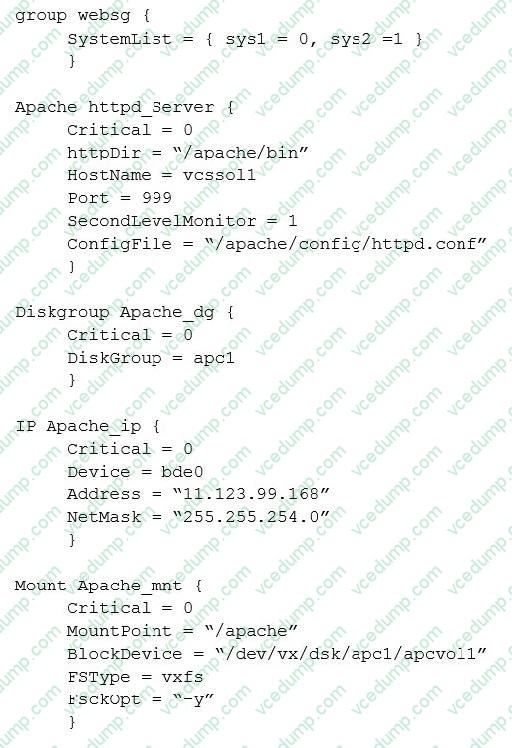
B. Any resource fault leads to the service group failing over.
C. Any resource fault leads to the service group being taken offline.
D. Any resource fault leaves the service group partially online.
E. Any resource fault leaves the service group fully online. -
Question 29:
Which log can an administrator review to determine why a resource failed to come online?
A. /etc/VRTSvcs/conf/config/main_A.log
B. /var/VRTSvcs/log/messages_A.log
C. /var/VRTSvcs/log/resources_A.log
D. /var/VRTSvcs/log/engine_A.log -
Question 30:
What is the purpose of the AutoClearLimit attribute?
A. It defines the number of attempts to clear the Faulted state of a resource on all nodes.
B. It defines the number of attempts to clear the Faulted state of a service group on all nodes.
C. It defines the number of attempts to clear the AutoDisabled state of a service group on a node.
D. It defines the number of attempts to clear Faulted state of a resource on a single node.
Related Exams:
-
VCS-256
Administration of Veritas InfoScale Availability 7.1 for UNIX/Linux -
VCS-257
Administration of Veritas InfoScale Storage 7.1 for UNIX/Linux -
VCS-260
Administration of Veritas InfoScale Availability 7.3 for UNIX/Linux -
VCS-261
Administration of Veritas InfoScale Storage 7.3 for UNIX/Linux -
VCS-275
Administration of Veritas NetBackup 7.7 and NetBackup Appliances 2.7 -
VCS-276
Administration of Veritas NetBackup 8.0 -
VCS-277
Administration of Veritas NetBackup 8.0 and NetBackup Appliances 3.0 -
VCS-278
Administration of Veritas NetBackup 8.1.2 -
VCS-279
Administration of Veritas NetBackup 8.1.2 and NetBackup Appliances 3.1.2 -
VCS-285
Veritas NetBackup 10.x and NetBackup Appliance 5.x Administrator
Tips on How to Prepare for the Exams
Nowadays, the certification exams become more and more important and required by more and more enterprises when applying for a job. But how to prepare for the exam effectively? How to prepare for the exam in a short time with less efforts? How to get a ideal result and how to find the most reliable resources? Here on Vcedump.com, you will find all the answers. Vcedump.com provide not only Veritas exam questions, answers and explanations but also complete assistance on your exam preparation and certification application. If you are confused on your VCS-256 exam preparations and Veritas certification application, do not hesitate to visit our Vcedump.com to find your solutions here.